

MHSAA Historian Picks 10 to Remember
August 9, 2016
By Rob Kaminski
MHSAA benchmarks editor
It sounded simple and fun, the theme for the MHSAA's spring issue of benchmarks: a history of MHSAA tournaments.
It certainly was the latter, but simple? Not so much.
There’s no way to do justice to nearly a century’s worth of history in some sports. Complicating matters was the abundance of information and photographs for some, and the scant amount of detailed data and images for others.
MHSAA historian Ron Pesch was given an equally challenging task: recount a “Top 10” list from his days covering various MHSAA Finals. He shares them here and, he adds, they are in no order of favorites.
The Shot: 1986 Class B Boys Basketball Final at Crisler Arena – Saginaw Buena Vista’s Chris Coles’ desperation shot, launched at the buzzer from well beyond half court, dropped through the hoop to give the Knights a 33-32 win over defending champion Flint Beecher in a rematch of the 1985 Class B title game. The shot was Coles’ first of the second half and his only points in the contest.
The Smurfs: 1986 Class A Football Final at the Pontiac Silverdome – The "Smurfs" – Muskegon Coach Dave Taylor's nickname for his small, quick swarming defensive linemen – limited heavily favored Sterling Heights Stevenson to four yards rushing and 73 yards of total offense in a 10-0 win. As a 1979 graduate of Muskegon High School, I was elated.
The Drive: 1989 Class B Football Final at the Pontiac Silverdome – I slid down from the press box into the stands at the Silverdome for the end of this one. With 2:20 remaining, the atmosphere was simply electric, as Farmington Hills Harrison’s lauded quarterback Mill Coleman took the reins with his team down 27-21 to DeWitt. The senior executed a flawless two-minute drill, guiding his team to the DeWitt 9 before scampering into the end zone for the tying points. Steve Hill added his fourth PAT for the lead, then secured the victory with an interception on the next series.
King Kool: 2005 Class B Boys Basketball Final, Breslin Center, East Lansing – David Kool was a flawless 20 for 20 from the free-throw line and scored 43 points as Grand Rapids South Christian downed Muskegon Heights 67-60.
The Parade: 2004 Individual Wrestling Finals, The Palace of Auburn Hills – In 2004, I traveled to Auburn Hills to watch the MHSAA Individual Wrestling Finals for the first time. The pageantry of the Grand March, the skills on display, the roar of the massive crowd, and the ensuing beauty and chaos of a wrestling extravaganza of this scale is truly a sight to see.
 A Marathon: 2007 Division 3 Football Final, Ford Field, Detroit – East Grand Rapids and Orchard Lake St. Mary’s ended regulation tied 14-14, and this would turn into a five overtime battle that required an extra hour of play. No previous football playoff game, from Districts up, had ever gone beyond four overtimes. After exchanging field goals, touchdowns, extra points and two-point conversions, East Grand Rapids emerged with a 46-39 victory.
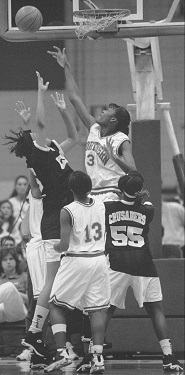
Tawana Towers: 1994 Class A Girls Basketball Final at Kellogg Arena, Battle Creek – Flint Northern, coached by Leteia Hughley and led by 6-4 freshman Tawana McDonald, defeated 1993 runner-up Detroit Martin Luther King, 46-32, for the Class A championship. McDonald batted down an MHSAA-record 10 shots, pulled down 13 rebounds and added five points and seven assists in a stellar performance.
Never Quit: 2008 Division 2 Football Semifinal, Spartan Stadium, East Lansing – Unbeaten, No. 1-ranked and heavily favored Muskegon trailed Davison by 22 late in the third quarter and 16 with less than five minutes to play. In perhaps the greatest comeback in playoff history, Muskegon recovered two onside kicks and scored 19 points in the final 4:31 to escape with a 38-35 victory and its third trip in five years to an MHSAA Final.
MHSAA Legends: 1998-2008 – For 10 years, the MHSAA showcased great teams from the past with their Legends of the Game series. From a historian’s perspective it was a chance to meet and learn more about folks I had often known only from the pages of microfilm. It was quite the treat to see years fall away as coaches, team managers and players reunited, in many cases for the first time after decades apart.
The MHSAA Record Books: Online, 1994 – One of my first efforts as state historian was to expand the record books beyond their primary focus on football, basketball, track & field and swimming & diving. With the arrival of the internet, an enhanced version of the record books was brought online. Coaches and fans were quick to respond with letters and e-mails, happily listing entries that had been “missed.” Soon, five category headings in a sport grew to 20, then to 50 and beyond.
Kids: 2004 Football Finals, Pontiac Silverdome – (OK, this is No. 11 ... consider it an extra point). For the first time, my sons joined me for my annual excursion to Metro Detroit for a Thanksgiving Day football weekend. They got to see the Silverdome before the move of the MHSAA Football Finals to beautiful Ford Field. Future Big Reds, they also got to see their future alma mater win another title.
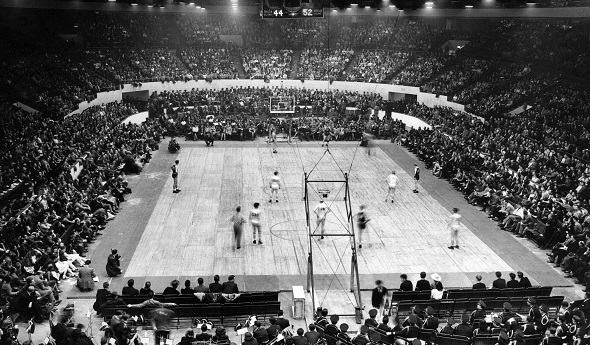
PHOTOS: (Top) An MHSAA boys basketball tournament game is played at Olympia Stadium in Detroit. (Middle) Flint Northern's Tawana McDonald blocks a shot during the 1994 Class A Final.
Jack Roberts, on Tom Rashid: One More Call
By
John E. (Jack) Roberts
MHSAA Executive Director, 1986-2018
December 9, 2021
More than a decade ago, with his knowledge, I placed in my “Will & Instructions Upon Death” that Tom Rashid was to be the one and only person to speak at my funeral or memorial service. A short number of years later, Tom told me that I was to do the same for him. Obviously, we knew that we could not both keep our promise to the other. But I must say, if Tom does not actually show up for my funeral, that will be the first time he has not kept a promise to me.
I understand there will be a time in the future, when the weather warms and COVID wanes, when school administrators across Michigan can gather in force to show their respects to Tom, and when I will provide the eulogy that Tom asked of me. But Tom’s recent death reminds us how uncertain life can be and suggests that I say some things now, before it’s too late.
Tom was the unparalleled master of award presentations; and for more than a dozen years he wrote and delivered polished praise on award recipients at the annual conference of the Michigan Interscholastic Athletic Administrators Association. My tribute now isn’t an awards presentation or hall-of-fame induction, so I won’t recount the particulars of Tom’s career; but what you will see here is the importance of Tom’s life … the themes that distinguish him from any other person I’ve known.
Tom comes from a large, complicated and compassionate family of parents, aunts, uncles, brothers, sisters, nephews and nieces who mourn his loss at levels few of us can fathom. Over the years, and for many years, he was the caretaker for several family members; and he was generous with all of them. My hope for each family member now – and for many days, weeks and months to come – is that you are at peace. Tom’s pain is over; and his place in eternity is secure. Tom purchased a reserved seat.
Tom often joked that his only good habit was prayer. That’s not really true, of course. But for as long as I’ve known Tom, he talked to God many times a day; and I’ve always had the feeling that he talked to God the same way he talked to us: bluntly, forcefully, passionately, honestly, loudly, making very plain what he had on his mind.
Tom was a rigorous practitioner of his devout Catholic faith; and, the God whom Tom believed in is a big God … the president, general manager and head coach of a huge, diverse team whose game plan is a large, loving Gospel of limitless parameters and possibilities. I have no doubt that, both in times of need and not, members of the Roberts family – including both my parents, my sister, my wife and our children and grandchildren – have been specific in his petitions to God. I have no doubt that Tom’s daily prayers included many of you, and your loved ones as well.
In addition to Tom’s immediate family is the even larger and even more complicated family Tom developed through a long, illustrious career in Michigan school sports administration: a full 25 years with the Archdiocese of Detroit, until 2003, when I invited him to join me at the MHSAA office in East Lansing.
During my 32 years as the executive director of the MHSAA, I never saw another like Tom … never, anywhere. He talked to anybody, anytime of the day or night, about any question or problem they might have. Usually, Tom didn’t need to give me notes reviewing his telephone conversations. From my adjacent office, and given his forceful voice, I could hear Tom’s every word, very clearly.
Tom had the ability to anticipate what I might need and take care of it without my asking. It is no exaggeration to say that Tom would do anything for me. For example, Tom’s reluctance to travel and his fear of flying are well known to many of you. I believe the one and only time that Tom flew in an airplane was in 2003, when I ordered him to fly to Texas so that he might receive the highest award of the National High School Coaches Association. He had never flown before; he has never flown since.
Most remarkable was not merely Tom’s unselfish, unlimited, legendary availability to athletic administrators at any hour of the day or night, nor his experienced, learned grasp of the subject matter in answering their calls. What was more remarkable was his effort to help school administrators through their hard times. On many occasions these callers had made an error of commission or omission. They had made a mistake or an oversight; and Tom was supremely compassionate in guiding them through the local fallout from disappointed athletes and disgruntled adults. Secure in himself and our mission to be servant-leaders, Tom very often shared or completely shouldered unjustified blame so others would not. He gave cover to countless local school administrators every year of his MHSAA career so that those administrators might survive and even thrive in their careers.
Among my remarkably loyal MHSAA staff, Tom still stands out. And he earned the enduring loyalty of those with whom he worked. I think especially of his successor at the Archdiocese of Detroit, Vic Michaels: I doubt that more than two days ever passed between their almost daily telephone conversations … usually in the morning … for the full 15 years that my office was next to Tom’s at the MHSAA. I have never, ever been witness to anything like that; and I know there is no one in our good work who misses our dear colleague more than Vic.
But most remarkable of all was Tom’s ability to turn an adversary into an ally. He could have a knock-down, drag-out argument with a person one day, and by the next day, and for years to come, that person was Tom’s greatest advocate and admirer.
Well … maybe second-greatest advocate and admirer. Because no one in athletic administration – no one – loved Tom more than I. And no one in our work told him this more than I did.
I have written often about my admiration and affection for Tom. I have spoken both publicly and privately of it, on many occasions. But let me say it one more time, here, as we celebrate his life, and mourn our loss …
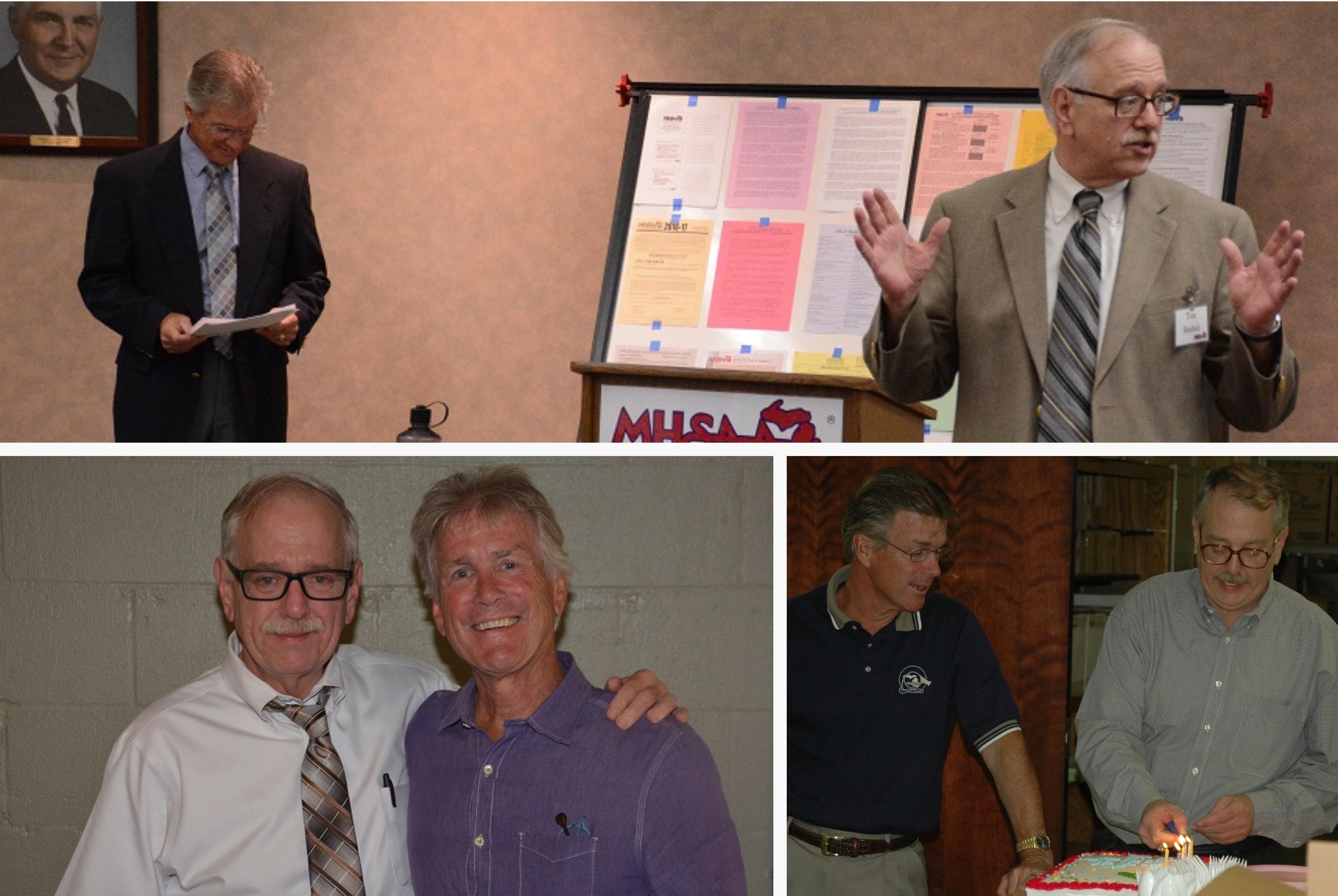
Tom and I provide proof that opposites attract, and we tag-teamed MHSAA’s leadership. One of us was very outgoing and vocal, the other more reserved and reticent. One of us was loud, the other more subdued. One of us was more comfortable on the phone, the other with the pen. One of us had no idea what to do with apostrophes, while the other would put them in the correct places. One of us was more spontaneous and extemporaneous, the other a more detailed planner and measurer of consequences. One of us hated to travel, the other sent messages to him from distant oceans and continents every year on Christmas or New Year’s Day to thank him for his life and service. But in our hearts, where one’s core values are harbored, we were almost identical twins.
I doubt that any two people who were side-by-side in the workplace for 15 years expressed their gratitude for each other more than we did, nor any two co-workers who said “I love you” to one another as often as we did. We each felt in deep debt to the other for myriad gifts and gestures that improved our careers and our lives.
Over the years, Tom and I developed the strategy of making one more telephone call before we made a final decision in a difficult matter … making one more call that sometimes made a difference in the controversial decision we had to make or in how that decision was accepted by those it affected. Tom loved to be the one to make those calls. And, sometimes, that “one more call” made all the difference.
Throughout my adult life, whenever I’ve attended a funeral or memorial service, I’ve found myself asking what it is I should learn and try to emulate from the life of the deceased. If you should find your mind and heart doing anything like that now, may I suggest these two answers.
First, Tom’s life and death remind us that we should not delay a single day in telling those with whom we work that we appreciate them and are grateful for what they do. And, if it is true and you are able, say you love them. Tom did this more often than anyone I’ve known.
And the second message is this. Tom’s life stands for faithfulness … faithfulness to his God, faithfulness to his family, faithfulness to his colleagues and friends, and faithfulness to his work and the mission of not just amateur athletics, but particularly school-operated, educational athletics. His was a steadfast faithfulness, never-a-day-off faithfulness, you-come-first faithfulness.
So Tom, my dear friend, once again I say, “I love you.”
And, “Rest in peace, Tom. God knows, you rarely rested in life.”
I would give anything for just one more call.