

MHSAA Historian Picks 10 to Remember
August 9, 2016
By Rob Kaminski
MHSAA benchmarks editor
It sounded simple and fun, the theme for the MHSAA's spring issue of benchmarks: a history of MHSAA tournaments.
It certainly was the latter, but simple? Not so much.
There’s no way to do justice to nearly a century’s worth of history in some sports. Complicating matters was the abundance of information and photographs for some, and the scant amount of detailed data and images for others.
MHSAA historian Ron Pesch was given an equally challenging task: recount a “Top 10” list from his days covering various MHSAA Finals. He shares them here and, he adds, they are in no order of favorites.
The Shot: 1986 Class B Boys Basketball Final at Crisler Arena – Saginaw Buena Vista’s Chris Coles’ desperation shot, launched at the buzzer from well beyond half court, dropped through the hoop to give the Knights a 33-32 win over defending champion Flint Beecher in a rematch of the 1985 Class B title game. The shot was Coles’ first of the second half and his only points in the contest.
The Smurfs: 1986 Class A Football Final at the Pontiac Silverdome – The "Smurfs" – Muskegon Coach Dave Taylor's nickname for his small, quick swarming defensive linemen – limited heavily favored Sterling Heights Stevenson to four yards rushing and 73 yards of total offense in a 10-0 win. As a 1979 graduate of Muskegon High School, I was elated.
The Drive: 1989 Class B Football Final at the Pontiac Silverdome – I slid down from the press box into the stands at the Silverdome for the end of this one. With 2:20 remaining, the atmosphere was simply electric, as Farmington Hills Harrison’s lauded quarterback Mill Coleman took the reins with his team down 27-21 to DeWitt. The senior executed a flawless two-minute drill, guiding his team to the DeWitt 9 before scampering into the end zone for the tying points. Steve Hill added his fourth PAT for the lead, then secured the victory with an interception on the next series.
King Kool: 2005 Class B Boys Basketball Final, Breslin Center, East Lansing – David Kool was a flawless 20 for 20 from the free-throw line and scored 43 points as Grand Rapids South Christian downed Muskegon Heights 67-60.
The Parade: 2004 Individual Wrestling Finals, The Palace of Auburn Hills – In 2004, I traveled to Auburn Hills to watch the MHSAA Individual Wrestling Finals for the first time. The pageantry of the Grand March, the skills on display, the roar of the massive crowd, and the ensuing beauty and chaos of a wrestling extravaganza of this scale is truly a sight to see.
 A Marathon: 2007 Division 3 Football Final, Ford Field, Detroit – East Grand Rapids and Orchard Lake St. Mary’s ended regulation tied 14-14, and this would turn into a five overtime battle that required an extra hour of play. No previous football playoff game, from Districts up, had ever gone beyond four overtimes. After exchanging field goals, touchdowns, extra points and two-point conversions, East Grand Rapids emerged with a 46-39 victory.
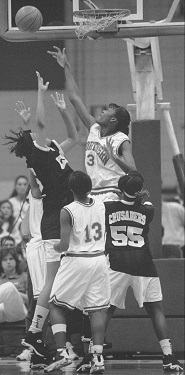
Tawana Towers: 1994 Class A Girls Basketball Final at Kellogg Arena, Battle Creek – Flint Northern, coached by Leteia Hughley and led by 6-4 freshman Tawana McDonald, defeated 1993 runner-up Detroit Martin Luther King, 46-32, for the Class A championship. McDonald batted down an MHSAA-record 10 shots, pulled down 13 rebounds and added five points and seven assists in a stellar performance.
Never Quit: 2008 Division 2 Football Semifinal, Spartan Stadium, East Lansing – Unbeaten, No. 1-ranked and heavily favored Muskegon trailed Davison by 22 late in the third quarter and 16 with less than five minutes to play. In perhaps the greatest comeback in playoff history, Muskegon recovered two onside kicks and scored 19 points in the final 4:31 to escape with a 38-35 victory and its third trip in five years to an MHSAA Final.
MHSAA Legends: 1998-2008 – For 10 years, the MHSAA showcased great teams from the past with their Legends of the Game series. From a historian’s perspective it was a chance to meet and learn more about folks I had often known only from the pages of microfilm. It was quite the treat to see years fall away as coaches, team managers and players reunited, in many cases for the first time after decades apart.
The MHSAA Record Books: Online, 1994 – One of my first efforts as state historian was to expand the record books beyond their primary focus on football, basketball, track & field and swimming & diving. With the arrival of the internet, an enhanced version of the record books was brought online. Coaches and fans were quick to respond with letters and e-mails, happily listing entries that had been “missed.” Soon, five category headings in a sport grew to 20, then to 50 and beyond.
Kids: 2004 Football Finals, Pontiac Silverdome – (OK, this is No. 11 ... consider it an extra point). For the first time, my sons joined me for my annual excursion to Metro Detroit for a Thanksgiving Day football weekend. They got to see the Silverdome before the move of the MHSAA Football Finals to beautiful Ford Field. Future Big Reds, they also got to see their future alma mater win another title.
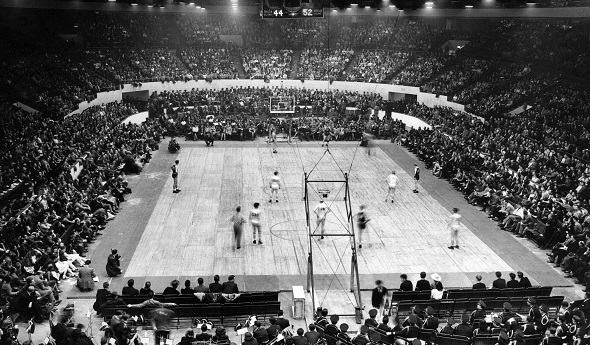
PHOTOS: (Top) An MHSAA boys basketball tournament game is played at Olympia Stadium in Detroit. (Middle) Flint Northern's Tawana McDonald blocks a shot during the 1994 Class A Final.
How Can COVID-19 Impact Student-Athletes' Return-To-Play?
October 5, 2021

COVID-19 And Student Athletes: How Can the Virus Impact Return-To-Play?
The end of summer marked the start of the school year, and for student athletes, the kickoff of the fall sports season. For many, COVID-19 sidelined practices, team gatherings and games to some extent last year. And while there is still hope that young athletes will have more opportunity to play this season despite rising cases of the Delta variant, there are other factors causing concern among athletes and their parents.
According to Ramsey Shehab, M.D., a sports medicine physician for Henry Ford Health System, many athletes are concerned about reaching peak performance after a long time off or after they have recovered from a COVID diagnosis. He reassures students that the feeling of exhaustion or even underperformance compared to past years is to be expected when you take time off or after fighting an illness.
“When you are infected with a virus, it taxes your immune system, and all of your energy goes towards fighting off that infection,” says Dr. Shehab. “You’ll likely feel weak and more tired during this time.”
Fortunately, as the body begins to recover, you’ll start to feel more like yourself again as you get your energy back. But this doesn’t mean that you won’t lose some of that fitness and endurance you’ve built up.
“It only takes about a week of deconditioning to set you back from peak athletic abilities,” says Dr. Shehab. “It is completely expected that your body will need time to get back to performing at your best.”
Playing Sports After Recovering From COVID-19
The unfortunate news: COVID-19 affects people differently in the long term. Some people are able to recover and get back to their routine without delay, whereas others see further complications months after an infection.
Akshay Khandelwal, M.D., a cardiologist with Henry Ford Health System, breaks down some of the more serious findings regarding COVID-19 and your heart health.
“With COVID-19, there is a risk of direct injury like heart failure or an arrhythmia due to the stress your body is under while fighting off the virus,” says Dr. Khandelwal. “As a result, having the virus can cause inflammation of the heart, a condition called myocarditis.”
Because of this, talking to your doctor before returning to a sport is a must if you had COVID or are recovering from the virus. It is important to make sure there are no systemic changes to your body such as overall heart health and lung function. They will be able to rule out any long-term effects that could impact your fitness output.
Expert-Recommended Steps for Return-To-Play
As you get back to your game, both experts share their insights for a healthy recovery:
1. Take quarantine periods seriously. If you are sick, even if you don’t necessarily feel sick, make sure you are taking time to rest and recover properly. “Don’t try to push or overexert yourself,” says Dr. Khandelwal. “It could prolong your recovery.”
2. Get back to training slowly. “Start using low-exertion activities to get your body used to working out again,” says Dr. Shehab. “Once you are able to handle each activity, you can push ahead to something more challenging.” Realistically, it may take a couple of weeks before you are able to get back to your peak.
3. Listen to your body. If workouts seem increasingly difficult, talk with your doctor or trainer before pushing yourself further. You can also help your body recover by making healthy, thoughtful choices:
► Get plenty of sleep
► Warm up and cool down before and after workouts
► Stay hydrated
► Take breaks when you’re tired
► Practice injury prevention
► Make smart food choices
4. Get vaccinated. If medical or religious reasons, or age requirements aren’t stopping you from getting the vaccine, consider getting the shot for yourself and those around you. The Delta variant is highly transmittable, meaning that, it is much easier for it to spread to teammates and family members than the original strain of the virus. To learn more about the COVID-19 vaccine, visit our Vaccine FAQs page.
Talk to your doctor to learn more about safely returning to a sport. To find a doctor, visit henryford.com or call 1-800-436-7936.
Dr. Ramsey Shehab is the deputy chief of Sports Medicine at Henry Ford Health System. He sees patients at the Henry Ford Center for Athletic Medicine and Henry Ford Medical Center - Bloomfield Township.
Dr. Akshay Khandelwal is an interventional cardiologist who sees patients at Henry Ford Medical Center – Second Avenue.