

MHSAA Historian Picks 10 to Remember
August 9, 2016
By Rob Kaminski
MHSAA benchmarks editor
It sounded simple and fun, the theme for the MHSAA's spring issue of benchmarks: a history of MHSAA tournaments.
It certainly was the latter, but simple? Not so much.
There’s no way to do justice to nearly a century’s worth of history in some sports. Complicating matters was the abundance of information and photographs for some, and the scant amount of detailed data and images for others.
MHSAA historian Ron Pesch was given an equally challenging task: recount a “Top 10” list from his days covering various MHSAA Finals. He shares them here and, he adds, they are in no order of favorites.
The Shot: 1986 Class B Boys Basketball Final at Crisler Arena – Saginaw Buena Vista’s Chris Coles’ desperation shot, launched at the buzzer from well beyond half court, dropped through the hoop to give the Knights a 33-32 win over defending champion Flint Beecher in a rematch of the 1985 Class B title game. The shot was Coles’ first of the second half and his only points in the contest.
The Smurfs: 1986 Class A Football Final at the Pontiac Silverdome – The "Smurfs" – Muskegon Coach Dave Taylor's nickname for his small, quick swarming defensive linemen – limited heavily favored Sterling Heights Stevenson to four yards rushing and 73 yards of total offense in a 10-0 win. As a 1979 graduate of Muskegon High School, I was elated.
The Drive: 1989 Class B Football Final at the Pontiac Silverdome – I slid down from the press box into the stands at the Silverdome for the end of this one. With 2:20 remaining, the atmosphere was simply electric, as Farmington Hills Harrison’s lauded quarterback Mill Coleman took the reins with his team down 27-21 to DeWitt. The senior executed a flawless two-minute drill, guiding his team to the DeWitt 9 before scampering into the end zone for the tying points. Steve Hill added his fourth PAT for the lead, then secured the victory with an interception on the next series.
King Kool: 2005 Class B Boys Basketball Final, Breslin Center, East Lansing – David Kool was a flawless 20 for 20 from the free-throw line and scored 43 points as Grand Rapids South Christian downed Muskegon Heights 67-60.
The Parade: 2004 Individual Wrestling Finals, The Palace of Auburn Hills – In 2004, I traveled to Auburn Hills to watch the MHSAA Individual Wrestling Finals for the first time. The pageantry of the Grand March, the skills on display, the roar of the massive crowd, and the ensuing beauty and chaos of a wrestling extravaganza of this scale is truly a sight to see.
 A Marathon: 2007 Division 3 Football Final, Ford Field, Detroit – East Grand Rapids and Orchard Lake St. Mary’s ended regulation tied 14-14, and this would turn into a five overtime battle that required an extra hour of play. No previous football playoff game, from Districts up, had ever gone beyond four overtimes. After exchanging field goals, touchdowns, extra points and two-point conversions, East Grand Rapids emerged with a 46-39 victory.
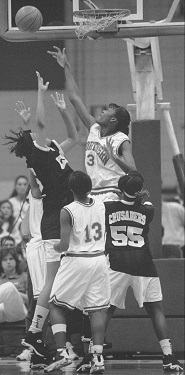
Tawana Towers: 1994 Class A Girls Basketball Final at Kellogg Arena, Battle Creek – Flint Northern, coached by Leteia Hughley and led by 6-4 freshman Tawana McDonald, defeated 1993 runner-up Detroit Martin Luther King, 46-32, for the Class A championship. McDonald batted down an MHSAA-record 10 shots, pulled down 13 rebounds and added five points and seven assists in a stellar performance.
Never Quit: 2008 Division 2 Football Semifinal, Spartan Stadium, East Lansing – Unbeaten, No. 1-ranked and heavily favored Muskegon trailed Davison by 22 late in the third quarter and 16 with less than five minutes to play. In perhaps the greatest comeback in playoff history, Muskegon recovered two onside kicks and scored 19 points in the final 4:31 to escape with a 38-35 victory and its third trip in five years to an MHSAA Final.
MHSAA Legends: 1998-2008 – For 10 years, the MHSAA showcased great teams from the past with their Legends of the Game series. From a historian’s perspective it was a chance to meet and learn more about folks I had often known only from the pages of microfilm. It was quite the treat to see years fall away as coaches, team managers and players reunited, in many cases for the first time after decades apart.
The MHSAA Record Books: Online, 1994 – One of my first efforts as state historian was to expand the record books beyond their primary focus on football, basketball, track & field and swimming & diving. With the arrival of the internet, an enhanced version of the record books was brought online. Coaches and fans were quick to respond with letters and e-mails, happily listing entries that had been “missed.” Soon, five category headings in a sport grew to 20, then to 50 and beyond.
Kids: 2004 Football Finals, Pontiac Silverdome – (OK, this is No. 11 ... consider it an extra point). For the first time, my sons joined me for my annual excursion to Metro Detroit for a Thanksgiving Day football weekend. They got to see the Silverdome before the move of the MHSAA Football Finals to beautiful Ford Field. Future Big Reds, they also got to see their future alma mater win another title.
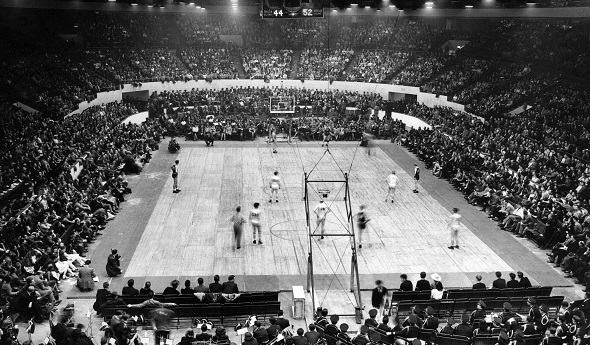
PHOTOS: (Top) An MHSAA boys basketball tournament game is played at Olympia Stadium in Detroit. (Middle) Flint Northern's Tawana McDonald blocks a shot during the 1994 Class A Final.

Title IX Continues to Fuel Growth of Girls and Women’s Sports, Olympic Dominance
By
Karissa Niehoff
NFHS Executive Director
September 24, 2021
To say that American female athletes dominated the recent Olympics in Tokyo would be an understatement.
Among the 66 medals earned by American female Olympians – most by any country in the history of the Games – were gold-medal performances by the U.S. basketball, volleyball, water polo and beach volleyball teams. Eighteen medals were earned by the U.S. women swimmers, female track and field athletes claimed 15 medals, and the U.S. women’s softball and soccer teams won silver and bronze medals, respectively.
In the past 30 years of the Olympic Games, the United States has dominated the women’s team sports of basketball (nine golds), soccer (four golds, one silver, one bronze) and softball (three golds, two silvers) — not to mention the untold number of medals in track and field. And this past summer, the U.S. women’s volleyball team claimed its first gold medal.
These performances by some of our nation’s most skilled female athletes never would have been possible without the passage of Title IX and the offerings of these sports through our nation’s schools. With the chance to play afforded by the landmark Title IX legislation in 1972, girls participation in several high school sports skyrocketed in the years that followed.
When the NFHS conducted its first participation survey in 1971, basketball and outdoor track and field were the primary girls sports, comprising about two-thirds of the 294,000 total. However, with the opportunity to play additional sports, girls flocked to volleyball and softball first, along with cross country and eventually soccer.
Soccer, in fact, has had the most remarkable growth. In 1971, only 700 girls were playing high school soccer. Twenty-five years later, that number had climbed to almost 210,000; and as the 50th anniversary of Title IX approaches, there are now almost 400,000 girls playing high school soccer – a staggering 56,200 percentage increase in 50 years. Soccer now ranks fourth in popularity among girls high school sports – all because of that opportunity in 1972.
There are many other success stories, however. The pre-Title IX survey in 1971 indicated that 1,719 girls were participating in cross country. With increases every year until 2015, today, there are 219,345 girls competing in high school programs and the sport ranks sixth in popularity.
Although participation numbers have leveled a bit the past 10 years, fast-pitch softball is another sport that flourished after the passage of Title IX. With fewer than 10,000 participants in 1971, the numbers quickly rose to 220,000 by 1985 and 343,000 by 2000, and softball is currently fifth among girls sports with 362,038 participants.
Since track and field and basketball were the primary sports in the early days of girls sports programs, increases in those sports have not been as dramatic; however, they remain the first and third most-popular sports, respectively, today. Volleyball, however, much like soccer, continues its upward climb.
Without a doubt, volleyball has seen the steadiest increases among girls high school sports the past 50 years. After starting with 17,952 participants in 1971, the numbers jumped to 300,810 by 1990 and 409,332 by 2010 and 452,808 by 2018. During its climb, volleyball surpassed basketball as the No. 2 girls sport.
And among the top six girls sports from 2010 to 2018 (numbers are not available the past two years due to the pandemic), volleyball has gained the most participants (43,476), followed by soccer (32,549). And all of this has occurred thanks to legislation passed in 1972 that was not fundamentally meant to address opportunities for girls to participate in high school sports.
The NFHS is leading a yearlong celebration of the 50th anniversary of Title IX, which officially occurs on June 23, 2022. “Title IX at 50 – Celebrating and Growing Opportunities” is highlighting the law’s impact by celebrating the inspirational individuals and landmark moments in the history of Title IX, and continuing to grow the educational and competitive opportunities for the future.
More information, including a Title IX Timeline, Title IX Milestones, The History and Importance of Title IX, Title IX Fact Sheet, Title IX Frequently Asked Questions and several Title IX videos, can be accessed on the NFHS Website.
Dr. Karissa L. Niehoff is beginning her fourth year as executive director of the National Federation of State High School Associations (NFHS) in Indianapolis. She is the first female to head the national leadership organization for high school athletics and performing arts activities and the sixth full-time executive director of the NFHS. She previously was executive director of the Connecticut Association of Schools-Connecticut Interscholastic Athletic Conference for seven years.