

MHSAA Historian Picks 10 to Remember
August 9, 2016
By Rob Kaminski
MHSAA benchmarks editor
It sounded simple and fun, the theme for the MHSAA's spring issue of benchmarks: a history of MHSAA tournaments.
It certainly was the latter, but simple? Not so much.
There’s no way to do justice to nearly a century’s worth of history in some sports. Complicating matters was the abundance of information and photographs for some, and the scant amount of detailed data and images for others.
MHSAA historian Ron Pesch was given an equally challenging task: recount a “Top 10” list from his days covering various MHSAA Finals. He shares them here and, he adds, they are in no order of favorites.
The Shot: 1986 Class B Boys Basketball Final at Crisler Arena – Saginaw Buena Vista’s Chris Coles’ desperation shot, launched at the buzzer from well beyond half court, dropped through the hoop to give the Knights a 33-32 win over defending champion Flint Beecher in a rematch of the 1985 Class B title game. The shot was Coles’ first of the second half and his only points in the contest.
The Smurfs: 1986 Class A Football Final at the Pontiac Silverdome – The "Smurfs" – Muskegon Coach Dave Taylor's nickname for his small, quick swarming defensive linemen – limited heavily favored Sterling Heights Stevenson to four yards rushing and 73 yards of total offense in a 10-0 win. As a 1979 graduate of Muskegon High School, I was elated.
The Drive: 1989 Class B Football Final at the Pontiac Silverdome – I slid down from the press box into the stands at the Silverdome for the end of this one. With 2:20 remaining, the atmosphere was simply electric, as Farmington Hills Harrison’s lauded quarterback Mill Coleman took the reins with his team down 27-21 to DeWitt. The senior executed a flawless two-minute drill, guiding his team to the DeWitt 9 before scampering into the end zone for the tying points. Steve Hill added his fourth PAT for the lead, then secured the victory with an interception on the next series.
King Kool: 2005 Class B Boys Basketball Final, Breslin Center, East Lansing – David Kool was a flawless 20 for 20 from the free-throw line and scored 43 points as Grand Rapids South Christian downed Muskegon Heights 67-60.
The Parade: 2004 Individual Wrestling Finals, The Palace of Auburn Hills – In 2004, I traveled to Auburn Hills to watch the MHSAA Individual Wrestling Finals for the first time. The pageantry of the Grand March, the skills on display, the roar of the massive crowd, and the ensuing beauty and chaos of a wrestling extravaganza of this scale is truly a sight to see.
 A Marathon: 2007 Division 3 Football Final, Ford Field, Detroit – East Grand Rapids and Orchard Lake St. Mary’s ended regulation tied 14-14, and this would turn into a five overtime battle that required an extra hour of play. No previous football playoff game, from Districts up, had ever gone beyond four overtimes. After exchanging field goals, touchdowns, extra points and two-point conversions, East Grand Rapids emerged with a 46-39 victory.
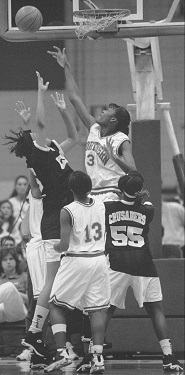
Tawana Towers: 1994 Class A Girls Basketball Final at Kellogg Arena, Battle Creek – Flint Northern, coached by Leteia Hughley and led by 6-4 freshman Tawana McDonald, defeated 1993 runner-up Detroit Martin Luther King, 46-32, for the Class A championship. McDonald batted down an MHSAA-record 10 shots, pulled down 13 rebounds and added five points and seven assists in a stellar performance.
Never Quit: 2008 Division 2 Football Semifinal, Spartan Stadium, East Lansing – Unbeaten, No. 1-ranked and heavily favored Muskegon trailed Davison by 22 late in the third quarter and 16 with less than five minutes to play. In perhaps the greatest comeback in playoff history, Muskegon recovered two onside kicks and scored 19 points in the final 4:31 to escape with a 38-35 victory and its third trip in five years to an MHSAA Final.
MHSAA Legends: 1998-2008 – For 10 years, the MHSAA showcased great teams from the past with their Legends of the Game series. From a historian’s perspective it was a chance to meet and learn more about folks I had often known only from the pages of microfilm. It was quite the treat to see years fall away as coaches, team managers and players reunited, in many cases for the first time after decades apart.
The MHSAA Record Books: Online, 1994 – One of my first efforts as state historian was to expand the record books beyond their primary focus on football, basketball, track & field and swimming & diving. With the arrival of the internet, an enhanced version of the record books was brought online. Coaches and fans were quick to respond with letters and e-mails, happily listing entries that had been “missed.” Soon, five category headings in a sport grew to 20, then to 50 and beyond.
Kids: 2004 Football Finals, Pontiac Silverdome – (OK, this is No. 11 ... consider it an extra point). For the first time, my sons joined me for my annual excursion to Metro Detroit for a Thanksgiving Day football weekend. They got to see the Silverdome before the move of the MHSAA Football Finals to beautiful Ford Field. Future Big Reds, they also got to see their future alma mater win another title.
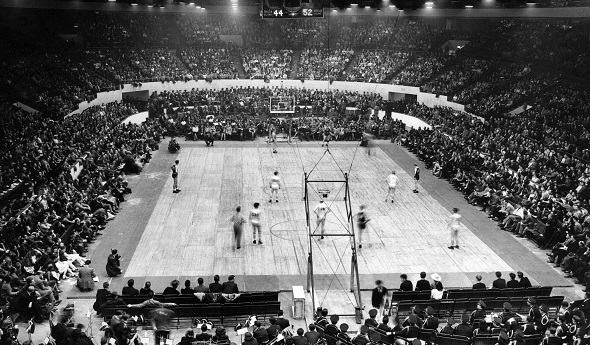
PHOTOS: (Top) An MHSAA boys basketball tournament game is played at Olympia Stadium in Detroit. (Middle) Flint Northern's Tawana McDonald blocks a shot during the 1994 Class A Final.
Women & ACL Injuries: Know Risks, Steps for Prevention
August 10, 2021

Whether you’re a casual jogger or elite athlete, you’re at risk for an injury to your anterior cruciate ligament (ACL). If you’re a woman, you are at even greater risk for these injuries.
But there are steps you can take to prevent them.
“Among athletes, women are more than twice as likely to have an ACL injury than men,” says Nithin Natwa, M.D., a sports medicine specialist and primary care physician at Henry Ford Health System. “Once you have an ACL injury, you are at greater risk for having further soft tissue injuries in the future. That’s why it is important to prevent these injuries and follow your treatment plan if injured.”
What Is An ACL Injury?
An ACL injury is a strain or tear in the ACL, one of the four major ligaments that support the knee so it can flex and bend. The ACL is a strong band of tissue that helps connect your thigh bone (femur) to your shin bone (tibia). “An ACL injury usually occurs without contact when you turn suddenly while running or land off-balance on one leg. These actions overload the knee joint and cause the ACL to be torn,” says Dr. Natwa.
In the United States, 100,000 people have ACL injuries each year. Anyone can experience an ACL injury, though athletes participating in sports like football, basketball, soccer and gymnastics are at highest risk. And summer is a peak time for outdoor sports injuries.
Seek immediate care if you have any of these signs of an ACL injury:
• An audible “pop” in the knee
• Intense knee pain and rapid-onset swelling (within hours)
• Loss of range of motion
• An unstable feeling or locking of your knee
The most common treatment for ACL injuries is surgery followed by physical therapy. After treatment, you can expect to return to normal activities in 6 to 9 months. However, peak athletic performance can take up to two years.
Why Are Women At Higher Risk For ACL Injuries?
According to Dr. Natwa, the differences in athletic training techniques for males versus females have left women at greater risk for ACL injuries. “There has been more emphasis on overall conditioning and mechanics for boys participating in sports compared to girls,” he says.
As a result, women are at greater risk for ACL tears and sprains due to:
• Differences in neuromuscular control: Without conditioning from an early age, women may not have the same ability to land and perform athletic motions that men do. For example, women are at higher risk for an ACL injury after landing from a jump.
• Strength imbalance for muscles that support the knee: Female athletes tend to have more defined quadriceps muscles but weaker hamstrings than men, putting them at greater risk for injury.
According to Dr. Natwa, there are many theories about women’s risk for ACL injury that lack scientific evidence, including:
• Width of the pelvis: Some people have suggested that the wider width of a woman’s pelvis puts more pressure on the knee joint and increases the risk for injury. However, this difference has not been shown to impact a women’s risk for ACL tears or sprains.
• Knee anatomy: The ACL runs through a section of the femur called the intercondylar notch. Women tend to have a narrower notch than men. Regardless of gender, individuals who possess smaller notch dimensions appear to be at greater risk for injury than individuals with larger notches.
• Hormones: Men and women have different hormone levels. But there is currently no concrete evidence that female hormones place women at higher risk for ACL injures.
Steps To Prevent ACL Injuries – Conditioning Early, Often
“The best way to prevent ACL injuries is to begin and maintain regular conditioning exercises at an early age,” Dr. Natwa says. “The more frequently you engage in proper exercises, the lower your risk for injury.”
Consult with a sports medicine specialist, physical therapist or athletic trainer to develop a training routine to prevent ACL and other injuries. Your training program should include exercises that:
• Strengthen the muscles that support your knee: Add strength training to build up your calves, hamstrings and quadriceps muscles. These muscles help stabilize your knee as you move. By strengthening these muscle groups evenly, you can lower your risk for injury.
• Improve overall neuromuscular control: Focus on adding neuromuscular exercises that train your nerves and muscles to react and communicate. For example, you may work on your balance by standing on one leg or sit upright on an exercise ball for short periods of time. And core exercises can strengthen the muscles that support your abdomen and back and help improve your posture as you move. These moves can strengthen your joints and help you learn appropriate balance and technique.
“Exercise really is the best medicine. It can improve your balance and agility as you participate in a sport or prevent injury as you move through your daily activities,” says Dr. Natwa. “Consider adding these exercises to your wellness program.”
Dr. Nithin Natwa is a sports medicine doctor who sees patients at Henry Ford Macomb Health Center in Chesterfield and Henry Ford Macomb Orthopedics and Wound Care in Clinton Township.
Want to learn more? Henry Ford Health System sports medicine experts are treating the whole athlete, in a whole new way. From nutrition to neurology, and from injury prevention to treatment of sports-related conditions, they can give your athlete a unique game plan. To find a sports medicine physician at Henry Ford, visit henryford.com or call 1-800-436-7936.