

MHSAA Historian Picks 10 to Remember
August 9, 2016
By Rob Kaminski
MHSAA benchmarks editor
It sounded simple and fun, the theme for the MHSAA's spring issue of benchmarks: a history of MHSAA tournaments.
It certainly was the latter, but simple? Not so much.
There’s no way to do justice to nearly a century’s worth of history in some sports. Complicating matters was the abundance of information and photographs for some, and the scant amount of detailed data and images for others.
MHSAA historian Ron Pesch was given an equally challenging task: recount a “Top 10” list from his days covering various MHSAA Finals. He shares them here and, he adds, they are in no order of favorites.
The Shot: 1986 Class B Boys Basketball Final at Crisler Arena – Saginaw Buena Vista’s Chris Coles’ desperation shot, launched at the buzzer from well beyond half court, dropped through the hoop to give the Knights a 33-32 win over defending champion Flint Beecher in a rematch of the 1985 Class B title game. The shot was Coles’ first of the second half and his only points in the contest.
The Smurfs: 1986 Class A Football Final at the Pontiac Silverdome – The "Smurfs" – Muskegon Coach Dave Taylor's nickname for his small, quick swarming defensive linemen – limited heavily favored Sterling Heights Stevenson to four yards rushing and 73 yards of total offense in a 10-0 win. As a 1979 graduate of Muskegon High School, I was elated.
The Drive: 1989 Class B Football Final at the Pontiac Silverdome – I slid down from the press box into the stands at the Silverdome for the end of this one. With 2:20 remaining, the atmosphere was simply electric, as Farmington Hills Harrison’s lauded quarterback Mill Coleman took the reins with his team down 27-21 to DeWitt. The senior executed a flawless two-minute drill, guiding his team to the DeWitt 9 before scampering into the end zone for the tying points. Steve Hill added his fourth PAT for the lead, then secured the victory with an interception on the next series.
King Kool: 2005 Class B Boys Basketball Final, Breslin Center, East Lansing – David Kool was a flawless 20 for 20 from the free-throw line and scored 43 points as Grand Rapids South Christian downed Muskegon Heights 67-60.
The Parade: 2004 Individual Wrestling Finals, The Palace of Auburn Hills – In 2004, I traveled to Auburn Hills to watch the MHSAA Individual Wrestling Finals for the first time. The pageantry of the Grand March, the skills on display, the roar of the massive crowd, and the ensuing beauty and chaos of a wrestling extravaganza of this scale is truly a sight to see.
 A Marathon: 2007 Division 3 Football Final, Ford Field, Detroit – East Grand Rapids and Orchard Lake St. Mary’s ended regulation tied 14-14, and this would turn into a five overtime battle that required an extra hour of play. No previous football playoff game, from Districts up, had ever gone beyond four overtimes. After exchanging field goals, touchdowns, extra points and two-point conversions, East Grand Rapids emerged with a 46-39 victory.
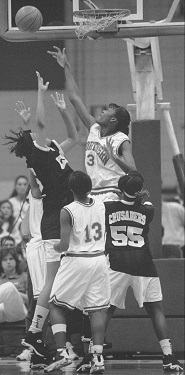
Tawana Towers: 1994 Class A Girls Basketball Final at Kellogg Arena, Battle Creek – Flint Northern, coached by Leteia Hughley and led by 6-4 freshman Tawana McDonald, defeated 1993 runner-up Detroit Martin Luther King, 46-32, for the Class A championship. McDonald batted down an MHSAA-record 10 shots, pulled down 13 rebounds and added five points and seven assists in a stellar performance.
Never Quit: 2008 Division 2 Football Semifinal, Spartan Stadium, East Lansing – Unbeaten, No. 1-ranked and heavily favored Muskegon trailed Davison by 22 late in the third quarter and 16 with less than five minutes to play. In perhaps the greatest comeback in playoff history, Muskegon recovered two onside kicks and scored 19 points in the final 4:31 to escape with a 38-35 victory and its third trip in five years to an MHSAA Final.
MHSAA Legends: 1998-2008 – For 10 years, the MHSAA showcased great teams from the past with their Legends of the Game series. From a historian’s perspective it was a chance to meet and learn more about folks I had often known only from the pages of microfilm. It was quite the treat to see years fall away as coaches, team managers and players reunited, in many cases for the first time after decades apart.
The MHSAA Record Books: Online, 1994 – One of my first efforts as state historian was to expand the record books beyond their primary focus on football, basketball, track & field and swimming & diving. With the arrival of the internet, an enhanced version of the record books was brought online. Coaches and fans were quick to respond with letters and e-mails, happily listing entries that had been “missed.” Soon, five category headings in a sport grew to 20, then to 50 and beyond.
Kids: 2004 Football Finals, Pontiac Silverdome – (OK, this is No. 11 ... consider it an extra point). For the first time, my sons joined me for my annual excursion to Metro Detroit for a Thanksgiving Day football weekend. They got to see the Silverdome before the move of the MHSAA Football Finals to beautiful Ford Field. Future Big Reds, they also got to see their future alma mater win another title.
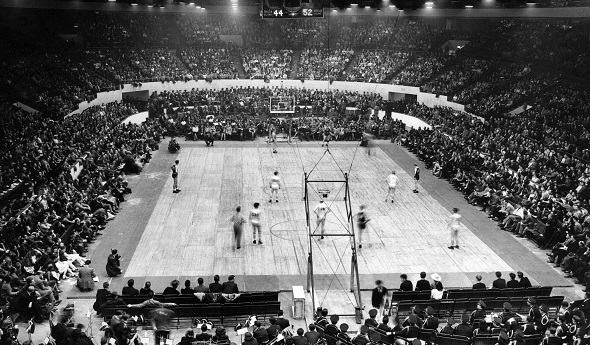
PHOTOS: (Top) An MHSAA boys basketball tournament game is played at Olympia Stadium in Detroit. (Middle) Flint Northern's Tawana McDonald blocks a shot during the 1994 Class A Final.
Play it Safe: Basics of Proper Helmet Use
June 8, 2021

If you or your child plays sports or participates in physically risky activities, wearing a helmet could be lifesaving. While no helmet is concussion-proof, wearing one can help reduce the risk of serious head injuries.
"Helmets are made with materials that help reduce impact to the head, protecting the skull from damage," says Jeffrey Kutcher, M.D., a sports neurologist who treats athletes at the Henry Ford Kutcher Clinic for Concussion and Sports Neurology. "You should be wearing a helmet whether you're playing a contact sport or riding something on a hard surface, such as a bike, scooter, skateboard or rollerblades."
Head Injury Prevention 101: Helmet Buying Basics
All helmets are certified at the same level for multi-use recreational activities. So there's no need to search for a specific seal or rating. Instead, when you're purchasing a helmet — or getting one second-hand — focus on these four factors:
How you’ll use it:
Pay attention to the risks involved with the activity you're doing. If you're biking, skiing or snowboarding, for example, you're wearing a helmet in case you get hit, not because you'll get hit.
There are two types of helmets: single-impact and multiple-impact. Single-impact helmets are made with foam materials that break down when hit as part of their force mitigating strategy. These helmets work well for bicycling, skateboarding, skiing or snowboarding. Multiple-impact helmets, such as those designed for sports like football, hockey and lacrosse, can withstand many hits over an entire season. The materials in these helmets don't break down, but rather compress and regain their original form.
"A helmet may perform better in the lab — for example, the dummy brain will experience 98Gs of force instead of 100Gs — but 2Gs of force probably won't make enough of a difference with a one-time injury," Dr. Kutcher says. "But 2Gs less force per hit for a linebacker who suffers multiple blows on a daily basis for many years? That could make a big difference.”
If football is your sport, the National Football League provides a helmet rating system that assesses helmets based on their ability to mitigate force over time.
How it fits:
Helmets fit differently depending on the make, style and type of sport they’re made for. "The key is making sure the helmet covers the entire skull and doesn't move around when in use," Dr. Kutcher says. The helmet should sit on the head without falling forward or backward. If you're relying only on a chinstrap to keep it in place, you don't have the right fit.
How comfortable it is:
Not all helmet brands fit every head. Helmet designs vary just like running shoes do. When you're shopping for a helmet, make sure it's snug, but not tight or uncomfortable. Comfort is critical, especially for kids. "You don't want a child to develop a negative association with wearing a protective helmet," Dr. Kutcher says.
What condition it’s in:
To get the most protection, your helmet should be in top condition. Do not wear a cracked or broken helmet, or one that has been involved in a crash or similar event (unless it's a multiple-impact design). An impact can crush foam materials. And don't allow the helmet to get too hot or cold — that can cause the materials to break down over time.
Get the Best Helmet Fit for Your Head
Properly wearing a helmet provides the greatest defense against injury — more than any style or brand. To make sure your helmet is secure, follow these rules:
· Measure head circumference: Every helmet brand provides a size chart, along with instructions about how to select the best fit. To get the best measurement, use a cloth tape to measure your head circumference. Place the tape about an inch above the eyebrows, keeping it level from front to back. If the measurement falls between sizes, select the smaller size.
· Pay attention to hairstyles: Make sure to try the helmet on with the hairstyle you'll have during the activity. A long-haired bike rider who gets a short haircut may require a helmet adjustment.
· Watch your vision: The helmet should not block your vision. You should be able to see straight ahead and side to side.
To Wear a Helmet or Not To Wear a Helmet: When to Play It Safe
There are several sports that don't require wearing a helmet. But if you or your child is involved in rugby or soccer, or another sport where helmets are optional, that doesn’t mean you're in the clear.
"It's important to base any decision about whether or not to wear a helmet in conjunction with your sports neurologist," notes Dr. Kutcher. "Your past medical history and current health status may still warrant the use of a helmet."
Unsure whether you're at risk of sustaining a head injury? Get a brain health baseline evaluation. Proper consideration of your brain health includes a physical examination, along with a personal and family medical and neurological history. It also offers you an opportunity to learn how to best protect your head.
Dr. Jeffrey Kutcher is a sports neurologist at the Henry Ford Concussion and Sports Neurology Clinic and the global director of the Kutcher Clinic.
Want to learn more? Henry Ford Health System sports medicine experts are treating the whole athlete, in a whole new way. From nutrition to neurology, and from injury prevention to treatment of sports-related conditions, they can give your athlete a unique game plan.
Visit henryford.com/sports or call (313) 972-4216 for an appointment within 24 business hours.