

105 Schools Recognized As HEARTSafe
October 19, 2016
The Michigan Departments of Health and Human Services (MDHHS), and Education (MDE); American Heart Association (AHA); Michigan High School Athletic Association (MHSAA); and Michigan Alliance for Prevention of Sudden Cardiac Death of the Young (MAP-SCDY) have awarded 105 schools in Michigan with the MI HEARTSafe School designation which recognizes schools that are prepared to respond to cardiac emergencies.
“Many sudden cardiac deaths that claim the lives of children and young adults could be prevented through screening, detection, and treatment,” said Dr. Eden Wells, chief medical executive of MDHHS. “Appropriate medical response within three to five minutes is crucial for increasing the chance of survival, which is why I’m pleased to see so many of our schools taking vital measures to prepare and address this health issue.”
In order for a school to receive a MI HEARTSafe School designation, it must perform at least one cardiac emergency response drill per year, have a written medical emergency response plan and team, have current CPR/AED certification of at least 10 percent of staff, 100 percent of head varsity coaches, and 50 percent of P.E. staff; have accessible, properly maintained and inspected AEDs with signs identifying their location; and ensure pre-participation sports screening of all student athletes using the current physical and history form endorsed by the Michigan High School Athletic Association.
“We are so proud to support Michigan’s HEARTSafe schools,” said State Superintendent Brian Whiston. “Ensuring schools are prepared for sudden cardiac emergencies through planning, training, and life-saving AEDs is an important part of having safer learning environments for students, staff, and the community.”
Between 2003 and 2012 in Michigan, there were 2,590 young individuals between 1 and 39 years of age who died of sudden cardiac death. Of those, 214 were between 5 and 19 years of age. This is the third year of the MI HEARTSafe Schools program in Michigan. In the first two years of the initiative, 162 schools were previously designated as MI HEARTSafe Schools and prepared to help reduce the number of sudden cardiac deaths in our youth.
Public Act 12 of 2014 requires all schools (grades kindergarten to 12) to have a cardiac emergency response plan in place. This MI HEARTSafe School designation recognizes the 267 school buildings that have taken steps above and beyond to prepare to respond in the event of a cardiac emergency, and is awarded for a period of three years. Click for the list of designated schools.
Schools that meet all of the requirements will be able to apply for the MI HEARTSafe School designation each year. Click for information about the MI HEARTSafe Schools program.
Awards Honor Those Lending a Hand
April 12, 2017
By Geoff Kimmerly
Second Half editor
Sports often make up a significant, although singular part of the lives of Michigan’s high school student-athletes and coaches.
 Many also find ways to have significant impacts on the lives of others – and we’d like to tell the rest of our state how they’re making a difference.
The Michigan High School Athletic Association, together with Lake Trust Credit Union, will award this spring the inaugural Community Service Awards to recognize individuals and teams that have worked to benefit their communities.
Each winner will receive a $1,000 award to be applied toward an individual college scholarship, credited to a team’s account with its athletic department or even gifted to the group helped by our honoree.
Please help us get the word out. Encourage a student, coach or administrator to tell us about a completed or ongoing community service project. Any student, team or coach currently participating in interscholastic athletics at an MHSAA member high school can apply. Applications should be e-mailed both to the school’s athletic director and MHSAA’s Kurt Tiesman at [email protected].
The deadline for applications is May 1, and multiple winners will be selected and notified by May 12. Click for more information.
We hear and read about these contributions and successes throughout the school year. Thank you in advance for your help in allowing us to honor some of this great work in the community by those who also shine on the field.
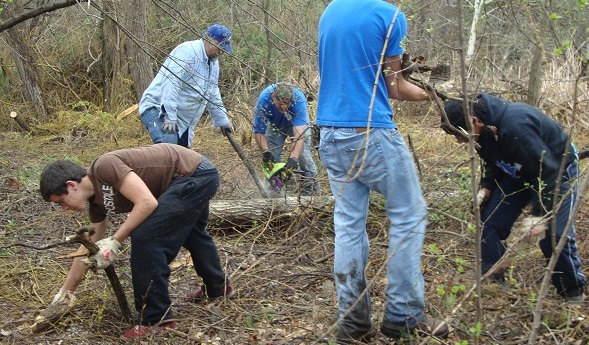
PHOTO: Members of the Adrian boys track & field team help clean up after a tornado in Dexter in 2012.