

2020 Class Honored Together, from Afar
By
Geoff Kimmerly
MHSAA.com senior editor
May 15, 2020
Ishpeming Westwood’s girls basketball team was two hours into a three-hour trip to its Division 3 Regional Final on March 12 when the Patriots were told to turn the bus around and come home.
In an instant, the 2019-20 school year – and with it all MHSAA sports across the state – had come to a halt. And two months later, the high school world and its sports community continue to wait for bits of normalcy to return.
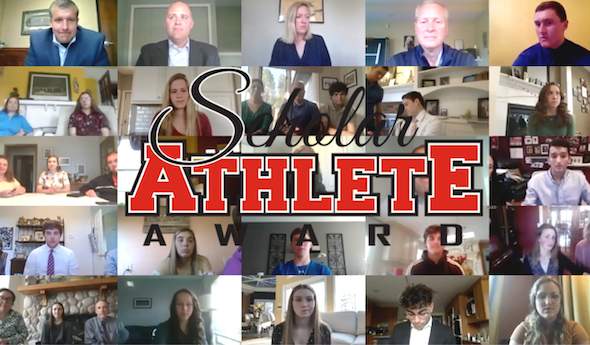
On Wednesday, we were able to enjoy a little bit of normal that’s been part of the annual MHSAA calendar for three decades. A Zoom call brought together 31 families from all over the state along with MHSAA staff and Farm Bureau Insurance CEO Don Simon to celebrate this year’s MHSAA/Farm Bureau Insurance Scholar-Athlete Award winners.
Living rooms, kitchens and home offices replaced Breslin Center as settings for this “virtual” ceremony. And yet, this ceremony may be remembered more than any other because of its necessity – due to the COVID-19 pandemic – and because of how it brought so many together, remotely, while the coronavirus has forced all of us to remain apart.
Below is the ceremony, in full, including words from Simon, MHSAA Executive Director Mark Uyl and Assistant Director Andy Frushour and, for the first time, a student speaker from the class – Ishpeming Westwood senior Madelyn Koski, who was part of that basketball team destined for Sault Ste. Marie. A brief Q&A with Koski follows.
Koski was an all-stater on the court who would’ve finished her high school career with four varsity letters each for hoops, tennis and softball. She will continue at Ferris State University, where she’ll pursue a degree in pharmacy and continue her basketball career.
Second Half: How did you decide what you wanted to say? Was there a message you wanted to get across?
It was easy to write the sad part, because I know what happened – I was there. But it was hard for me to make a positive spin at the end because I don’t think anyone’s over it yet. I was glad to be able to turn it into something that was bigger than sports … more about our whole lives and less about our time in high school.
Second Half: It’s been two months. How have you been navigating the disappointment, the sadness? And is there advice you’d give to other people your age trying to do it?
As time went on, it got a little bit better. The day after was pretty sad; that’s all I could think about. Now there’s so many other things to do – the weather’s nicer, we can go outside. And I’m playing college basketball – not everyone has that chance – but at least I have that to practice for, look forward to.
I guess, it’s just … time heals.
Second Half: Even though you can’t be with them and hang out with them, I’m sure you’re talking a lot of your friends and teammates. What kind of conversations are you having? Is it looking ahead? Is it still thinking about, “We’d be playing softball right now?"
I think we kinda tried to leave the basketball stuff in the past because it was too sad to talk about. We made sure we do talk, obviously not in person, but on social media or FaceTime, we just talk about our memories and everything. That helped. It didn’t close the chapter, but it was nice to talk to them when we were all alone. And now we just don’t talk about that anymore. Nobody really wants to talk about it. We see memories popping up on Facebook and all these other things about, “Oh, we had a softball game last year at this time.” And it’s pretty sad. But no one else is playing. So it’s like we’re all in the same boat.
 Second Half: You can turn on the news and you can see what every adult has to say about what’s going on right now. … You’re 17, you’re finishing your last year of high school, you’re going through something no one has gone through in more than 100 years. How do you see everything that’s happening in the world right now, as you look at it from a 17-year-old’s point of view and see seasons end and school end?
I know we can’t help what happened. But obviously I think it’s unfair that it happened to our class. It stinks for every grade, but (as seniors) we’re missing out on our best parts of high school right now and it’s pretty horrible. We’ve been waiting years for our senior proms and graduations, banquets and award ceremonies, like the MHSAA one. So that kinda stinks.
Ever since March 12, I’ve been staying optimistic. But I’m proved wrong every time because things just keep getting canceled and canceled. … (But) I’m a pretty optimistic person, so I still have some left.
Second Half: What happens next? What does your summer look like? What happens for people who are in your shoes?
I’ll keep working out, and one of the girls on my high school basketball team is going to play at Michigan Tech so (eventually) we can work out together. … I think the biggest thing to do this summer, that I think I’ll do, is appreciate time with my family. I have gotten to spend a lot of time with them. And then maybe once summer rolls around and we’re allowed to be in bigger groups, I’ll be able to be with people other than my mom and dad, like my grandparents and cousins and my aunts and uncles. … (My sister Jillian and I) have been playing the same varsity sports for the last couple of years, and she’s been really successful. It’s been fun to win all these championships and stuff with her.
Second Half: What do you think you’re going to remember from this in five years, 10 years, when people ask you what your experience was like?
I’m probably going to say it’s a pretty bad experience. I guess it was an eye-opener that life can change at any moment. That’s kind’ve it. It didn’t change in a good way.
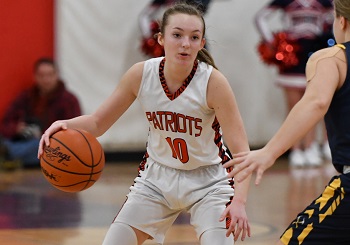
PHOTO: Westwood's Madelyn Koski sets up a play as Negaunee's Breanne Giotto defends her during their Jan. 24 game. (Photo by Cara Kamps.)

Rep Council Wrap-Up: Fall 2015
December 14, 2015
By Geoff Kimmerly
Second Half editor
Results of recent changes to health and safety policies and possibilities for future work to help keep school sports safe were main topics of discussion by the Representative Council of the Michigan High School Athletic Association during its annual Fall Meeting on Dec. 4 in East Lansing.
Generally, Council takes only a few actions during its Fall Meeting, with topics often introduced for additional consideration and actions during its meetings in winter and spring. The Council heard reports on a number of subjects, chiefly the “4 H’s” of health and safety – Health Histories, Heads, Heat and Hearts – and the MHSAA’s recent work on these topics.
Among data most noteworthy, it was reported that 747 of 750 member high schools complied with the first-time requirement this fall that all head coaches have a valid certification in CPR. Eighty percent of high schools arranged in-person CPR training for all of their high school varsity head coaches, and two-thirds of high schools included assistant and subvarsity coaches in school-arranged in-person training.
The Council reviewed the preliminary concussion care data released to the public Dec. 9, recent actions by U.S. Soccer to reduce heading in youth soccer, discussion in the girls lacrosse community regarding head protection and actions taken by other states and the National Federation of State High School Association regarding football practice policies and their similarities to changes adopted for MHSAA schools prior to the 2014 season. Council members also examined results from this fall’s Update Meeting opinion poll, including questions related to the possibility of using electronic forms to track students’ health histories and the possibility of practice limitations for all sports similar to those adopted for football.
As a result of the recent amendment of the MHSAA Constitution allowing for membership at the 6th-grade level, a number of potential changes to the MHSAA Handbook necessitated by the amendment were presented to the Council, as was a draft of an updated 2016-17 Membership Resolution. Both are expected to be voted on at the March meeting.
The Council also received reports on athletic-motivated and athletic-related transfers, reviewed an updated list of Approved International Student Programs for 2015-16 and discussed concerns regarding the exception to the Transfer Regulation for residential students of boarding schools.
Changes to out-of-season coaching rules were among the most significant efforts taken up by MHSAA staff over the last year, and Council members shared their observations of the impacts of changes including the rule change that allows a school coach to work with up to four athletes at one time instead of the previous three. The Council discussed if the MHSAA should consider a policy requiring in all sports athletes to participate in a minimum number of contests against school teams to be eligible for MHSAA tournaments, but declined to take action on the topic beyond policies already in place for skiing, ice hockey and soccer. Council members also were presented with examples of calendars for a balanced school year and possible movement of standardized testing dates, which both have the potential to affect the school sports calendar in the future.
The Council voted on one matter concerning MHSAA tournaments, approving a recommendation by the Girls Lacrosse Committee to not accept the new overtime rule of U.S. Women’s Lacrosse that grants in tournament play sudden victory to the first team that scores. The MHSAA will retain its current overtime procedure for tournament games, which calls for two full 3-minute halves of stop-clock overtime – and, if the game remains tied after those first two halves – additional 3-minute overtime periods with sudden victory.
The Fall Meeting also saw the addition of Courtney Hawkins, athletic director at Flint Beecher High School, to the 19-person Council. He was appointed to a two-year term and also serves as his school’s varsity football coach. He fills the position formerly held by Maureen Klocke, athletic director at Yale High School, whose term ended. Also, Cheri Meier, principal at Ionia Middle School, was re-appointed for a second two-year term.
The Council re-elected Scott Grimes, assistant superintendent of human services for Grand Haven Area Public Schools, as its president; Benton Harbor athletic director Fred Smith was re-elected vice president and Vic Michaels, director of physical education and athletics for the Archdiocese of Detroit, was re-elected secretary-treasurer.
The Representative Council is the legislative body of the MHSAA. All but five members are elected by member schools. Four members are appointed by the Council to facilitate representation of females and minorities, and the 19th position is occupied by the Superintendent of Public Instruction or designee.
The MHSAA is a private, not-for-profit corporation of voluntary membership by more than 1,400 public and private senior high schools and junior high/middle schools which exists to develop common rules for athletic eligibility and competition. No government funds or tax dollars support the MHSAA, which was the first such association nationally to not accept membership dues or tournament entry fees from schools. Member schools which enforce these rules are permitted to participate in MHSAA tournaments, which attract more than 1.4 million spectators each year.