


43 Percent of Athletes are Multi-Sport
August 19, 2019
By Geoff Kimmerly
Second Half editor
Nearly 43 percent of athletes at MHSAA member high schools continued to participate in two or more sports in 2018-19, according to the Multi-Sport Participation Survey, reinforcing similar data collected for the first time two years ago and providing a foundation for work by the MHSAA’s Multi-Sport Task Force as it prepares to continue efforts this fall to promote the multi-sport high school experience.
Early and intense sport specialization has become one of the most serious issues related to health and safety at all levels of youth sports, as overuse injuries and burnout among athletes have been tied to chronic injuries and health-related problems later in life. In early 2016, the MHSAA appointed the Task Force on Multi-Sport Participation as part of a continued effort to promote and protect participant health and address the issues leading to early sport specialization.
The multi-sport participation survey was created in 2018 to provide data on the prevalence of sport specialization at MHSAA member high schools. This year’s survey received responses from 82.9 percent of member high schools and measured how multi-sport participation exists at schools. The collection of survey results annually is expected to show how schools are succeeding in promoting a multi-sport high school experience, providing another tool as schools work to guide students toward a well-rounded interscholastic sports career.
From schools that responded to this year’s survey, 42.9 percent of students participated in athletics in 2018-19 – 46.3 percent of boys and 39.5 percent of girls. The overall participation number was up nearly half a percent from 2017-18 (42.5), with the boys percentage holding steady and the girls increasing nearly a full percent from a year ago. Class D schools – those with the smallest enrollments – again enjoyed the highest percentage of athletes among the entire student body, at 57.1 percent, followed by Class C (50.7), Class B (45.8) and Class A (39.4).
Of those athletes counted by responding schools, 43 percent participated in more than one sport – including 45.1 percent of boys and 40.4 percent of girls – with all three of those percentages nearly identical to those derived from the first survey a year ago. Class D again enjoyed the highest percentage of multi-sport athletes, 61.8 percent, followed by Class C (56.7), Class B (48.7) and Class A (35.4).
Similar results for overall sport participation and multi-sport participation relative to enrollment size were seen by further breaking down Class A into schools of fewer than 1,000 students, 1,000-1,500 students, 1,501-2,000 students and more than 2,000 students. Similarly to 2017-18 for both sport participation as a whole and multi-sport participation specifically, the smallest Class A schools continued to enjoy the highest percentages, while percentages then decreased for every larger size group of schools.
Also of note, the percentage of two-sport athletes at every school measure around one-third of athletes – from 29.2 percent at Class A schools to 35.7 at Class B, 37.2 at Class C and 35.6 at Class D. However the number of athletes participating in three sports decreased substantially relative to the increase in school enrollment, with 22.5 percent of Class D athletes playing three sports, 18.2 in Class C, 12.4 in Class B and 6.0 percent in Class A.
The MHSAA Task Force on Multi-Sport Participation will be meeting this fall to discuss creating a program to measure multi-sport participation at MHSAA member schools and to recognize “achievers” – that is, schools that surpass the norm given their enrollment and other factors that affect school sports participation.
For 2018-19, in Class A, Marquette posted the highest percentage of multi-sport athletes with 85.9 percent, up 3.3 percent from its top-ranking Class A percentage from 2017-18. Grand Rapids Northview also topped 80 percent multi-sport participation, with 83.1 percent of its athletes playing two or more sports. Orchard Lake St. Mary’s, Detroit East English and Gibraltar Carlson all saw multi-sport participation from at least 70 percent of their athletes.
In Class B, four schools again achieved at least 80 percent multi-sport participation – Coloma (87.2 percent), Gladstone (86.7), Flat Rock (83.2) and Dundee (80.2), while 10 schools had 70 percent or more athletes playing at least two sports.
Six Class C schools reported more than 80 percent of its athletes taking part in more than one sport – Schoolcraft (87.1), Mayville (86.2), Manton (85.3), Houghton Lake (84.9), Cass City (84.7) and Decatur (83.5) – and 12 schools total with 75 percent or more athletes participating in multiple sports. There were 14 Class D schools with multi-sport participation at 80.9 percent or higher, with Gaylord St. Mary (93.2), Waterford Our Lady of the Lakes (91.5) and Watersmeet (90.3) topping the survey not just for Class D but among all schools that responded.
The full summary report on the Multi-Sport Participation Survey is available on the “Health & Safety” page of the MHSAA Website.
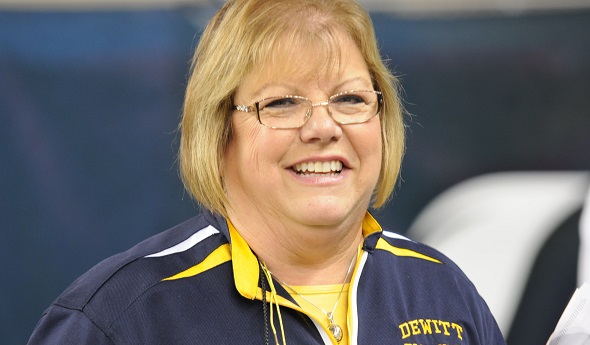
Honoree Leads from Behind the Scenes
January 28, 2014
By Geoff Kimmerly
Second Half editor
Off to the side somewhere, where athletic directors generally reside, Teri Reyburn often enjoys her favorite part of leading DeWitt’s athletic department – watching her school’s athletes shine.
As head of one of the Lansing area’s most successful programs, she has celebrated more often than not. But while her contributions to those successes usually fall outside of fanfare, they hardly go unappreciated by those who understand the inner workings of high school sports.
Reyburn's faithful support of her school and continuous service to Michigan High School Athletic Association programs will be celebrated Sunday, when she receives the MHSAA’s 27th Women In Sports Leadership Award during the WISL banquet at the Crowne Plaza Lansing West.
In addition to heading a department since 1999 that annually produces winning teams, Reyburn was a key voice in the creation and growth of the Capital Area Activities Conference a decade ago and has hosted more than 80 MHSAA tournaments at various levels in various sports.
“I absolutely love the kids. And I take a huge amount of pride in being able to put on and prepare an event, have hundreds or thousands walk in and sit down, enjoy themselves and walk out and leave not knowing the amount of work it took,” Reyburn said. “We have a large amount of volunteers who make that happen. I have some of the most amazing coaches, and the parents support their kids too. It doesn’t get any better than here, and I love what I do.”
Each year, the Representative Council considers the achievements of women coaches, officials and athletic administrators affiliated with the MHSAA who show exemplary leadership capabilities and positive contributions to athletics.
Both DeWitt’s girls and boys golf teams have won two MHSAA Finals championships apiece during her tenure. The football program has played in four Finals and both the boys basketball team and competitive cheer teams have finished MHSAA runners-up.
The Panthers girls basketball team has advanced to three MHSAA Semifinals, and the boys and girls soccer teams and baseball team have combined for five Semifinal appearances during her time guiding the program.
DeWitt has a strong athletic tradition going back decades. But there’s no question Reyburn has played her part well in continuing that legacy.
“DeWitt teams are always hard-working and always the model of good sportsmanship. Many people would assign the credit to the coaches for such behavior,” wrote Lansing Catholic athletic director Rich Kimball is recommending Reyburn for the WISL award. “Having been a coach, I know they deserve a lot of credit for how their teams perform and act, but without the leadership from the ‘boss’ those things don’t usually happen. Teri makes sure her program operates with class at all times.”
Her contributions to athletics off the field of play have been similarly significant, if also understated.
Since taking over the DeWitt program as interim athletic director in March 1999, and then fulltime that summer, Reyburn regularly has hosted five MHSAA tournaments per school year plus a total of more than 20 rules meetings and a number of clinics in coordination with statewide coaches and officials associations.
Reyburn, 59, also was among athletic directors who played a significant role in the formation of the CAAC, which combined schools from four leagues into one in 2003. She also was a leading voice in the formation of DeWitt High School’s Hall of Fame, which has inducted 35 athletes and nine teams since 2008.
Reyburn has spoken at WISL conferences on both the role of Title IX in high school athletics and “Tackling the Media Blitz” for young coaches and athletes. She has served on the WISL planning committee as well as on Scholar-Athlete Award, athletic equity, competitive cheer rules, site and officials selection committees.
“Teri Reyburn has provided nearly two decades of quiet, steady leadership in her school district and serves as a mentor for those who are following her in the athletic director role,” said John E. “Jack” Roberts, executive director of the MHSAA. “She’s a role model for not just women, but anyone who aspires to a career in educational athletics. We’re pleased to honor her with the Women In Sports Leadership Award.”
Reyburn graduated from Cedar Springs High School in 1972, the same year as the enactment of Title IX and the first MHSAA tournaments in girls sports. Her school offered three sports, and she played intramural volleyball and was a cheerleader. She also was a championship-caliber horseback rider during high school summers.
Soon after graduation, Reyburn married her high school sweetheart Kris (they will celebrate their 41st anniversary in November). Hers sons were born not long after – Mike, now a lieutenant colonel in the U.S. Army stationed in South Korea, and then D.J., who will begin his first fulltime season as a Major League Baseball umpire this spring.
Reyburn took college classes, worked as a study hall aide at Cedar Springs and later served on the Portland Public Schools board of education for 11 years before her family moved to DeWitt. She had intentions of earning a college degree, and discussed the possibility again after joining DeWitt schools a media specialist, middle school sports coordinator and assistant to the high school athletic director in 1994. But after five years in those roles, a sad circumstance led to her taking over the DeWitt program fulltime.
She was brought into athletics initially by previous director Jim Lutzke, who also worked in the human resources department and served as the Panthers boys basketball coach. He relied on Reyburn to coordinate middle school events and serve as a game manager for many at the high school.
Lutzke was diagnosed with cancer early in the 1998-99 school year, and Reyburn took on additional roles including game setup and equipment ordering. Lutzke died that March, and Reyburn and girls basketball coach Bill McCullen took over the high school athletic director duties on an interim basis. She was then hired as Lutzke’s successor for the following fall – and continues to employ lessons she learned under his mentoring.
“The biggest thing I got from Jim was just learning not to react quickly. To think, to understand a situation and know all of the facts before I do anything,” Reyburn said. “Jim was extremely good at that. He was even keel and level with everything he did.”
Reyburn also received plenty of tutelage and support from local athletic directors including longtime Haslett leader Jamie Gent, Williamston’s Jeff Lynch and then-Fowlerville athletic director Jack Wallace.
Now Reyburn is among those passing the knowledge forward. She’s one of the longest-serving athletic directors in the CAAC and was recognized as her region’s Athletic Director of the Year in 2006 by the Michigan Interscholastic Athletic Administrators Association.
“There are few, if any, athletic directors who are more capable, more organized or more in touch with high school sports than Teri,” Lansing Catholic’s Kimball also wrote. “Teri is the perfect person to win this award – passionate, smart, humorous, organized, but most of all an advocate for educational athletes.”
Past Women In Sports Leadership Award recipients
1990 – Carol Seavoy, L’Anse
1991 – Diane Laffey, Harper Woods
1992 – Patricia Ashby, Scotts
1993 – Jo Lake, Grosse Pointe
1994 – Brenda Gatlin, Detroit
1995 – Jane Bennett, Ann Arbor
1996 – Cheryl Amos-Helmicki, Huntington Woods
1997 – Delores L. Elswick, Detroit
1998 – Karen S. Leinaar, Delton
1999 – Kathy McGee, Flint
2000 – Pat Richardson, Grass Lake
2001 – Suzanne Martin, East Lansing
2002 – Susan Barthold, Kentwood
2003 – Nancy Clark, Flint
2004 – Kathy Vruggink Westdorp, Grand Rapids
2005 – Barbara Redding, Capac
2006 – Melanie Miller, Lansing
2007 – Jan Sander, Warren Woods
2008 – Jane Bos, Grand Rapids
2009 – Gail Ganakas, Flint; Deb VanKuiken, Holly
2010 – Gina Mazzolini, Lansing
2011 – Ellen Pugh, West Branch; Patti Tibaldi, Traverse City
2012 – Janet Gillette, Comstock Park
2013 – Barbara Beckett, Traverse City
PHOTO: DeWitt athletic director Teri Reyburn walks the Ford Field sideline before the Panthers Division 3 Final against Zeeland West this fall. (Click to see more at HighSchoolSportsScene.com.)