

'Always just a phone call away'
By
Geoff Kimmerly
MHSAA.com senior editor
March 30, 2012
By the time Charles Schwedler joined the Bullock Creek school district nearly 19 years ago, Bill Mick had moved on to other educational roles in the Midland area.
They had never worked together. They didn’t know each other from a previous experience. Schwedler, now his district’s Superintendent, had never worked with either of Mick’s children.
The only connection they shared was an interest in the success of Bullock Creek’s students.
“Bill has always been just a phone call away for anything that I have needed from the day I arrived in Bullock Creek,” Schwedler wrote in his letter of recommendation for this year’s MHSAA Charles B. Forsythe Award. “That may not sound all that unusual except for the fact that he really has never had a reason to help me. … Bill intuitively knew that if I succeeded, kids would have a better shot at succeeding. No hidden agenda; just what’s best for kids.”
 For more than four decades, Mick contributed to high school athletics as a coach, administrator and then mentor to those who followed him in those roles. That drive, which has continued after Mick’s official retirement from education, made him this year’s recipient of the MHSAA’s highest honor.
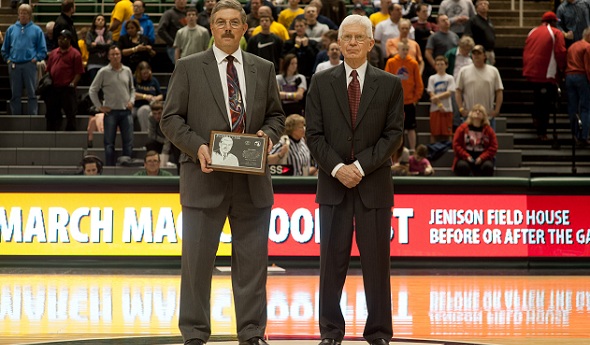
The Forsythe Award is in its 35th year and is named after former MHSAA Executive Director Charles E. Forsythe, the Association's first full-time and longest-serving chief executive. Forsythe Award recipients are selected each year by the MHSAA Representative Council, based on an individual's outstanding contribution to the interscholastic athletics community. Mick received the award during halftime of Saturday’s Class B Boys Basketball Final at Michigan State’s Breslin Center.
“I think it’s just being around athletic directors, particularly the new or younger athletic directors, that keeps the juices flowing, so to speak,” Mick said. “It goes both ways. I think I have experiences I can share with people that can help them. And it sounds trite, but it’s the truth: Their enthusiasm makes them flow faster.”
Mick began his career at Bullock Creek Public Schools from 1963-76, first as a science and physical education teacher and later as a counselor and Guidance Department head. He then moved to Midland Public Schools, serving as a counselor at Midland High and then Counseling Department Head at Midland Dow until becoming the district’s Coordinator of Health, Physical Education and Athletics from 1985-97. Mick finished his educational career as a part-time counselor at Midland’s Windover High School from 1997-2002 and then again at Bullock Creek High School from 2002-03.
Among his various contributions to athletics, Mick served on the MHSAA Representative Council for three years and in a number of roles with the Michigan Interscholastic Athletic Administrators Association (MIAAA) over 24 years. He coached cross country, track, football and basketball, and has served as an instructor in the MHSAA Coaches Advancement Program.
He remains part of the committee that organizes the MIAAA’s annual statewide conference, and also makes a trip to the MHSAA office once a year to assist in a conference for new athletic directors. He passes on lessons from the challenges he's faced over the years, with an eye on new ones that continue to crop up.
“The whole electronic media thing, things happen so much quicker. There is so much more with the Internet, and that’s probably the biggest change I can see since I got started,” Mick said. “(And) the role of the AD now is so much more complex, and we don’t see as many fulltime ADs. They have other responsibilities and obligations, so much on their plates – probably more than we had on our plates when we were ADs.”
Mick has received multiple honors from the MIAAA, including the State Award of Merit in 2002 and Distinguished Service Award in 2008. He also received the MHSAA’s Al Bush Award in 1998 for his many contributions to the association, and the Midland Area Community Foundation’s Lloyd Osborn Award in 1997 for his service to youth and athletics in that community. He was inducted into the Midland County Sports Hall of Fame in 1998.
Mick also was an MHSAA Track Finals meet manager for three years and served as executive secretary of the Mid-Michigan B league for five.
“Bill Mick contributed to high school athletics in a number of mentorship capacities during his career, and he remained engaged in that service after his retirement,” said MHSAA Executive Director John E. “Jack” Roberts. “Through his work with the MHSAA and MIAAA, Bill has provided valuable training to the next generation of leaders. We’re proud to honor Bill Mick with the Forsythe Award.”
A Tawas High School and Albion College graduate, Mick also received a master’s degree from Central Michigan University and did post-graduate work at Saginaw Valley State University.
His father and brothers all were superintendents and his mother was a teacher. His wife Mary Lou was an elementary school counselor for Midland Schools, and together they still attend a number of Battle Creek basketball games – where they now watch the children of those they taught, counseled and mentored.
They have two sons who are both doctors, one living in California and the other in Maine.
Past recipients of the Charles E. Forsythe Award are:
1978 - Brick Fowler, Port Huron; Paul Smarks, Warren
1979 - Earl Messner, Reed City; Howard Beatty, Saginaw
1980 - Max Carey, Freesoil
1981 - Steven Sluka, Grand Haven; Samuel Madden, Detroit
1982 - Ernest Buckholz, Mt. Clemens; T. Arthur Treloar, Petoskey
1983 - Leroy Dues, Detroit; Richard Maher, Sturgis
1984 - William Hart, Marquette; Donald Stamats, Caro
1985 - John Cotton, Farmington; Robert James, Warren
1986 - William Robinson, Detroit; Irving Soderland, Norway
1987 - Jack Streidl, Plainwell; Wayne Hellenga, Decatur
1988 - Jack Johnson, Dearborn; Alan Williams, North Adams
1989 - Walter Bazylewicz, Berkley; Dennis Kiley, Jackson
1990 - Webster Morrison, Pickford; Herbert Quade, Benton Harbor
1991 - Clifford Buckmaster, Petoskey; Donald Domke, Northville
1992 - William Maskill, Kalamazoo; Thomas G. McShannock, Muskegon
1993 - Roy A. Allen Jr., Detroit; John Duncan, Cedarville
1994 - Kermit Ambrose, Royal Oak
1995 - Bob Perry, Lowell
1996 - Charles H. Jones, Royal Oak
1997 - Michael A. Foster, Richland; Robert G. Grimes, Battle Creek
1998 - Lofton C. Greene, River Rouge; Joseph J. Todey, Essexville
1999 - Bernie Larson, Battle Creek
2000 - Blake Hagman, Kalamazoo; Jerry Cvengros, Escanaba
2001 - Norm Johnson, Bangor; George Lovich, Canton
2002 - John Fundukian, Novi
2003 - Ken Semelsberger, Port Huron
2004 – Marco Marcet, Frankenmuth
2005 – Jim Feldkamp, Troy
2006 – Dan McShannock, Midland; Dail Prucka, Monroe
2007 – Keith Eldred, Williamston; Tom Hickman, Spring Lake
2008 – Jamie Gent, Haslett; William Newkirk, Sanford-Meridian
2009 – Paul Ellinger, Cheboygan
2010 – Rudy Godefroidt, Hemlock; Mike Boyd, Waterford
2011 – Eric C. Federico, Trenton
PHOTO: Midland's Bill Mick (right) receives the Charles B. Forsythe Award from MHSAA Representative Council president James Derocher during halftime of the Class B Final.

Applications Available on MHSAA Website for 2023-24 Scholar-Athlete Awards
By
Geoff Kimmerly
MHSAA.com senior editor
October 25, 2023
One of the Michigan High School Athletic Association’s most popular programs, the Scholar-Athlete Award, will again with Farm Bureau Insurance present 32 $2,000 scholarships to top student-athletes at member high schools during the 2023-24 school year.
 The MHSAA/Farm Bureau Insurance Scholar-Athlete Award highlights the value extracurricular activities play in the total education of high school students, often improving their academic achievements in the process. The Scholar-Athlete Award is in its 35th year. Since the award’s inception in 1988-89, Farm Bureau Insurance has presented $1,024,000 in scholarships through this program.
The first 30 scholarships will be presented on a graduated basis across the MHSAA’s traditional class structure. From Class A schools, six boys and six girls will receive scholarships; from Class B schools, four boys and four girls; from Class C schools, three boys and three girls; and from Class D schools, two boys and two girls will be honored. The final two scholarships will be awarded at-large to minority recipients, regardless of school size. The scholarships may be used at the institution of higher learning the recipients attend during the first year at those colleges.
Applications from individual schools will be limited to the number of available scholarships in their enrollment class. Class A schools may submit the names of six boys and six girls, Class B schools may submit four boys and four girls, Class C may submit three boys and three girls and Class D may submit two boys and two girls.
Students applying for Scholar-Athlete Awards must be graduating during the 2023-24 school year, carrying an unrounded 3.5 (on a 4.0 scale) grade-point average and have won a varsity letter in a sport in which the MHSAA sponsors a postseason tournament: baseball, girls and boys basketball, girls and boys bowling, girls competitive cheer, girls and boys cross country, football, girls and boys golf, girls gymnastics, ice hockey, girls and boys lacrosse, girls and boys skiing, girls and boys soccer, softball, girls and boys swimming & diving, girls and boys tennis, girls and boys track & field, girls volleyball and wrestling.
Applicants will be required to show involvement in other school and community activities and submit an essay on the importance of sportsmanship in educational athletics.
Information – including answers to a number of frequently asked questions – and links to the application are available online on the Scholar-Athlete Award page. Applications are available in digital format only and must be submitted online by 4 p.m. Dec. 1.
A committee composed of school administrators from across the state will select finalists and winners in late January, with the winners to be announced throughout February. All applicants, finalists and scholarship recipients will be announced on the MHSAA Website. The 32 scholarship recipients will be recognized during the 2024 MHSAA Boys Basketball Finals at the Breslin Student Events Center in East Lansing.
Farm Bureau Insurance of Michigan was founded in 1949 by Michigan farmers who wanted an insurance company that worked as hard as they did. Those values still guide the company today and are a big reason why it is known as Michigan’s Insurance Company, dedicated to protecting the farms, families, and businesses of this great state. Farm Bureau Insurance agents across Michigan provide a full range of insurance services—life, home, auto, farm, business, retirement, Lake Estate®, and more— protecting more than 660,000 Michigan residents.
The MHSAA is a private, not-for-profit corporation of voluntary membership by more than 1,500 public and private senior high schools and junior high/middle schools which exists to develop common rules for athletic eligibility and competition. No government funds or tax dollars support the MHSAA, which was the first such association nationally to not accept membership dues or tournament entry fees from schools. Member schools which enforce these rules are permitted to participate in MHSAA tournaments, which attract more than 1.3 million spectators each year.