


Assistant Director Mazzolini to Retire
By
Geoff Kimmerly
MHSAA.com senior editor
November 23, 2015
Gina Mazzolini, a pioneering athlete, former high school and college coach, and one of the longest-serving current assistant directors for the Michigan High School Athletic Association, will retire from her post at the end of this school year, effective July 31, 2016.
 Mazzolini has served the MHSAA since 1993 and is the administrator for girls volleyball, swimming and diving, alpine skiing and tennis. She also handles the sanctioning of out-of-state competitions and serves as the MHSAA’s point person on foreign exchange and international student issues.
After standout basketball and volleyball careers at St. Johns High School and Central Michigan University, Mazzolini taught and coached multiple sports during the 1979-80 school year at Ovid-Elsie High School. She then spent two years teaching and serving as an assistant volleyball coach at Michigan State University, where she also earned her master’s degree in physical education. Mazzolini then left to teach and serve as assistant volleyball coach and interim women’s Sports Information Director at the University of Texas.
In 1982, Mazzolini became an activities director with the University Interscholastic League, the service organization to high school activities in Texas. She became an assistant athletic director at the UIL in 1988, and five years later she returned to Michigan as a member of the MHSAA staff.
Mazzolini will receive a Citation from the National Federation of State High School Associations next summer and was the 2010 recipient of the MHSAA’s Women in Sports Leadership Award. She has served on NFHS rules committees for soccer, swimming and diving, and volleyball (chairing that sport’s rules committee from 2004-08). She also has served on NFHS advisory committees for athletic directors and sports medicine.
“Gina’s accomplishments from her days as a pioneer on the court to those as administrator have truly been local, statewide, national and global,” MHSAA Executive Director John E. “Jack” Roberts said. “She has shaped the rules for the games in which our children compete and helped maintain not only a level playing field with her work with eligibility and foreign exchange rules, but a safe field with her national committee work in sports medicine.”
Mazzolini was named the first Female Athlete of the Year at St. Johns High School, graduating in 1974 after an accomplished career that included leading the Redwings to a District title in the first MHSAA Girls Basketball Tournament in 1973. She also played softball and ran track for her high school.
She went on to star in both basketball and volleyball at Central Michigan University; she graduated in 1978 as the leading scorer, rebounder and shot-blocker in CMU history and still ranks among the Chippewas’ leaders in multiple statistical categories – ninth in career field goal percentage (.496), tied for sixth in career rebounds (880), second in career rebounding average per game (10.5), fifth and sixth in season rebounding average per game (11.5 and 11.1) and tied for first for rebounds in one game (24). She was inducted into the CMU Athletic Hall of Fame in 1992.
In addition to her work at the MHSAA, Mazzolini has provided a long list of contributions at the national level. Along with those mentioned above, she has served as the NFHS representative on the board for the Council on Standards for International Educational Travel, which identifies, promotes and supports international youth exchange programs, and has sat on several CSIET committees. She’s currently serving on the NFHS Annual Meeting Planning Committee.
Vermontville Ace Joins NFHS Hall (Video)
August 15, 2016
By Geoff Kimmerly
Second Half editor
Michigan celebrated its eighth inductee to the National High School Sports Hall of Fame with the honoring of Vermontville baseball star Ken Beardslee during the annual National Federation of State High School Associations summer meeting, this summer in Reno, Nevada.
 Beardslee, who died in 2007, has been proclaimed as “prep baseball’s first ace” in the NFHS National High School Sports Record Book and was featured in the former print version of the book for his incredible feats from 1947-49. In his three years on the mound for Vermontville, Beardslee won 24 of his 25 starts (the team was 31-1 during that time). His 24 victories included eight no-hitters, with two perfect games, and seven one-hitters.
He set seven national records, and two still stand after 66 years: his per-game season strikeout mark of 19.0 and his per-game career strikeout mark of 18.1. He was drafted by the New York Yankees immediately after graduating from high school and pitched in the minor leagues from 1949 to 1956, when an injury ended his playing career. Beardslee went on to scout for the Pittsburgh Pirates for 21 years, and he received a World Series ring after the team’s championship win in 1971. He also went on to write eight books including novels, poetry and an instructional on pitching.
He was one of 12 individuals, including five athletes, inducted as part of this year’s class. His wife Marilene represented Beardslee in accepting the honor, and offered this as to the role high school athletics played in her husband’s life and career:
“My time with Ken was long after his high school days. I'm sure Ken's career gave him joy, happiness. It allowed him to accomplish goals. It opened doors; it opened doors to friendships throughout his life ... Terry Collins with the Mets, Doug Melvin (who) just this year stepped down with the Milwaukee Brewers. Those are things that high school opened doors for him.”
Beardslee was nominated for the NFHS Hall of Fame by the Michigan High School Athletic Association after years of research by Charlotte resident Terry Lowery. Lowery didn't have an immediate connection to Beardslee and only moved to Eaton County as an adult. But during a funeral for one of Beardslee’s high school teammates, Lowery heard the stories of the high school ace – and went to work building his application.
Below is the video produced by the NFHS that played during Beardslee’s portion of the induction ceremony and includes a touching interview with Marilene, who received Ken’s plaque from MHSAA assistant director Kathy Vruggink Westdorp.
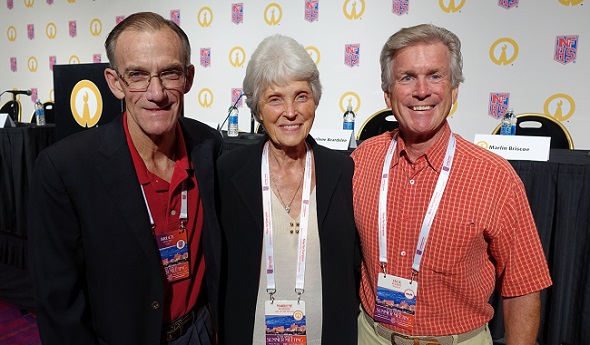
PHOTOS: (Top) Marilene Beardslee stands with the NFHS’s Bruce Howard (left) and MHSAA Executive Director Jack Roberts during the Hall of Fame festivities in Reno, Nev. (Middle) Ken Beardslee, during his high school days at Vermontville. (Top photo courtesy of Terry Lowery.)