

Athletes: Get Ready to Beat the Heat
August 2, 2019
By Geoff Kimmerly
Second Half editor
While this summer may have seemed to arrive late in many parts of Michigan, the warm and sunny weather over these last few weeks has provided another reminder that student-athletes must prepare for training in hot weather that traditionally accompanies the beginning of August as MHSAA member schools prepare to begin fall sports practices this month.
Each year, the MHSAA provides information to its member schools to help them prepare for hot weather practice and game conditions during the late summer and early fall. Practices for cross country, football, Lower Peninsula girls golf, boys soccer and Lower Peninsula boys and Upper Peninsula girls tennis can begin August 12, with volleyball and Lower Peninsula girls swimming & diving able to start August. 14.
The “Health & Safety” page of the MHSAA Website has a number of links to various publications and information including guidelines for acclimatization from the National Athletic Trainers’ Association and recommendations on proper hydration from the National Federation of State High School Associations (NFHS). The preseason publication Heat Ways also is available for download and includes valuable information on heat management in addition to requirements and resources regarding head injuries and sudden cardiac arrest.
The first days of formal practices in hot weather should be more for heat acclimatization than the conditioning of athletes, and practices in such conditions need planning to become longer and more strenuous over a gradual progression of time. Schools also must consider moving practices to different locations or different times of day, or change practice plans to include different activities depending on the conditions. Furthermore, football practice rules allow for only helmets to be worn during the first two days, only shoulder pads to be added on the third and fourth days, and full pads to not be worn until the fifth day of team practice.
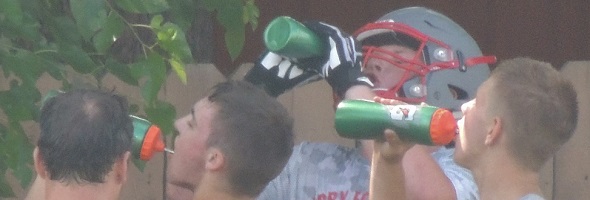
The MHSAA advises student-athletes to make sure to hydrate all day long – beginning before practice, continuing during and also after practice is done. Water and properly-formulated sports drinks are the best choices for hydration, while energy drinks, high-carbohydrate fruit juices (greater than eight percent carb content), carbonated and caffeinated beverages are among those that should be avoided.
A number of member schools follow the MHSAA’s Model Policy for Managing Heat & Humidity, which while not mandated for member schools was adopted as a rule for MHSAA postseason competition in 2013. The plan directs schools to begin monitoring the heat index at the activity site once the air temperature reaches 80 degrees, and provides recommendations when the heat index reaches certain points, including ceasing activities when it rises above 104 degrees. (When the temperature is below 80 degrees, there is no combination of heat and humidity that will result in a need to curtail activity.) The model heat & humidity policy is outlined in a number of places on the MHSAA Website, including as part of Heat Ways.
MHSAA Connecting at Junior High Level
By
Geoff Kimmerly
MHSAA.com senior editor
June 6, 2017
By Geoff Kimmerly
Second Half editor
Signs and banners were displayed at stadiums. Announcements were made to the crowd.
And most of all, questions were answered concerning the current role of the Michigan High School Athletic Association in junior high/middle school athletics – and the increased role the Association would like to take on in the future.
Throughout May, the MHSAA served as presenting sponsor at junior high/middle school track & field meets at Ravenna, Harrison, Grand Blanc and Saginaw White Pine Middle School.
This sponsorship pilot program was a first step on the path to making stronger connections with student-athletes before they reach high school. The MHSAA provided meet management with banners and other signage to hang at the events, and public address announcements on sportsmanship, multi-sport participation, officials recruitment and other notable topics affecting competitors and their families.
Also made available were printed materials on sportsmanship, officials recruitment and the benefits of taking part in junior high/middle school sports. And as part of the opportunity, the MHSAA donated grants of $500 to help with the administration of those meets – again, all in the name of getting the MHSAA message in front of students years before they reach high school.
“I couldn’t believe how many people did not realize middle schools were connected to the MHSAA. That in itself was huge for publicity,” said Damon Amey, athletic director at White Pine. “I feel that if they know we are members, they immediately know we follow a set of rules. We are student-first oriented.”
The MHSAA served 740 junior high/middle school members, plus 24 elementary schools with 6th graders participating, during the 2016-17 school year – up from 705 junior high/middle schools only a year before.
Junior high/middle schools long have been eligible for membership in the MHSAA. An entire section of the MHSAA Handbook is dedicated to them. But the Association also has turned a heavier focus toward that level over the last four years.
The MHSAA Representative Council approved the creation of a Junior High/Middle School Task Force during its December 2013 meeting, and that task force was instrumental in the addition of 6th grader participation this past school year and the lengthening of contests in some sports. The Council this spring approved a recommendation by the Junior High/Middle School Committee (a permanent committee separate from the task force) urging all MHSAA sport committees to consider opportunities to add more games and dates to middle school schedules.
Last month’s sponsorship pilot program also stemmed from this recent work.
“We need to, for the future of high school sports, get more involved at the junior high/middle school level,” said MHSAA assistant director Cody Inglis, who oversees the Junior High/Middle School Committee and led the task force. “It’s not a matter of should we, but how quickly can we get involved.”
Inglis served as something of an ambassador in setting up and attending multiple sponsored junior high/middle school meets. Because of the perception that the MHSAA is mostly associated with high school athletics, Inglis noticed some curious and questioning looks in response to the visible presence of the Association at those meets.
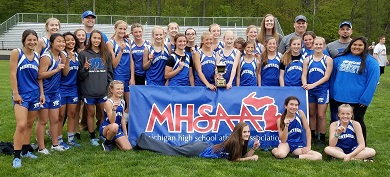 But there were more positives, by far. On multiple occasions, the winners of the meets asked to have their team photos taken with the MHSAA banner on the field. One team took individual photos of each athlete holding the trophy in front of the banner as well.
While not many, Inglis did have conversations about officiating with a handful of interested people – good news as the MHSAA is always in pursuit of adding to those numbers. And his presence gave fans an opportunity to ask about the MHSAA’s role both at the high school and junior high/middle school level – and gave him the opportunity to explain how the Association works and dispel some myths.
“I love the fact that the MHSAA was at our conference track meet,” Montague NBC Middle School athletic director Jay Mulder said. “Cody did a great job in talking with parents, athletes and coaches. The presence was just enough to get people to take notice of the MHSAA.
“As a middle school AD and a middle school coach, I am very encouraged and excited to see the active role that the MHSAA is taking with middle school sports. I think that it bodes well for the future.”
Amey noted a number of opportunities with printed materials and championship medals that could further promote the MHSAA’s messaging at junior high/middle school meets. Also part of future plans is the recruitment of regional “ambassadors” – retired coaches, athletic directors and officials would be among candidates – who will travel to junior highs and middle schools in their areas and grow connections at that level.
As members, junior highs and middle schools receive the structure and support of MHSAA rules and governance, and every athlete receives catastrophic and concussion care insurance managed by the MHSAA. More interaction by these ambassadors could lead to more membership – the meet at White Pine, for example, included nearly half non-MHSAA schools – and also more benefit to members, be it additional sponsorship, off-field programs or even MHSAA-created championship events to give those athletes more opportunities to shine at this lower level and as they work toward taking that big step to high school.
“It’s been like a light bulb has gone off,” Inglis said. “The brand of the MHSAA is viewed as a high school-only brand, and it was humbling to see the power in that brand as people look to the ultimate goal.
“However we can parlay that into more of a presence and use that brand to get involved in school sports at the younger levels, that helps in that transition.”
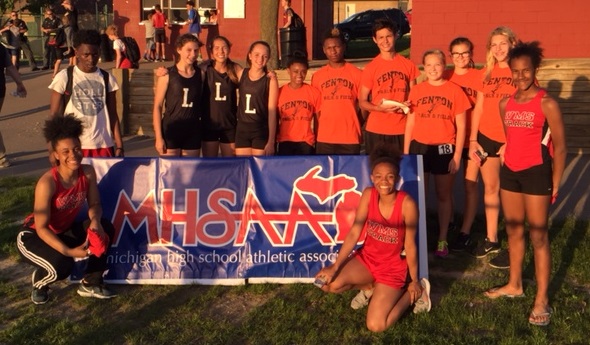
PHOTOS: (Top) Students from Grand Blanc West Middle School, Fenton Schmidt Middle School and Linden Middle School stand together with an MHSAA banner during the Flint Metro League meet last month. (Middle) The Montague NBC Middle School girls track & field team poses with a banner after winning the West Michigan Conference championship. (Photos courtesy of the Grand Blanc and Montague schools’ athletic departments.)