

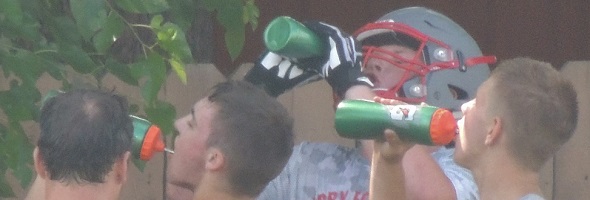
Athletes: Get Ready to Beat the Heat
August 2, 2019
By Geoff Kimmerly
Second Half editor
While this summer may have seemed to arrive late in many parts of Michigan, the warm and sunny weather over these last few weeks has provided another reminder that student-athletes must prepare for training in hot weather that traditionally accompanies the beginning of August as MHSAA member schools prepare to begin fall sports practices this month.
Each year, the MHSAA provides information to its member schools to help them prepare for hot weather practice and game conditions during the late summer and early fall. Practices for cross country, football, Lower Peninsula girls golf, boys soccer and Lower Peninsula boys and Upper Peninsula girls tennis can begin August 12, with volleyball and Lower Peninsula girls swimming & diving able to start August. 14.
The “Health & Safety” page of the MHSAA Website has a number of links to various publications and information including guidelines for acclimatization from the National Athletic Trainers’ Association and recommendations on proper hydration from the National Federation of State High School Associations (NFHS). The preseason publication Heat Ways also is available for download and includes valuable information on heat management in addition to requirements and resources regarding head injuries and sudden cardiac arrest.
The first days of formal practices in hot weather should be more for heat acclimatization than the conditioning of athletes, and practices in such conditions need planning to become longer and more strenuous over a gradual progression of time. Schools also must consider moving practices to different locations or different times of day, or change practice plans to include different activities depending on the conditions. Furthermore, football practice rules allow for only helmets to be worn during the first two days, only shoulder pads to be added on the third and fourth days, and full pads to not be worn until the fifth day of team practice.
The MHSAA advises student-athletes to make sure to hydrate all day long – beginning before practice, continuing during and also after practice is done. Water and properly-formulated sports drinks are the best choices for hydration, while energy drinks, high-carbohydrate fruit juices (greater than eight percent carb content), carbonated and caffeinated beverages are among those that should be avoided.
A number of member schools follow the MHSAA’s Model Policy for Managing Heat & Humidity, which while not mandated for member schools was adopted as a rule for MHSAA postseason competition in 2013. The plan directs schools to begin monitoring the heat index at the activity site once the air temperature reaches 80 degrees, and provides recommendations when the heat index reaches certain points, including ceasing activities when it rises above 104 degrees. (When the temperature is below 80 degrees, there is no combination of heat and humidity that will result in a need to curtail activity.) The model heat & humidity policy is outlined in a number of places on the MHSAA Website, including as part of Heat Ways.

Rate of MHSAA High Schools Charging Participation Fees Falls to Lowest in 22 Years
By
Geoff Kimmerly
MHSAA.com senior editor
August 5, 2026
The annual Michigan High School Athletic Association participation fee survey completed for the 2025-26 school year continued to confirm the positive direction that has emerged this decade as the rate of member high schools charging student-athletes to play sports fell to its lowest in more than two decades.
Of the 703 MHSAA member schools (93 percent of membership) which responded to the most recent survey, only 38 percent (270 schools) charged participation fees in 2025-26 – a drop of two percent from the year prior and the lowest percentage since 34.5 percent of member schools reported charging a fee for the 2004-05 school year. Over the two decades between, the rate of high schools charging participation fees reached a high of 57 percent in 2013-14. Rates consistently have measured in the low 40s after the COVID-19 pandemic.
The MHSAA began conducting the participation fee survey with the 2003-04 school year. For the purposes of the survey, a participation fee is anything $20 or more regardless of what the school called the charge – registration fee, athletic fee, etc.
All four school-size classifications also saw rate decreases, with Class A schools leading the way with 46 percent charging fees – which was still a reduction of seven percent from 2024-25. Class B was down slightly to 39 percent charging for participation, while Class C schools were down six points to 28 percent charging and Class D schools were down four points also to 28 percent.
A standardized fee for each team on which a student-athlete participates – regardless of the number of teams – has remained the norm over the history of the MHSAA’s survey, and for the second-straight year 43 percent of schools charging a fee did so in this way during 2025-26. That was followed by 33 percent of responding schools charging a one-time standardized fee and 13 percent assessing fees based on tiers of the number of sports a student-athlete plays (for example, charging a larger fee for the first team and less for additional sports).
For 2025-26, the median maximum amount a school charged per student-athlete for the school year was $150, and the median annual maximum charged per family was $350. For schools charging student-athletes a one-time fee to cover all sports played, the median was $125. For schools charging a fee per sport, the median was $80 for each team.
The survey for 2025-26 and surveys from previous years can be found on the Pay-To-Play Survey page (direct link to this year’s results).
The MHSAA is a private, not-for-profit corporation of voluntary membership by more than 1,500 public and private senior high schools and junior high/middle schools which exists to develop common rules for athletic eligibility and competition. No government funds or tax dollars support the MHSAA, which was the first such association nationally to not accept membership dues or tournament entry fees from schools. Member schools which enforce these rules are permitted to participate in MHSAA tournaments, which attract more than 1.3 million spectators each year.