

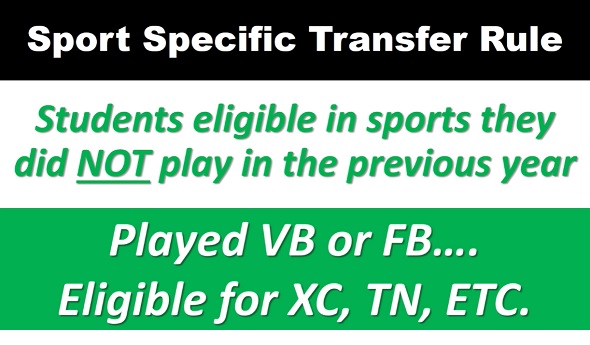
Brush Up on the New Transfer Rule
July 18, 2019
By Rob Kaminski
MHSAA benchmarks editor
Eligibility under the new “sport-specific” transfer rule begins this coming fall after circulating extensively for nearly one school year.
Unless one of the stated 15 exceptions is met, participation during the 2018-19 school year determines eligibility for 2019-20.
The new rule adopted by the Representative Council at its May 2018 meeting has found support among most audiences. A transfer student’s eligibility in 2019-20 is based upon that student’s participation from this past school year (2018-19). It will be paramount for administrators and coaches to have awareness of the sports a transfer student participated in during the previous school year.
The long-standing 15 Exceptions to immediate eligibility, such as a full and complete residential change or a student moving between divorced parents by completing of an Educational Transfer Form, did not change.
One might call the rule on the way out “The Fourth-Friday Transfer Rule.” Under this old rule, when a student enrolled at the new school determined his or her eligibility. Under the new Sport Specific Transfer rule, what a student played in the previous season determines eligibility.
The Council passed a more lenient rule on the one hand and more restrictive on the other. The more lenient aspect is a change that finds a transfer student ELIGIBLE in any sport in which he or she did not participate in a game or a scrimmage in the previous school year.
The more restrictive portion tends to discourage students who change schools for sports reasons. A transfer student who did play a sport in the previous season – and who does not meet one of the 15 Exceptions – is NOT ELIGIBLE in that sport for the next season. If a student changes schools in mid-season, the student would be ineligible for the rest of that season in that sport and the next season for that sport.
Participation under this and other rules means playing in an interscholastic game or scrimmage after starting the 9th grade at any high school. It does not mean practice, but entering an interscholastic game, meet or scrimmage in any way. It also may involve more than one sport, so a three-sport athlete who does not have a residential change and transfers would be ineligible in those sports during the next school year – but eligible for any other sport. It also means a student cut from a team – one who never entered a scrimmage or game – may transfer and play without delay for that new school’s team. It may also mean that a student who meets one of the stated exceptions such as a residential change but enrolls in a school other than her or his school of residence, would have eligibility in sports not played in the previous year.
The new rule will tend to discourage students from changing schools for sports because they would be ineligible in any sport they have played in school the previous season for that sport. It will increase participation for some students who were otherwise not eligible under the current rule.
It is always best to contact school athletic directors who can connect with the MHSAA to verify eligibility prior to enrollment.
If the student’s new school requests in writing, the MHSAA Executive Committee may approve a waiver that reduces the period of ineligibility to 90 scheduled school days at the new school if the change of schools was for compelling reasons demonstrated with outside documentation having nothing to do with sports, curriculum, finances, and school demographics. The Executives Committee also has authority to approve immediate eligibility.

MHSAA 2023-24 School Year Classifications Announced
By
Geoff Kimmerly
MHSAA.com senior editor
April 6, 2023
Classifications for Michigan High School Athletic Association elections and postseason tournaments for the 2023-24 school year have been announced, with enrollment breaks for postseason tournaments posted to each sport’s page on the MHSAA Website.
Classifications for the upcoming school year are based on a second semester count date, which for MHSAA purposes was Feb. 8. The enrollment figure submitted for athletic classification purposes may be different from the count submitted for school aid purposes, as it does not include students ineligible for athletic competition because they reached their 19th birthday prior to Sept. 1 of the current school year and will not include alternative education students if none are allowed athletic eligibility by the local school district.
All sports’ tournaments are conducted with schools assigned to equal or nearly equal divisions, with lines dependent on how many schools participate in those respective sports.
For 2023-24, there are 750 tournament-qualified member schools. Schools recently were notified of their classification, and sport-by-sport divisions were posted to the MHSAA Website today (April 6). MHSAA Executive Director Mark Uyl said schools may not subsequently lower their enrollment figure. However, if revised enrollment figures are higher and indicate that a school should be playing in a higher division, that school would be moved up.
Five MHSAA Finals champions awarded so far during the 2022-23 school year are assigned to different divisions for 2023-24. Division 6 champion Grand Rapids West Catholic will play 11-player football in Division 5 this upcoming season. The Holland Christian boys soccer team will be moving into Division 2 after winning the Division 3 Final in the fall, and East Grand Rapids’ girls swimming & diving program is headed back to Lower Peninsula Division 3 after winning in LP Division 2 this past season. A pair of cross country champions are on the move – LP Division 4 boys champion Wyoming Potter’s House Christian to LP Division 3, and Upper Peninsula Division 3 girls champion Munising into UP Division 2 – and the Grass Lake boys bowling team will compete in Division 3 next winter after winning the Division 4 championship last month.
Also set to change divisions among Finals runners-up from head-to-head sports are Cadillac volleyball (Division 2 to D1), Ann Arbor Greenhills boys soccer (Division 4 to D3), Mendon 8-player football (Division 2 to D1) and three 11-Player Finals runners-up – Caledonia (Division 1 to D2), Grand Rapids Forest Hills Central (Division 2 to D3) and Muskegon (Division 3 to D2).
Visit the respective sport pages on the MHSAA Website to review the divisional alignments for all MHSAA-sponsored tournament sports. Click the “SPORTS” menu above to access the page for each sport, then the “Assignments” link on the selected sport page and then “DIVISION LIST” to see the 2023-24 division.
Traditional classes (A, B, C, D) – formerly used to establish tournament classifications – are used only for MHSAA elections. To determine traditional classifications, after all counts are submitted, tournament-qualified member schools are ranked according to enrollment and then split as closely into quarters as possible. For 2023-24, there are 187 member schools in Class A, Class B and Class C, and 189 member schools in Class D.
Effective with the 2023-24 school year, schools with 807 or more students are in Class A. The enrollment limits for Class B are 380-806, Class C is 177-379, and schools with enrollments of 176 and fewer are Class D. The break between Classes A and B decreased eight students from 2022-23, the break between Classes B and C decreased 11 students, and the break between Classes C and D is six students fewer than for the 2022-23 school year.
The new classification breaks will see 21 schools move up in Class for 2023-24 while 24 schools will move down:
Moving Up from Class B to Class A
Bay City John Glenn
Fowlerville
Garden City
Lansing Eastern
Orchard Lake St. Mary’s
Tecumseh
Moving Down from Class A to Class B
Detroit Henry Ford
Detroit Mumford
Harper Woods
Plainwell
Sault Ste. Marie
Spring Lake
Moving Up from Class C to Class B
Ann Arbor Greenhills
Grand Rapids Covenant Christian
Hartford
Ishpeming Westwood
Kent City
Mason County Central
Pinconning
Moving Down from Class B to Class C
Blissfield
Clawson
Clinton Township Clintondale
Detroit Northwestern
Elk Rapids
Fennville
Sanford Meridian
Stockbridge
Moving Up from Class D to Class C
Auburn Hills Oakland Christian
Benton Harbor Countryside Academy
Detroit Crocket Midtown Science & Medicine
Grand Traverse Academy
Martin
Munising
Rudyard
Saginaw Michigan Lutheran Seminary
Moving Down from Class C to Class D
Eau Claire
Fowler
Jackson Prep
L’Anse
Marcellus
Merrill
Mesick
Morenci
Muskegon Heights Academy
St. Ignace
New Postseason-Eligible Tournament Schools in 2023-24
Waterford Oakside Prep
Enrollment Breaks by Classes – 2023-24
(Number of schools in parentheses)
Class A: 807 and above (187 schools)
Class B: 380 – 806 (187)
Class C: 177 – 379 (187)
Class D: 176 and below (189)