

Brush Up on the New Transfer Rule
July 18, 2019
By Rob Kaminski
MHSAA benchmarks editor
Eligibility under the new “sport-specific” transfer rule begins this coming fall after circulating extensively for nearly one school year.
Unless one of the stated 15 exceptions is met, participation during the 2018-19 school year determines eligibility for 2019-20.
The new rule adopted by the Representative Council at its May 2018 meeting has found support among most audiences. A transfer student’s eligibility in 2019-20 is based upon that student’s participation from this past school year (2018-19). It will be paramount for administrators and coaches to have awareness of the sports a transfer student participated in during the previous school year.
The long-standing 15 Exceptions to immediate eligibility, such as a full and complete residential change or a student moving between divorced parents by completing of an Educational Transfer Form, did not change.
One might call the rule on the way out “The Fourth-Friday Transfer Rule.” Under this old rule, when a student enrolled at the new school determined his or her eligibility. Under the new Sport Specific Transfer rule, what a student played in the previous season determines eligibility.
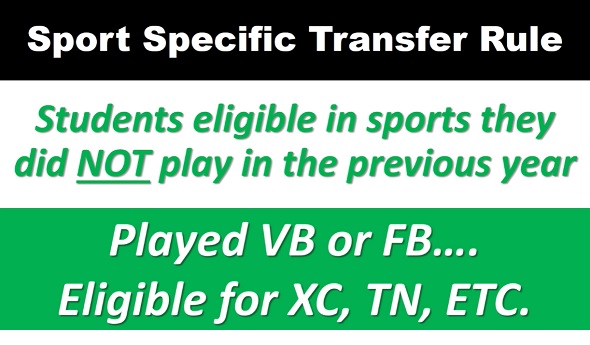
The Council passed a more lenient rule on the one hand and more restrictive on the other. The more lenient aspect is a change that finds a transfer student ELIGIBLE in any sport in which he or she did not participate in a game or a scrimmage in the previous school year.
The more restrictive portion tends to discourage students who change schools for sports reasons. A transfer student who did play a sport in the previous season – and who does not meet one of the 15 Exceptions – is NOT ELIGIBLE in that sport for the next season. If a student changes schools in mid-season, the student would be ineligible for the rest of that season in that sport and the next season for that sport.
Participation under this and other rules means playing in an interscholastic game or scrimmage after starting the 9th grade at any high school. It does not mean practice, but entering an interscholastic game, meet or scrimmage in any way. It also may involve more than one sport, so a three-sport athlete who does not have a residential change and transfers would be ineligible in those sports during the next school year – but eligible for any other sport. It also means a student cut from a team – one who never entered a scrimmage or game – may transfer and play without delay for that new school’s team. It may also mean that a student who meets one of the stated exceptions such as a residential change but enrolls in a school other than her or his school of residence, would have eligibility in sports not played in the previous year.
The new rule will tend to discourage students from changing schools for sports because they would be ineligible in any sport they have played in school the previous season for that sport. It will increase participation for some students who were otherwise not eligible under the current rule.
It is always best to contact school athletic directors who can connect with the MHSAA to verify eligibility prior to enrollment.
If the student’s new school requests in writing, the MHSAA Executive Committee may approve a waiver that reduces the period of ineligibility to 90 scheduled school days at the new school if the change of schools was for compelling reasons demonstrated with outside documentation having nothing to do with sports, curriculum, finances, and school demographics. The Executives Committee also has authority to approve immediate eligibility.

MHSAA's Westdorp Recognized by NFHS
January 15, 2013
Michigan High School Athletic Association assistant director Kathy Vruggink Westdorp has been named 2013 Coach Educator of the Year by the National Federation of State High School Associations (NFHS).
Westdorp developed and continues to direct the MHSAA Coaches Advancement Program (CAP), a six-level educational regimen that aids coaches in their growth and development as they advance in the field of educational athletics.
 Nearly 5,800 coaches have completed at least the first-level CAP unit since the program’s inception during the 2004-05 school year. More than 1,000 coaches have advanced at least through the program’s fourth level.
A former principal, athletic director, teacher and coach in the Grand Rapids area, Westdorp oversees the program and personally presents many of the CAP units.
“Kathy Westdorp is the heart and soul of our coaches education efforts,” said John E. “Jack” Roberts, executive director of the MHSAA. “She is very deserving of this recognition.”
Delivery to Michigan’s current and prospective interscholastic coaches is done in two ways. First, presenters trained and evaluated by Westdorp travel the state to provide programs, which are coordinated by schools, school districts, leagues and coaches associations. Or, after faculty training and with Westdorp’s regular evaluation, colleges and universities in Michigan are licensed to present up to five levels of CAP through their undergraduate or graduate studies.
All aspects of CAP are administered from the MHSAA office under Westdorp’s direction. This includes the arrangements for continuing education credits through the State Department of Education, as well as liability insurance and an online newsletter for all coaches who complete CAP units.
Westdorp joined the MHSAA in 2004 after serving as principal at Grand Rapids Forest Hills Central High School. She also previously served as athletic director at Grand Rapids Creston and as director of health and wellness programs for Grand Rapids Public Schools, taught at Grand Rapids Central and has coached basketball, field hockey, gymnastics, track and field and volleyball. Westdorp is a past president of the Ottawa-Kent Conference and a past recipient of the MHSAA’s Women in Sports Leadership Award.
The NFHS Coach Educator Award is presented annually to an individual who has exemplified passion and leadership for the promotion of coach education at the local, state and national levels. Nominations are considered by the NFHS Coach Education Committee, and the recipient is approved by the NFHS Board of Directors.