

Clinic to Serve Voices of Our Communities
December 20, 2017
By Geoff Kimmerly
Second Half editor
Roger Smith was a senior at Lake Orion High School in 1993-94 when he got his first public address announcing opportunity, filling in for varsity boys basketball games after the longtime announcer decided to take a season off.
Tony Coggins was only a freshman when he grabbed the microphone for the first time – getting that chance when his dad, Flushing athletic director Dale Coggins, couldn’t find anyone else to announce middle school football games.
Steve Miller actually started as a game official during his senior year of high school at East Detroit, and is a college football official today – but with the PA bug keeping him in that part of the game as well.
All three have similar getting-started stories – they jumped in with little to no experience but with both feet, found mentors to emulate (including one in common, longtime MHSAA and Michigan State University voice Erik O. Furseth), and honed their craft over decades on their ways to becoming mainstays in their communities and regulars at MHSAA Finals in multiple sports.
Miller, Coggins and Smith will share those experiences and wisdom as instructors at the MHSAA’s Public Address Announcers Clinic on Jan. 6 at the MHSAA Office in East Lansing. The day will provide an opportunity not just for training, but for announcers statewide to come together and discuss the key contribution they make to high school sports all over our state.
“I don’t claim to be an expert, but I’ve done it enough years now too that I’ve had emergency situations and really odd requests,” Smith said. “I’m the only football announcer here (at Lake Orion), and I never get to get with my fellow colleagues. So it’s nice to have that network, to know there are other people out there who do it, and to learn from others and to see mistakes that I probably still am making and how to get better and situations I haven’t thought about.”
The clinic will use a curriculum developed by the National Association of Sports Public Address Announcers and focus on the role of the public address announcer, public address announcing expectations (school, state association and NASPAA), public address announcing philosophy, sportsmanship/NASPAA Code of Conduct, announcing Do's and Don'ts, scriptwriting and handling emergency situations.
Registration is limited to 75 attendees, but spots are available. Click for the registration form.
“The public address announcer helps set the tone for educational athletic events,” said John Johnson, MHSAA Director of Broadcast Properties. “At the high school level, we expect our announcers to inform everyone of what’s happening – not to entertain them – and to be a welcoming and reassuring presence. This clinic provides information they can’t get anywhere else.”
Miller initially hoped to work in sports television growing up, then switched lanes to education. He teaches mathematics and applied technology at Harrison Township L’Anse Creuse, where he started doing PA in 1999 for girls basketball games.
 Coggins’ middle school football debut came in 1985, and 33 years later he’s going strong. Now in his 18th year announcing where he teaches at Holly, Coggins lends his voice to football, basketball, baseball, softball, volleyball, competitive cheer and swimming & diving events. Smith is in his 17th year back at his alma mater, where he teaches broadcasting. He primarily announces football and basketball although he’s helped with baseball, softball and swimming as well, using the opportunity to practice what he preaches to his students in the classroom.
“I have zero athletic ability whatsoever, which is interesting because my father was an all-state running back. But I enjoy being involved, and I've always been the one for history and statistics and knowing what's going on,” Coggins said. “This is a way for me to be involved. It's a way for me to use a talent I've been given; public speaking has always come pretty naturally for me.
“So I worked at my craft to get better. I got better from watching the people around me, from studying the people I like, and the people – if I saw someone I didn’t care for – I'd make a note and say to myself, ‘Don't do that.’ I take feedback from people very personally, and I mean that in a good way. If somebody takes the time to come up and say ‘You did this well; I think you should change this,’ that means they care about the program also. We all have the same goal in mind, and that's to make the experience good for the high school student and the parents, the fans, that come there.”
Miller began learning his craft by attending MHSAA championship events and paying special attention to Furseth, the longtime and legendary voice of Football and Basketball Finals. Nearly two decades after getting his start, Miller also is the voice of University of Michigan men’s and women’s lacrosse and has announced MHSAA Finals in multiple sports since 2005.
In 2012, he officiated the Division 1 Football Final at Ford Field, then moved to the press deck to announce the Division 3 Final that night.
“There are a lot of great examples of how to do this at this level, and also not great examples,” Miller said. “The biggest issue is just doing it the right way and knowing what’s expected at our level – being the informational voice instead of the cheerleader. I was fortunate; I took the lead from guys like Eric who knew that was what was expected. And it just wasn’t my personality or my style to start yelling and screaming.”
The conference registration fee of $75 includes the NASPAA’s second edition of “The Voice Above The Crowd” – the official public address announcing manual for amateur sports – plus a one-year membership in the NASPAA and lunch.
All three instructors are members of the NASPAA and continue to announce MHSAA Finals in football, basketball, baseball and softball.
“I’m super honored to be involved in those kinds of events, to be able to provide a soundtrack to some of the biggest moments in people’s lives,” Miller said. “Knowing I’m providing a service is big for me, and it’s kinda neat being the invisible voice … the invisible soundtrack that helps make the experience special for them.”
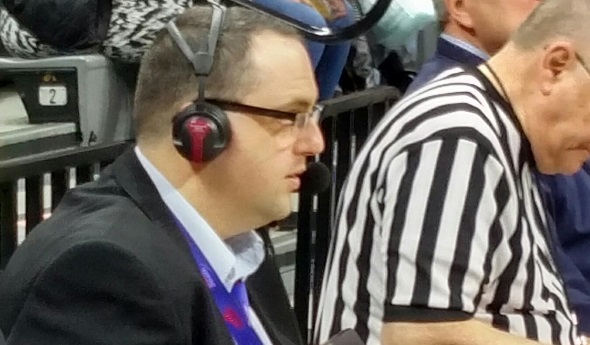
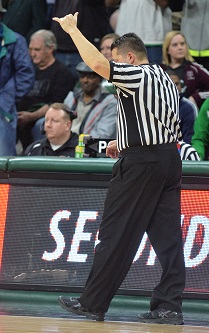
PHOTOS: (Top) Steve Miller calls a basketball game during an MHSAA Finals weekend at the Breslin Center at Michigan State University. (Middle) While officials regulate action on the court, announcers like Roger Smith (lower left) call the shots from the PA seat.

Officials Join Sportsmanship Summits Line-up
October 11, 2016
By Geoff Kimmerly
Second Half editor
Two first-time locations and sessions conducted by local game officials are among additions to the Michigan High School Athletic Association’s annual Sportsmanship Summit series, which will run again during the first three weeks of November.
The MHSAA has conducted Sportsmanship Summits across Michigan for more than 20 years and will visit four sites this fall including Traverse City and Ann Arbor each for the first time. The Summit series kicks off Nov. 7 at Saginaw Valley State University and finishes Nov. 16 in Grand Rapids.
MHSAA staff, with assistance from school administrators and the MHSAA Student Advisory Council, conduct Sportsmanship Summits. More than 1,000 students from more than 100 schools are expected to take part in the four workshops, where they will discuss the line that separates good from bad sportsmanship, especially when it comes to cheering at athletic events. Instruction will be based in part on insights gained during the Student Advisory Council’s Battle of the Fans competitions, which annually began recognizing the best student cheering section in Michigan during the 2011-12 winter season.
This fall’s Summits also again will feature hands-on breakout sessions. New this fall, students will have the opportunity to meet with and discuss sportsmanship with local game officials, who will explain sportsmanship from their points of view and how it may differ from what students experience as competitors or fans. Members of the Student Advisory Council have developed and will instruct during another breakout session and also play a role in the opening all-Summit presentation. To conclude the Summits, the delegation from each participating school will meet to develop a youth sportsmanship campaign to implement upon returning to school.
Sessions will take place at the following:
• Saginaw – Nov. 7 – Saginaw Valley State University Conference Center – 9 a.m.-1:30 p.m.
• Traverse City – Nov. 9 – Grand Traverse Resort – 9 a.m.-1:30 p.m.
• Ann Arbor – Nov. 14 – Sheraton Ann Arbor Hotel – 9 a.m.- 1:30 p.m.
• Grand Rapids – Nov. 16 – Crowne Plaza Airport – 9 a.m.- 1:30 p.m.
Registration at each site is limited to the first 300 students and administrators. Schools are welcome to bring as many as 10 total representatives, including two administrators. For additional registration information, contact Andy Frushour at the MHSAA office – [email protected] or (517) 332-5046. Click for details.