


Clipping Clipped as 2016-17 Begins
August 5, 2016
By Geoff Kimmerly
Second Half editor
Clipping has been eliminated in high school football, the biggest playing rules change on the horizon for member schools of the Michigan High School Athletic Association, which formally begin practice for 2016-17 fall sports next week.
Practice in football must begin on Aug. 8 for all schools wishing to begin regular-season games the weekend of Aug. 25-27. Schools must have 12 days of preseason practice at all levels before their first game, and those 12 days of practice may not occur before 16 calendar days.
Practice sessions for all other sports begin Wednesday (Aug. 10). In golf and tennis, competition may commence no earlier than after three separate days of team practice, and not before seven calendar days. The first day competition may take place in golf and tennis is Aug. 17. In all other fall sports, contests can take place after seven days of practice for the team and not before nine calendar days. The first day competition may take place in cross country, tennis, soccer, swimming and diving, and volleyball is Aug. 19.
This fall, two football dates again precede Labor Day, and a number of MHSAA schools will play their first varsity games on Thursday, Aug. 25. In Week 1, 131 varsity games will be played on Thursday, 169 contests will be played on Friday, and 17 games will be played on Saturday. In the second week, 245 games will take place on Thursday, 62 will be played on Friday and 6 contests are on Saturday.
Eliminating clipping from the high school game is the latest step in the national playing rules promulgated by the National Federation of State High School Associations. Clipping previously was permitted in the free-blocking zone when it met three conditions; however, clipping is now illegal anywhere on the field at any time. According to the rule, the free-blocking zone is defined as a rectangular area extending laterally 4 yards either side of the spot of the snap and 3 yards behind each line of scrimmage.
A few notable changes will go into effect for other fall sports:
• In cross country, a participant who assists an injured or ill competitor when the appropriate health care professional is not available no longer will be disqualified from the race; only the runner receiving assistance will be disqualified for not finishing the race unassisted.
• In soccer, changes were made to the offside rule that makes it match offside rules for the NCAA and FIFA/USSF. The most notable change states that a player in an offside position receiving the ball from an opponent who deliberately plays the ball (except from a deliberate save) is not considered to have gained an advantage and can move ahead toward attempting to score a goal. A player who does receive the ball while in offside position after a deliberate save remains offside, and the result is an indirect kick for the defending team.
• Also in soccer, eliminating of rough play will be a point of emphasis this school year. Rough play including contact above the shoulder often results in player injury.
• In volleyball, a change to rules on uniforms aims to make the libero more recognizable from all angles. Beginning this fall, the libero, her teammates, or both will be required to wear a solid-colored uniform top; the libero’s top must clearly contract the predominant color(s) of her teammates’ uniform tops. Also related the uniforms, soft hair devices, formerly no more than two inches in width, may now be up to three inches in width.
• Also in volleyball, a service toss that contacts a basketball backboard or its supports in a vertical position over the serving area is a service fault and not eligible for a re-serve. The opponent receives a point and the next serve.
The 2016 Fall campaign culminates with postseason tournaments beginning with the Upper Peninsula Girls Tennis Finals the week of Sept. 26, and wraps up with the 11-Player Football Playoff Finals on Nov. 25 and 26. Here is a complete list of fall tournament dates:
Cross Country:
U.P. Finals – Oct. 22
L.P. Regionals – Oct. 28 or 29
L.P. Finals – Nov. 5
11-Player Football:
Selection Sunday – Oct. 23
Pre-Districts – Oct. 28 or Oct. 29
District Finals – Nov. 4 or 5
Regional Finals – Nov. 11 or 12
Semifinals – Nov. 19
Finals – Nov. 25-26
8-Player Football:
Selection Sunday – Oct. 23
Regional Semifinals – Oct. 28 or Oct. 29
Regional Finals – Nov. 4 or 5
Semifinals – Nov. 12
Final – Nov. 18
L.P. Girls Golf:
Regionals – Oct. 5 or 6 or 7 or 8
Finals – Oct. 14-15
Soccer:
Boys L.P. Districts – Oct. 17-22
Boys L.P. Regionals – Oct. 25-29
Boys L.P. Semifinals – Nov. 2
Boys L.P. Finals – Nov. 5
L.P. Girls Swimming & Diving
Diving Regionals – Nov. 10
Swimming/Diving Finals – Nov. 18-19
Tennis:
U.P. Girls Finals – Sept. 28-Oct. 1
L.P. Boys Regionals – Oct. 6 or 7 or 8
L.P. Finals – Oct. 14-15
Girls Volleyball:
Districts – Oct. 31-Nov. 5
Regionals – Nov. 8 & 10
Quarterfinals – Nov. 15
Semifinals – Nov. 17-18
Finals – Nov. 19
The MHSAA is a private, not-for-profit corporation of voluntary membership by more than 1,400 public and private senior high schools and junior high/middle schools which exists to develop common rules for athletic eligibility and competition. No government funds or tax dollars support the MHSAA, which was the first such association nationally to not accept membership dues or tournament entry fees from schools. Member schools which enforce these rules are permitted to participate in MHSAA tournaments, which attract more than 1.4 million spectators each year.
2015-16 Classifications Announced
By
Geoff Kimmerly
MHSAA.com senior editor
March 30, 2015
Classifications for Michigan High School Athletic Association elections and postseason tournaments in traditionally classified sports (A, B, C, D) for the 2015-16 school year have been announced, with enrollment breaks for postseason tournaments set up by divisions posted to each sport’s page on the MHSAA Website.
Classifications for the upcoming school year are based on a second semester count date, which for MHSAA purposes was Feb. 11. The enrollment figure submitted for athletic classification purposes may be different from the count submitted for school aid purposes, as it does not include students ineligible for athletic competition because they reached their 19th birthday prior to September 1 of the current school year and will not include alternative education students if none are allowed athletic eligibility by the local school district.
After all the counts are submitted, tournament-qualified member schools are ranked according to enrollment, and then split as closely into quarters as possible. For 2015-16, there are 750 tournament-qualified member schools with 187 schools in both Class A and Class B, and 188 schools in both Class C and Class D.
Effective with the 2014-15 school year, schools with 875 or more students are in Class A in MHSAA postseason tournament competition. The enrollment limits for Class B are 420-874; Class C is 213-419; and schools with enrollments of 212 and fewer are Class D. The break between Classes A and B decreased seven students from 2014-15, the break between Classes B and C decreased four students, and the break between Classes C and D is two students fewer than the current school year.
The new classification breaks will see 13 schools move up in class for 2015-16, while 17 schools will move down.
Schools recently were notified of their classification. MHSAA Executive Director John E. "Jack" Roberts said schools may not subsequently lower their enrollment figure. However, if revised enrollment figures should be higher and indicate that a school should be playing in a higher class, that school would be moved up.
Schools have the option to play at any higher classification for a minimum of two years, but must exercise the option by April 15 for fall sports, August 15 for winter sports and October 15 for spring sports.
MHSAA tournament sports that will be conducted in traditional classifications for 2014-15 are Basketball and Girls Volleyball. Football will use traditional classifications to determine playoff points.
Sports which will compete in nearly equal divisions are: Baseball, Bowling, Girls Competitive Cheer, Lower Peninsula Cross Country, Lower Peninsula Golf, Ice Hockey, Lacrosse, Lower Peninsula Soccer, Skiing, Softball, Lower Peninsula Swimming and Diving, Lower Peninsula Tennis, Lower Peninsula Track and Field and Wrestling.
Visit the respective sport pages on the MHSAA Website to review the divisional alignments.
The divisions and qualifiers for the MHSAA Football Playoffs will be announced on Selection Sunday, Oct. 25, 2015.
A complete list of school enrollments used to determine classifications for the 2015-16 school year can be found on the Enrollment & Classification page of the MHSAA Website.
Here is a complete list of schools changing classification for 2015-16. (Note: This list does not include schools opting up in class/division for tournaments, which can be found on the Administrators page of the MHSAA Website, under Enrollment and Classification):
Moving Up From Class B to Class A
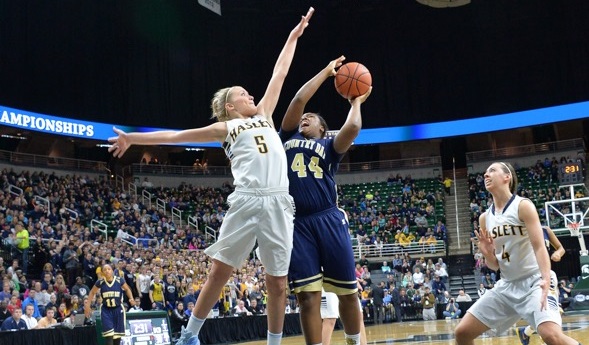
Haslett
Jackson Northwest
Parma Western
South Lyon East
Sturgis
Moving Down From Class A to Class B
Detroit Mumford
Fruitport
Hazel Park
Sault Area
Stevensville Lakeshore
Moving Up From Class C to Class B
Fennville
Grand Rapids West Michigan Aviation Academy
Hillsdale
Jackson Lumen Christi
Jonesville
Warren Michigan Collegiate
Moving Down From Class B to Class C
Delton Kellogg
Detroit Community
Detroit Pershing
Detroit Southeastern
Detroit West Side Academy
Hemlock
Lakeview
Moving Up From Class D to Class C
Burton Madison Academy
St. Ignace LaSalle
Moving Down From Class C to Class D
Highland Park Renaissance Academy
Marcellus
Potterville
Rogers City
Vestaburg
New Postseason Eligible Tournament Schools in 2015-16
Brighton Charyl Stockwell Preparatory
Canton Preparatory
Detroit Cornerstone Health & Technology
Detroit Public Safety Academy
Detroit Westside Christian Academy
Grand Rapids Hope Academy of West Michigan
Enrollment Breaks by Classes – 2015-16
(Number of schools in parentheses)
Class A: 875 and above (187 schools)
Class B: 420 – 874 (187)
Class C: 213 – 419 (188)
Class D: 212 and below (188)
The MHSAA is a private, not-for-profit corporation of voluntary membership by more than 1,400 public and private senior high schools and junior high/middle schools which exists to develop common rules for athletic eligibility and competition. No government funds or tax dollars support the MHSAA, which was the first such association nationally to not accept membership dues or tournament entry fees from schools. Member schools which enforce these rules are permitted to participate in MHSAA tournaments, which attract more than 1.4 million spectators each year.
PHOTO: Haslett, this season's Class B girls basketball runner-up, will play in Class A for the 2015-16 season.