


Clipping Clipped as 2016-17 Begins
August 5, 2016
By Geoff Kimmerly
Second Half editor
Clipping has been eliminated in high school football, the biggest playing rules change on the horizon for member schools of the Michigan High School Athletic Association, which formally begin practice for 2016-17 fall sports next week.
Practice in football must begin on Aug. 8 for all schools wishing to begin regular-season games the weekend of Aug. 25-27. Schools must have 12 days of preseason practice at all levels before their first game, and those 12 days of practice may not occur before 16 calendar days.
Practice sessions for all other sports begin Wednesday (Aug. 10). In golf and tennis, competition may commence no earlier than after three separate days of team practice, and not before seven calendar days. The first day competition may take place in golf and tennis is Aug. 17. In all other fall sports, contests can take place after seven days of practice for the team and not before nine calendar days. The first day competition may take place in cross country, tennis, soccer, swimming and diving, and volleyball is Aug. 19.
This fall, two football dates again precede Labor Day, and a number of MHSAA schools will play their first varsity games on Thursday, Aug. 25. In Week 1, 131 varsity games will be played on Thursday, 169 contests will be played on Friday, and 17 games will be played on Saturday. In the second week, 245 games will take place on Thursday, 62 will be played on Friday and 6 contests are on Saturday.
Eliminating clipping from the high school game is the latest step in the national playing rules promulgated by the National Federation of State High School Associations. Clipping previously was permitted in the free-blocking zone when it met three conditions; however, clipping is now illegal anywhere on the field at any time. According to the rule, the free-blocking zone is defined as a rectangular area extending laterally 4 yards either side of the spot of the snap and 3 yards behind each line of scrimmage.
A few notable changes will go into effect for other fall sports:
• In cross country, a participant who assists an injured or ill competitor when the appropriate health care professional is not available no longer will be disqualified from the race; only the runner receiving assistance will be disqualified for not finishing the race unassisted.
• In soccer, changes were made to the offside rule that makes it match offside rules for the NCAA and FIFA/USSF. The most notable change states that a player in an offside position receiving the ball from an opponent who deliberately plays the ball (except from a deliberate save) is not considered to have gained an advantage and can move ahead toward attempting to score a goal. A player who does receive the ball while in offside position after a deliberate save remains offside, and the result is an indirect kick for the defending team.
• Also in soccer, eliminating of rough play will be a point of emphasis this school year. Rough play including contact above the shoulder often results in player injury.
• In volleyball, a change to rules on uniforms aims to make the libero more recognizable from all angles. Beginning this fall, the libero, her teammates, or both will be required to wear a solid-colored uniform top; the libero’s top must clearly contract the predominant color(s) of her teammates’ uniform tops. Also related the uniforms, soft hair devices, formerly no more than two inches in width, may now be up to three inches in width.
• Also in volleyball, a service toss that contacts a basketball backboard or its supports in a vertical position over the serving area is a service fault and not eligible for a re-serve. The opponent receives a point and the next serve.
The 2016 Fall campaign culminates with postseason tournaments beginning with the Upper Peninsula Girls Tennis Finals the week of Sept. 26, and wraps up with the 11-Player Football Playoff Finals on Nov. 25 and 26. Here is a complete list of fall tournament dates:
Cross Country:
U.P. Finals – Oct. 22
L.P. Regionals – Oct. 28 or 29
L.P. Finals – Nov. 5
11-Player Football:
Selection Sunday – Oct. 23
Pre-Districts – Oct. 28 or Oct. 29
District Finals – Nov. 4 or 5
Regional Finals – Nov. 11 or 12
Semifinals – Nov. 19
Finals – Nov. 25-26
8-Player Football:
Selection Sunday – Oct. 23
Regional Semifinals – Oct. 28 or Oct. 29
Regional Finals – Nov. 4 or 5
Semifinals – Nov. 12
Final – Nov. 18
L.P. Girls Golf:
Regionals – Oct. 5 or 6 or 7 or 8
Finals – Oct. 14-15
Soccer:
Boys L.P. Districts – Oct. 17-22
Boys L.P. Regionals – Oct. 25-29
Boys L.P. Semifinals – Nov. 2
Boys L.P. Finals – Nov. 5
L.P. Girls Swimming & Diving
Diving Regionals – Nov. 10
Swimming/Diving Finals – Nov. 18-19
Tennis:
U.P. Girls Finals – Sept. 28-Oct. 1
L.P. Boys Regionals – Oct. 6 or 7 or 8
L.P. Finals – Oct. 14-15
Girls Volleyball:
Districts – Oct. 31-Nov. 5
Regionals – Nov. 8 & 10
Quarterfinals – Nov. 15
Semifinals – Nov. 17-18
Finals – Nov. 19
The MHSAA is a private, not-for-profit corporation of voluntary membership by more than 1,400 public and private senior high schools and junior high/middle schools which exists to develop common rules for athletic eligibility and competition. No government funds or tax dollars support the MHSAA, which was the first such association nationally to not accept membership dues or tournament entry fees from schools. Member schools which enforce these rules are permitted to participate in MHSAA tournaments, which attract more than 1.4 million spectators each year.
Several 1st-Time Winners Highlight 2025-26 MHSAA Parade of Champions
By
Geoff Kimmerly
MHSAA.com senior editor
June 18, 2026
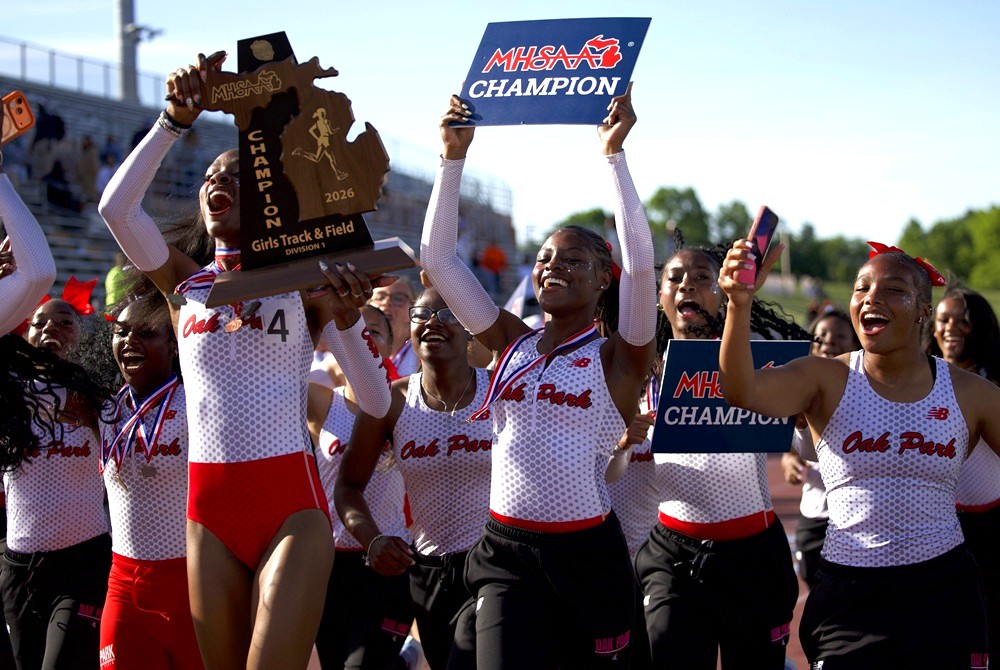
Three schools celebrated their first Michigan High School Athletic Association Finals championships in any sport during the 2025-26 school year as 39 teams total won first Finals titles in their respective sports.
Holland Calvary, in boys cross country, Durand in boys bowling and Walled Lake Northern in softball won their schools’ first Finals championships in any sport, as 88 schools total won at least one of the 132 MHSAA team titles awarded over the three seasons.
A total of 23 schools won two or more championships this school year, paced again by Marquette with eight earned in girls and boys cross country, boys golf, girls skiing, girls and boys swimming & diving, boys tennis and boys track & field. Detroit Country Day was next with seven Finals championships, followed by Detroit Catholic Central with six and Ann Arbor Pioneer with four.
Bloomfield Hills Cranbrook Kingswood, Negaunee, Northville and Rockford all won three titles in 2025-26. Winning two were Birmingham Seaholm, Charlevoix, Farmington Hills Mercy, Flint Kearsley, Flint Powers Catholic, Grand Rapids West Catholic, Jackson Lumen Christi, Lake Linden-Hubbell, Lowell, Newberry, Orchard Lake St. Mary’s, Pewamo-Westphalia, Ravenna, Rudyard and West Iron County.
A total of 48 champions were repeat winners from 2025-26. A total of 31 teams won championships for at least the third-straight season, while 22 teams extended title streaks to at least four consecutive seasons. The Lowell wrestling program owns the longest title streak at 13 seasons, followed by Dundee wrestling’s nine consecutive titles and runs of seven straight Finals victories by the Detroit Catholic Central ice hockey team and Marquette’s boys cross country and boys swimming & diving programs.
This school year saw the addition of field hockey and boys volleyball to the MHSAA’s postseason tournament offerings. Eighteen of the MHSAA's 30 team championship tournaments are unified, involving teams from the Upper and Lower Peninsulas, while separate competition to determine title winners in both peninsulas is conducted in remaining sports.
For a sport-by-sport listing of MHSAA champions for 2025-26, click here (PDF).
The MHSAA is a private, not-for-profit corporation of voluntary membership by more than 1,500 public and private senior high schools and junior high/middle schools which exists to develop common rules for athletic eligibility and competition. No government funds or tax dollars support the MHSAA, which was the first such association nationally to not accept membership dues or tournament entry fees from schools. Member schools which enforce these rules are permitted to participate in MHSAA tournaments, which attract more than 1.4 million spectators each year.
PHOTO The Oak Park girls track & field team hoist their championship trophy and sign May 30 at Rockford High School. (Click for more from RunMichigan.com.)