


Fall Sports Practices Begin Next Week
August 3, 2018
By Geoff Kimmerly
Special for Second Half
More than 100,000 student-athletes will begin practices next week in nine sports in which the Michigan High School Athletic Association sponsors postseason tournaments, signaling the beginning of the 2018-19 Fall sports season.
Practice in football may begin Aug. 6 for all schools wishing to begin regular-season games the weekend of Aug. 23-25. Schools must have 12 days of preseason practice at all levels before their first game, over a period of 16 calendar days before the first kickoff.
Practice sessions for all other sports begin Wednesday (Aug. 8). In golf and tennis, competition may commence no earlier than after three separate days of team practice, and not before seven calendar days. The first day competition may take place in golf and tennis is Aug. 15. In all other fall sports, contests can take place after seven days of practice for the team and not before nine calendar days. The first day competition may take place in cross country, soccer, swimming & diving, and volleyball is Aug. 17.
This fall, two football game dates again precede Labor Day, and a number of MHSAA schools will play their first varsity games Thursday, Aug. 23. In Week 1, 146 varsity games will be played on Thursday, 152 contests will be played Friday, and 12 games will be played Saturday. During the second week, one game will be played Wednesday, 245 games will take place Thursday, 62 will be played Friday, and one contest is scheduled for Saturday.
For fall sports, perhaps the most discussed change will concern MHSAA Tournament classification in volleyball. For the first time, volleyball teams are classified in four equal divisions instead of the traditional Class A-B-C-D. Class no longer will be used to organize the postseason for any sport, including girls and boys basketball in the winter. All other sports previously had switched from classes to divisions.
While most fall sports face at least minor rules changes this season, a few of the most noticeable adjustments in fall sports will come in football, volleyball, boys soccer and girls swimming & diving.
• In an effort to improve football pace of play by reducing re-kicks after a free or scrimmage kick (generally kickoffs or punts, respectively), an option has been added allowing the receiving team to accept a penalty and tack on the awarded yardage to the spot where the kick or punt return ended. This option incentivizes the receiving team to forgo a re-kick, and joins three other options after a penalty on the kicking team. The receiving team also may continue to accept a penalty from the previous spot and have the kicking team re-kick; and on kickoffs that travel out of bounds, the receiving team may continue to accept the ball and begin possession 25 yards from where the kickoff occurred or decline the penalty and begin possession where the kick flew out of bounds.
• Additionally for football, players who fail to properly wear required equipment or are missing required equipment during a down shall be replaced for one down rather than incur a yardage penalty. Previously, a penalty was assessed for delay of game in this scenario. If a player’s proper or legal equipment has become improperly worn through use and prompt repair is possible and does not cause a delay in game, that repair may be made without the player being replaced for the next down.
• A change in volleyball will allow teams to substitute for an injured/ill player prior to a replay; previously a replay would take place with no changes on the floor after the point was originally contested.
• Also in volleyball, with an eye on risk minimization, teams will be allowed to warm-up between sets only in their playing area and may not hit volleyballs over the net into the opponents’ playing area.
• For soccer – both boys this fall and girls in the spring – teams may continue to play up to two multi-team events every season, but beginning this fall a multi-team event can include two full 80-minute games the same day and still be counted as only one of a team’s 18 regular-season contests. Teams also may continue to play multi-team events with 30-minute halves and no more than 180 minutes total in one day (for example, three games with 30-minute halves) and call it just one contest of the 18.
• Another significant soccer change will switch the home team to wearing the dark uniform and the away team to wearing the white uniform. The change was made to allow home teams to wear their school colors – it does not require teams to purchase new uniforms, but only switches which team wears dark and which wears white.
• Also for soccer, a change has been made to the penalty when a player is whistled for denying the other team an obvious goal-scoring opportunity. If a player, in the penalty area, commits an infraction while attempting to play the ball, and that infraction results in a penalty kick, that offending player will receive a yellow card – previously this would have been a red card. If the player is not attempting to play the ball when an infraction is called in the penalty area that results in a penalty kick, the offending player still will receive a red card along with the opposing team being awarded the penalty kick.
• In swimming & diving regular-season competition, a pair of changes will provide more opportunities for divers. The diving event in dual, double-dual or other multi-team non-championship competition has been limited to six dives, but now may be expanded to an 11-dive competition – giving divers another opportunity to prepare for the 11-dive competitions at the MHSAA Qualification Meets and Finals levels. Also, while diving traditionally has been placed in the middle of the event order of a dual or other regular-season meet, it may now be conducted first, last or simultaneously with the swimming events. (Both require prior mutual consent by competing teams and officials.)
• Also in swimming & diving, visible 16.4-yard (or 15-meter) marks must be made visible on both sides of the pool deck to assist swimmers during competition.
The 2018 Fall campaign culminates with postseason tournaments beginning with the Upper Peninsula Girls Tennis Finals the week of Oct. 1 and wraps up with the 11-Player Football Playoff Finals on Nov. 23 and 24. Here is a complete list of fall tournament dates:
Cross Country
U.P. Finals – Oct. 20
L.P. Regionals – Oct. 26 or 27
L.P. Finals – Nov. 3
11-Player Football
Selection Sunday – Oct. 21
Pre-Districts – Oct. 26 or Oct. 27
District Finals – Nov. 2 or 3
Regional Finals – Nov. 9 or 10
Semifinals – Nov. 17
Finals – Nov. 23-24
8-Player Football
Selection Sunday – Oct. 21
Regional Semifinals – Oct. 26 or Oct. 27
Regional Finals – Nov. 2 or 3
Semifinals – Nov. 10
Finals – Nov. 17
L.P. Girls Golf
Regionals – Oct. 10 or 11 or 12 or 13
Finals – Oct. 19-20
Soccer
Boys L.P. Districts – Oct. 15-20
Boys L.P. Regionals – Oct. 23-27
Boys L.P. Semifinals – Oct. 31
Boys L.P. Finals – Nov. 3
L.P. Girls Swimming & Diving
Diving Regionals – Nov. 8
Swimming/Diving Finals – Nov. 16-17
Tennis
U.P. Girls Finals – Oct. 3 or 4 or 5 or 6
L.P. Boys Regionals – Oct. 11 or 12 or 13
L.P. Finals – Oct. 19-20
Girls Volleyball
Districts – Oct. 29-Nov. 3
Regionals – Nov. 6 & 8
Quarterfinals – Nov. 13
Semifinals – Nov. 15-16
Finals – Nov. 17
The MHSAA is a private, not-for-profit corporation of voluntary membership by more than 1,500 public and private senior high schools and junior high/middle schools which exists to develop common rules for athletic eligibility and competition. No government funds or tax dollars support the MHSAA, which was the first such association nationally to not accept membership dues or tournament entry fees from schools. Member schools which enforce these rules are permitted to participate in MHSAA tournaments, which attract more than 1.4 million spectators each year.
WISL Honoree Leads by Making Connections
By
Geoff Kimmerly
MHSAA.com senior editor
January 29, 2020
Nikki Norris received her life’s education from professional educators. Her father Howes Smith served as an assistant principal and then principal at Ithaca High School, and her mother Maple was a teacher. Howes’ mom also taught.
Their influence and example certainly rubbed off on Nikki and her siblings. Norris has worked in education for more than 30 years, while her sister is a school guidance counselor and their brother a college professor.
In fact, Norris has impacted educational athletics in nearly every role possible as a teacher and athletic director at multiple schools, coach at various levels and game official. She is in her second year as athletic director at East Lansing High School after eight in that position for Corunna Public Schools. She previously taught for six years at Carson City-Crystal and then 11 at Corunna before taking over the Cavaliers’ athletic department during the summer of 2010.
She also coached volleyball at multiple levels over more than 15 years including Corunna’s varsity from 1999-2002 and 2006-09, and coached high school basketball for a combined eight years during her time at the two schools where she taught. Before and between her volleyball coaching stints, Norris also has served as an MHSAA registered volleyball official for a total of 12 years.
Norris’ many and continuing contributions will be celebrated Sunday, Feb. 2, when she receives the Michigan High School Athletic Association’s 33rd Women In Sports Leadership Award during the WISL Banquet at the Crowne Plaza Lansing West.
“I try to connect with all students, athletes or not, because there are so many kids who just need a connection," Norris said. "And if we can find it through sports, or through clubs, or teaching – I do look at them all as my own children, to a certain extent. We used to say in Corunna, 'They're all our kids.' And I want them to be successful in whatever it is they want. And if I can help them, that's what I'm there for.
“So many people did it for me. Coming from a family of educators, and my dad an administrator, I knew what that entailed as far as how they get into your heart. I want to do that for kids.”
Each year, the MHSAA Representative Council considers the achievements of women coaches, officials and athletic administrators affiliated with the MHSAA who show exemplary leadership capabilities and positive contributions to athletics.
Those who wrote letters recommending Norris for this year’s WISL Award especially noted that personal impact she has on students, staff and colleagues.
Fowlerville athletic director Brian Osborn – one of her former coaches – wrote of how Norris goes above and beyond to care for and connect with her student-athletes. Owosso athletic director Dallas Lintner wrote of Norris’ dedication to children’s safety and educational values. Fenton athletic director Mike Bakker noted how fortunate her students are that Norris made the decision to leave coaching for administration, where she can have an even larger impact.
“Someone asked me once, why do you want to be an athletic director? Well, I can go from impacting 100 kids a day, at that time (as a coach and teacher), to maybe 600 kids a day, to now 1,200 kids a day (at East Lansing),” Norris said, then quipping, “Well, maybe (not all) 1,200 every day.”
But she does continue to lead on wide-ranging levels, both at her much larger school and beyond.
 While at Corunna, Norris served as master scheduler and part of the constitution committee for the Genesee Area Conference. Her schools have hosted various MHSAA Tournament events in multiple sports, in addition to local invitationals and conference meets. She’s served on every type of MHSAA Committee, providing input on a variety of sports, site selection, officials selection and the Scholar-Athlete Award. She also annually volunteers as a tournament administrator at the MHSAA’s Volleyball Finals in November and Baseball/Softball/Girls Soccer Finals in June.
A certified Red Cross instructor, Norris has provided CPR/AED training to coaches, bus drivers and staff members. Corunna in multiple years received the state’s HEARTSafe School designation recognizing preparedness to respond to cardiac emergencies.
As a member of the Michigan Interscholastic Athletic Administrators Association (MIAAA), she has facilitated sessions and presented at its conferences and served on the newsletter committee.
She was named the MIAAA’s Region 7 “Athletic Director of the Year” in 2016. She also has received “Certified Athletic Administrator” designation from the National Interscholastic Athletic Administrators Association (NIAAA).
“Nikki is one of the most genuine, caring and hard-working people I’ve ever met in athletics,” MHSAA Executive Director Mark Uyl said. “She has worked extremely hard in both Corunna and East Lansing to develop a first-class program that produced high-character people. Nikki is truly a role model to everyone in the world of athletic administration.”
A 1987 graduate of Ithaca High School, Norris received her bachelor’s degree in biology with a minor in exercise health science from Alma College – where she also competed as a runner and thrower in track & field – and then earned master’s degrees in biological sciences from Michigan State University and educational leadership from American College of Education.
Norris lives in Bancroft and is the mother to two daughters, Meredith and Elizabeth Norris. Neither is planning to go into education – but sports is a big part of both their current lives and likely futures, and no doubt the impact of growing up in a sports family has played a significant part. (Their dad, Dr. Robert Norris, played basketball at Alma College and serves as physician for the MSU hockey, volleyball and baseball programs and Lansing Lugnuts.)
Meredith was named the state’s Miss Volleyball Award winner in 2017 as a senior at Corunna and plays currently at Michigan State. Elizabeth is a senior at Corunna and was a finalist for the same award this past fall, and will continue her academic and volleyball careers at University of North Dakota. Meredith is majoring in kinesiology, and Elizabeth is planning on orthopedic surgery.
“I look at the names that are on the (WISL Award) list, and there are so many deserving women who over my career I've looked up to and aspired to be like when I 'grow up,'" Norris said. "So to even be considered in that group is amazing, humbling. It's an honor."
Past recipients of the Women In Sports Leadership Award
1990 – Carol Seavoy, L’Anse
1991 – Diane Laffey, Harper Woods
1992 – Patricia Ashby, Scotts
1993 – Jo Lake, Grosse Pointe
1994 – Brenda Gatlin, Detroit
1995 – Jane Bennett, Ann Arbor
1996 – Cheryl Amos-Helmicki, Huntington Woods
1997 – Delores L. Elswick, Detroit
1998 – Karen S. Leinaar, Delton
1999 – Kathy McGee, Flint
2000 – Pat Richardson, Grass Lake
2001 – Suzanne Martin, East Lansing
2002 – Susan Barthold, Kentwood
2003 – Nancy Clark, Flint
2004 – Kathy Vruggink Westdorp, Grand Rapids
2005 – Barbara Redding, Capac
2006 – Melanie Miller, Lansing
2007 – Jan Sander, Warren Woods
2008 – Jane Bos, Grand Rapids
2009 – Gail Ganakas, Flint; Deb VanKuiken, Holly
2010 – Gina Mazzolini, Lansing
2011 – Ellen Pugh, West Branch; Patti Tibaldi, Traverse City
2012 – Janet Gillette, Comstock Park
2013 – Barbara Beckett, Traverse City
2014 – Teri Reyburn, DeWitt
2015 – Jean LaClair, Bronson
2016 – Betty Wroubel, Pontiac
2017 – Dottie Davis, Ann Arbor
2018 – Meg Seng, Ann Arbor
2019 – Kris Isom, Adrian
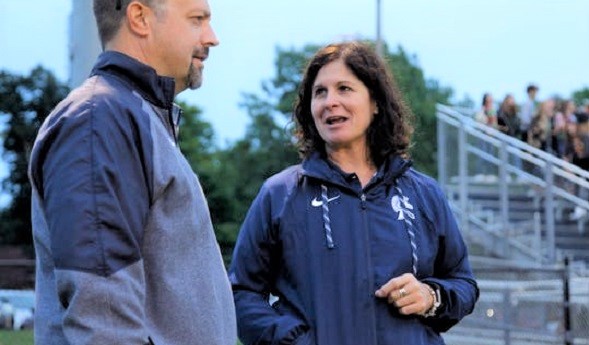
PHOTOS: (Top) East Lansing athletic director Nikki Norris confers with Grand Ledge athletic director Steve Baker during a 2018 football game. (Middle) Norris with daughters Elizabeth, left, and Meredith, after Nikki presented the Cavaliers with a District championship trophy won in 2016. (Top photo courtesy of the Lansing State Journal; middle photo courtesy of Nikki Norris.)