

Follow the 2011-12 Parade of Champions
June 28, 2012
A total of 97 schools won one or more of the 127 team Finals championships awarded by the Michigan High School Athletic Association during the 2011-12 school year. Four schools – Grosse Pointe South, Bloomfield Hills Brother Rice, Marquette and Houghton – tied for the high with four championships apiece.
A total of 18 schools won multiple titles, including Birmingham Seaholm, which won in Division 2 girls tennis and is the primary school in the Birmingham United co-op program that won in Division 1 girls lacrosse. In addition to those schools that won four championships, four more won three titles: Bloomfield Hills Cranbrook-Kingswood, St. Ignace, Detroit Country Day and Ishpeming Westwood.
One-third of this year’s champions – 43 of the 127 – were repeat winners from 2010-11. Of those multiple winners, 19 claimed titles for at least the third straight season. The Lake Leelanau St. Mary boys golf team’s Lower Peninsula Division 4 title was its school’s first MHSAA championship in any sport.
Sixteen of the MHSAA's 28 championship tournaments are unified, involving teams from the Upper and Lower Peninsulas, while separate competition to determine titlists in both Peninsulas is conducted in remaining sports.
Click for a sport-by-sport listing of MHSAA champions for 2011-12.
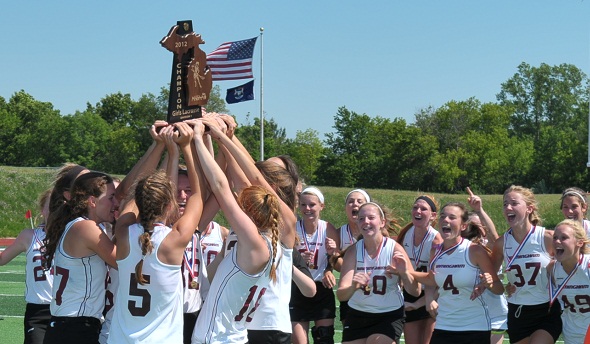
PHOTO: The Birmingham United girls lacrosse team celebrated its Division 1 championship earlier this month at Rockford High School.

Council Approves Regional Seeding-Based 11-Player Football Playoffs During Spring Meeting
By
Geoff Kimmerly
MHSAA.com senior editor
May 6, 2026
A change to the process for pairing 11-player football teams for the District and Regional rounds of the Michigan High School Athletic Association Playoffs was among the most noteworthy to emerge from the Spring Meeting of the MHSAA Representative Council, May 3-4 in Gaylord.
The Spring Meeting of the 19-member legislative body of the MHSAA’s more than 1,500 member schools is generally the busiest of its sessions each year. The Council considered 20 committee proposals and dealt with a variety of eligibility rule, postseason tournament and operational issues.
The change to designating football playoff pairings using a Regional seeding model was a recommendation from the MHSAA Football Committee. Beginning with this fall’s postseason, the playoff field in each of eight 11-player divisions will first be organized into eight-team Regionals. The eight teams in each Regional will then be seeded based on playoff-point average, with seeds 1, 4, 5 and 8 comprising one District and seeds 2, 3, 6 and 7 comprising the other. The winners of those Districts will play in the Regional Final.
As part of its continuing conversation on transfer matters, the Council approved the use of a “Transfer Tracker” system as the tool for entering student information when a student is transferring between schools, with the use of that tool becoming required with the start of the 2027-28 school year. The “Transfer Tracker” system allows schools to track movements by students between schools and is expected to assist administrators as they confirm students are eligible before participation at a new school.
The Council also took a formal step in ongoing discussions about MHSAA championships, approving a Classification Committee recommendation to create a “study group” made up of representatives from member schools to analyze school demographics, championship data at all levels of MHSAA tournaments and success factors – with those findings then used to assist in future classification processes.
Here is a summary of other notable Spring Meeting actions taken by the Representative Council, which will take effect during the 2026-27 school year:
Regulations
• The Council considered current game suspension guidance when activities are affected by inclement weather and approved an addition to current guidance to state a contest must be suspended if an independently validated lightning-detection device or mobile weather application indicates a lightning strike within 10 miles of the event location. The same devices or applications also may be used to eliminate uncertainty if no thunder can be heard but lightning flashes are observed low on the horizon and possibly farther than 10 miles away.
• The Council also approved a regulation that a student enrolled at an MHSAA member school may not participate as an unattached or non-school participant in any regular-season school contest.
Junior High/Middle School
• Following the creation of similar events in other individual sports, the Council approved a Wrestling Committee recommendation to have the MHSAA act as a presenting sponsor for junior high/middle school Individual Wrestling Regionals to be competed at the conclusions of the Winter 1 and 2 seasons. These Regionals will be conducted by the wrestling coaches association. Junior high/middle school participants may compete in only one Regional, and this event will not count as one of the 10 allowed during the junior high/middle school season.
Officials
• The Council approved an Officials Review Committee recommendation related to officials who make aggressive and/or intentional physical contact with a student or coach. Officials who do so will be suspended for a minimum of 14 days and excluded from postseason assignments.
Sport Matters
• BASKETBALL The Council approved a change in the point differential rule. Once a team trails by 40 points during the first half or 30 during the second, even if the margin becomes smaller than those standards, point-differential timing continues.
• COMPETITIVE CHEER The council approved Competitive Cheer Committee recommendations for new allowances for inversions at the high school level only.
• FIELD HOCKEY On the cusp of the first season of field hockey as an MHSAA-sponsored sport concluding in the fall, the Council approved a pair of Field Hockey Committee recommendations dealing with overtime and conclusion of games. The Council approved a 10-minute reduced player overtime procedure for all regular-season varsity games so that they align with postseason overtime procedures. Unless part of a regular-season bracketed tournament, a game still tied at the end of the 10-minute overtime would be declared a tie.
The Council also approved an inclement weather rule specific to field hockey for games that cannot be resumed after a delay. Any game with a goal differential of three or more at any time after the completion of the second quarter would be considered a complete game.
• FOOTBALL The Council approved a Football Committee recommendation allowing a team to participate in no more than one game of interscholastic football over five consecutive calendar days, and in no more than four interscholastic scrimmages and no more than nine games in one season (exclusive of the MHSAA Playoffs). A student also shall not participate in more than one game or four quarters in one day, and in no more than five quarters during one football week. For the purposes of this regulation, a “football week” is defined as Wednesday to Tuesday.
• GOLF The council approved a Golf Committee recommendation requiring a student to participate in at least eight dates of school team competition to be eligible to compete in the MHSAA Golf Tournament. If a school’s varsity team plays fewer than 16 regular-season dates of competition, a student must instead participate in at least 50 percent of the varsity’s regular-season dates to be eligible for the postseason.
• SOCCER The Council approved a Soccer Committee recommendation to expand the Limited Team Membership allowance for college ID camps to permit unlimited participation during the girls season, as these camps are scheduled during the spring.
The Council also approved a committee recommendation to move Boys Soccer Semifinals to Tuesday during years when Halloween falls on the usual Semifinal day of Wednesday. This is set to occur next in 2029, 2035 and 2040.
• VOLLEYBALL The Council approved a pair of Volleyball Committee recommendations regarding the MHSAA Tournament. The first requires a team receiving a No. 1 or No. 2 seed in a Girls Volleyball District to have a minimum of 15 varsity match results.
The second will allow a textured volleyball to used for the boys volleyball postseason beginning with the 2026-27 school year. Teams may continue to use a smooth or textured ball during regular-season play.
• WRESTLING The Council approved a Wrestling Committee recommendation that will allow, at dual-meet tournaments with an odd number of teams, for eligible individual wrestlers from separate participating teams to assemble as one team and compete in the event.
The Council also reviewed reports on membership, with 756 senior high schools and 773 junior high/middle schools in 2025-26 plus 61 elementary schools with 6th-grader participation; cooperative programs, with 425 high school programs for 807 teams during 2025-26; eligibility advancement applications, which totaled one; the use of Educational Transfer Forms, of which there were 162; travel forms for out-of-state practice, school violations, attendance at athletic director in-service workshops and Coaches Advancement Program sessions; officials’ registrations (which were up for the fifth-consecutive school year), and officials reports submitted for the past three sports seasons. The Association’s $16.8 million budget for the 2026-27 school year also was approved.
The Representative Council is the 19-member legislative body of the MHSAA. All but five are elected by member schools. Four members are appointed by the Council to facilitate representation of females and minorities, and the 19th position is occupied by the Superintendent of Public Instruction or designee.
The MHSAA is a private, not-for-profit corporation of voluntary membership by more than 1,500 public and private senior high schools and junior high/middle schools which exists to develop common rules for athletic eligibility and competition. No government funds or tax dollars support the MHSAA, which was the first such association nationally to not accept membership dues or tournament entry fees from schools. Member schools which enforce these rules are permitted to participate in MHSAA tournaments, which attract more than 1.4 million spectators each year.