

Goorhouse Gives Back at Home
By
Geoff Kimmerly
MHSAA.com senior editor
January 24, 2014
By Geoff Kimmerly
Second Half editor
Three traits have been key in making Holland Christian grad Mike Goorhouse nationally-recognized as a civic leader on the rise.
He’s a strong communicator, which comes in handy when coordinating support for causes all over the state.
He’s a relationship builder, allowing him to develop strong rapport as he explains how everyone can give something back to their communities.
 Finally, Goorhouse is a philanthropist – not just in job, but in life. He is the vice president for donor development at the Community Foundation of the Holland/Zeeland Area, where he works to raise support for nonprofit organizations. He also has served on the boards of directors/trustees for eight organizations, and he and his wife financially contribute to more than 15.
But a fourth quality, nurtured during his tennis and soccer careers, has been an asset as well for the 2003-04 MHSAA Scholar-Athlete Award winner.
“I always loved the competition side of sports. I talk to people who own companies, run companies, run shops. The reason they hire people who were involved in athletics is because of that drive,” said Goorhouse, 27, who was named in 2011 as one of the top 30 civic leaders nationally under the age of 30 by online networking site Splashlife. “Not everyone has that drive to succeed, to win, get a goal.
“Succeeding in the non-profit world looks a lot different. But it takes the same drive.”
 Goorhouse was among scholar-athletes recognized during the winter of 2004 by the MHSAA and Farm Bureau Insurance, which continues to sponsor the Scholar-Athlete Award program that has grown to honor 32 recipients annually. In advance of this March’s 25th celebration, Second Half is catching up with some of the hundreds who have been recognized (see additional links at the bottom of this page).
Earning a Scholar-Athlete Award likely meant more to Goorhouse than many of the other 607 who have been recognized over the quarter century. His grandfather, father and brother all have served as MHSAA officials, and his dad and brother both coach as well.
Mike also is part of a third generation of Goorhouses who annually attend the MHSAA Boys Basketball Finals, during which the Scholar-Athlete winners are recognized. He joined his dad and grandfather starting at 8 or 9 years old, and every year would read the bios of Scholar-Athlete Award winners in the Finals program and watch them line up on the court during halftime of the Class C championship game.
“Honestly, I wanted to be that,” Goorhouse said. “I had a lot of respect for the ability to balance academics and sports, and be good at both."
Goorhouse won the MHSAA Lower Peninsula Division 3 tennis title at No. 4 singles as a sophomore in 2002 and returned to the Finals at the No. 1 flight as a senior. He also played soccer at Holland Christian and then played tennis at Calvin College.
Tennis exposed Goorhouse to handling pressure on an individual basis while building mental toughness. Soccer was more about blending teammates’ skills and developing communication among the group.
“Everyone has his or her own version of the story, and that makes it more true; sports teaches a lot about leadership, and just about life and navigating the ups and downs, emotions, handling yourself under stress,” Goorhouse said. “I was in two way different sports, and it was fun to be able to see how those two things impacted me differently.”
As high school students begin focusing on college and potential occupations, professional giver probably isn’t an option many realize is possible. Goorhouse would’ve been counted in that group while at Holland Christian until becoming a member of the Community Foundation’s Youth Advisory Council. That opportunity joined him with many of his sports opponents from around the Holland area as they assisted the foundation in grant making for youth causes.
The philanthropy bug stuck. After his freshman year at Calvin, Goorhouse interned with the statewide Council of Michigan Foundations, which then hired him parttime as a college sophomore and fulltime once he graduated.
He returned to the Community Foundation in 2012 and works with 1,500 donors who contribute to the Holland/Zeeland area.
As donations grow, so does the foundation’s ability to give grants. But it’s not all about money. An oft-quoted definition of philanthropy is the “giving of time, talent and treasure” – and Goorhouse, as he speaks to various groups, makes sure to emphasize “and” as the most important word of that statement while encouraging donors to give of themselves in all three ways.
“It’s who I am as a person that fits this job so perfectly. It’s hardly work,” Goorhouse said. “When they’re thinking about giving back to the community, they’re at their best. I get to talk about what they care about.”
Goorhouse earned his bachelor’s degree in secondary education and then a master’s in public administration from Grand Valley State University. He’s able to take advantage of his relative youth in the professional world to connect with high school students and explain to them the opportunities to give back as part of the non-profit world. He serves on the boards of generationOn and Learning to Give, which both focus on integrating service into pre-college education.
While the national recognition in 2011 might’ve carried the most significance among honors Goorhouse has received, another he earned in 2009 has been his most meaningful on a personal level.
He was honored with the inaugural Young Philanthropist of the Year award by the Community Foundation. He didn't begin work for that organization until three years later, but giving back in his hometown always has been close to his heart.
“I love this place. It’s not that I can only do this work here, but it’s extra special to do the work you love in the place that you love,” Goorhouse said. “I could’ve lived anywhere because I would be on the road regardless. But to come home where my family and friends are, to the community I know best, it’s special.”
Click to read the series' first installments:
- 25 Years Later, Scholar Athletes Shine On
- On Call as Doctor, Director, Mom
- "Mailloux Management" Goes Global
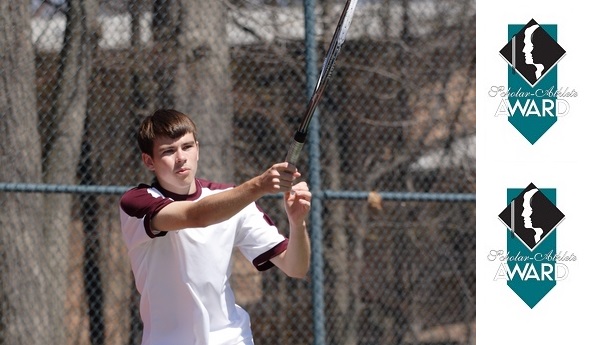
PHOTO: Mike Goorhouse sends a volley while playing tennis for Holland Christian. He won an MHSAA Scholar-Athlete Award in 2004. VIDEO: Goorhouse speaks in 2004 about playing for his high school tennis coach John Knoester.

Scholar-Athlete Finalists Announced
By
Geoff Kimmerly
MHSAA.com senior editor
January 22, 2016
By Geoff Kimmerly
Second Half editor
The 120 finalists for the Michigan High School Athletic Association's Scholar-Athlete Awards for the 2015-16 school year have been announced.
 The program, celebrating its 27th anniversary, has recognized student-athletes since the 1989-90 school year and again this winter will honor 32 individuals from MHSAA member schools who participate in at least one sport in which the Association sponsors a postseason tournament.
Farm Bureau Insurance underwrites the Scholar-Athlete Awards and will present a $1,000 scholarship to each recipient. Since the beginning of the program, 672 scholarships have been awarded.
Scholarships will be presented proportionately by school classification, with 12 scholarships to be awarded to Class A student-athletes, six female and six male; eight scholarships will be awarded to Class B student-athletes, four female and four male; six scholarships will be awarded to Class C student-athletes, three female and three male; and four scholarships will be awarded to Class D student-athletes, two female and two male. In addition, the final two scholarships will be awarded at-large to minority recipients, regardless of school size.
Every MHSAA member high school could submit as many applications as there are scholarships available in its classification, and could have more than one finalist. East Grand Rapids has five finalists this year, Grosse Ile has four finalists and Birmingham Seaholm and Marquette each have three. Fourteen schools each have two finalists: Ann Arbor Pioneer, Bellaire, Bronson, Dearborn Edsel Ford, Farmington Hills Harrison, Grand Rapids Forest Hills Central, Grandville, Hudsonville, Laingsburg, Scottville Mason County Central, Onsted, Pontiac Notre Dame Prep, Portland and White Cloud.
Multiple-sport participation remains the norm among applicants. The average sport participation rate of the finalists is 2.51, while the average of the application pool was 2.14. There are 62 three-plus sport participants in the finalists field, and all but one of the 28 sports in which the MHSAA sponsors postseason tournaments are represented.
Of 374 schools which submitted applicants, 45 submitted the maximum allowed. This year, 1,425 applications were received. All applicants will be presented with certificates commemorating their achievement. Additional Scholar-Athlete information, including a complete list of scholarship nominees, can be found on the MHSAA Website.
The applications were judged by a 58-member committee of school coaches, counselors, faculty members, administrators and board members from MHSAA member schools. Selection of the 32 scholarship recipients will take place in early February. Class C and D scholarship recipients will be announced Feb. 2; Class B scholarship recipients will be announced Feb. 9, and Class A scholarship recipients will be announced Feb. 16. All announcements will be made on the MHSAA Website.
To honor the 32 Scholar-Athlete Award recipients, a ceremony will take place during halftime of the Class C Boys Basketball Final, March 26, at the Breslin Student Events Center in East Lansing.
To be eligible for the award, students must have a cumulative grade point average of 3.50 (on a 4.0 scale), and previously have won a varsity letter in at least one sport in which the MHSAA sponsors a postseason tournament. Students also were asked to respond to a series of short essay questions, submit two letters of recommendation and a 500-word essay on the importance of sportsmanship in educational athletics.
Farm Bureau Insurance of Michigan was founded in 1949 by Michigan farmers who wanted an insurance company that worked as hard as they did. Those values still guide the company today and are a big reason why it is known as Michigan’s Insurance Company, dedicated to protecting the farms, families, and businesses of this great state. Farm Bureau Insurance agents across Michigan provide a full range of insurance services—life, home, auto, farm, business, retirement, Lake Estate®, and more—protecting nearly 500,000 Michigan policyholders.
The MHSAA is a private, not-for-profit corporation of voluntary membership by more than 1,400 public and private senior high schools and junior high/middle schools which exists to develop common rules for athletic eligibility and competition. No government funds or tax dollars support the MHSAA, which was the first such association nationally to not accept membership dues or tournament entry fees from schools. Member schools which enforce these rules are permitted to participate in MHSAA tournaments, which attract more than 1.4 million spectators each year.
2015-16 Scholar-Athlete Award Finalists
BOYS CLASS A
Jack Eisentrout, Ann Arbor Pioneer
Nathan Lazor, Birmingham Groves
Zaven Dadian, Birmingham Seaholm
Jason Ren, Canton
Brendan Oosse, East Grand Rapids
Easton Schultz, East Grand Rapids
Jared Char, Farmington Hills Harrison
Charles R. Perkins Jr., Farmington Hills Harrison
Santino J. Guerra, Flint Kearsley
Garrett Farney, Grandville
Noah Andrew Weigle, Grandville
Jeremy Tervo, Hartland
Eric Mettetal, Howell
Riley Costen, Hudsonville
Daniel Karel, Hudsonville
Traver Parlato, Kalamazoo Loy Norrix
Kevin Hansen, Lake Orion
Alexander Oquist, Livonia Stevenson
Benjamin G. Cole, Marquette
Joseph Weber, Marquette
Kobe Burse, Muskegon Mona Shores
Drew Blakely, Richland Gull Lake
Kyle Jones, Swartz Creek
Lars Hornburg, Traverse City Central
GIRLS CLASS A
Clare Brush, Ann Arbor Pioneer
Catherine Markley, Birmingham Seaholm
Lauren McLeod, Birmingham Seaholm
Cameron Peek, Caledonia
Jaime Freas, Dearborn Edsel Ford
Sarah Hartshorn, Dearborn Edsel Ford
Mallak Taleb, Dearborn Heights Crestwood
Mackenzie Cole, East Grand Rapids
Marie Lachance, East Grand Rapids
Anna Laffrey, East Grand Rapids
Allia Marie McDowell, Farmington Hills Mercy
Brianna Costigan, Fenton
Ally Stapleton, Grand Rapids Forest Hills Central
Catherine Stapleton, Grand Rapids Forest Hills Central
Meredith Howe, Grand Rapids Forest Hills Northern
Erin Armbruster, Grosse Pointe North
Kelsey Emmanuel, Lowell
Kayla Dobies, Macomb Dakota
Lindsey Rudden, Marquette
Genevieve Soltesz, Mattawan
Olivia Arends, Mt. Pleasant
Mary Catherine McLaughlin, Northville
Ellen Wegener, Rochester
Jennifer Eaton, St. Johns
BOYS CLASS B
Geoffrey Richard Pisani, Big Rapids
Spencer Keoleian, Bloomfield Hills Cranbrook Kingswood
Nicolas Arons, Chelsea
Brendan Spangler, Coldwater
Evan Ciancio, Comstock Park
Ryan Mangulabnan, Dearborn Divine Child
Kyle Gavulic, Goodrich
Caleb E. Doane, Grant
Adam Kopp, Grosse Ile
Blake Willison, Grosse Ile
Justin Carlson, Hastings
Josef Philipp, Hillsdale
Austin Davis, Onsted
Austin Robert Thompson, Onsted
David Arnst, Ovid-Elsie
Trevor Trierweiler, Portland
GIRLS CLASS B
Erin Isola, Allegan
Greta Wilker, Belding
Lindsey Carlson, Charlotte
Keri Frahm, Frankenmuth
Kate Tobin, Grosse Ile
Katherine Williams, Grosse Ile
Alexis LaChappa, Harrison
Camryn A. Klein, Ionia
Fallon Gates, Manistee
Abigail Ufkes, Marshall
Paiton Plutchak, Menominee
Erica Lynn Schwegman, Pontiac Notre Dame Prep
Elizabeth Swartz, Pontiac Notre Dame Prep
Amanda Pohl, Portland
Claudia Raines, Saginaw Swan Valley
Brenna James, Sault Ste. Marie
BOYS CLASS C
Joseph Comstock, Addison
Quentin E. Millette, Ann Arbor Greenhills
Daniel R. McMichael, Bronson
Sawyer Cuthrell, Cass City
Anthony Hoholik, Manistique
Spencer Graham Knizacky, Mason County Central
Cameron Brayman, Montague
Broc Roberts, Petersburg-Summerfield
Trenden Peacock, Sand Creek
Dylan Marshall, St Ignace
Michael Klettner, Traverse City St. Francis
Bowman Seabrook, White Cloud
GIRLS CLASS C
Hannah Steffke, Beal City
Molly Lynch, Bloomfield Hills Academy of the Sacred Heart
Alexa Ratkowski, Bronson
Kelsey Engstrom, Charlevoix
Ellen Doyle, Gobles
Hanna Angst, Laingsburg
Julia Angst, Laingsburg
Bailee Kimbel, Manton
Jordyn Sanders, Mason County Central
Mallory Raven, Morley-Stanwood
Shelby Vincke, New Lothrop
Christiana M. Jones, White Cloud
BOYS CLASS D
Garrett Kraatz, Allen Park Inter-City Baptist
Joshua Robert Riggs, Brethren
Matthew Gratowski, DeTour
Gregory Scott Seppanen, Eben Junction Superior Central
Jayvin Wolfe, Fulton-Middleton
Nathaniel Jones, Muskegon Catholic Central
Daniel Good, Owendale-Gagetown
Benjamin Turner, Sterling Heights Parkway Christian
GIRLS CLASS D
Lindsay Lampman, Bellaire
Chloe Niepoth, Bellaire
Maria Stankewicz, Crystal Falls Forest Park
Abby Sutherland, Lake Linden-Hubbell
Elizabeth Munoz, Leland
Averi Rachelle Munro, Morrice
Natalie Frances Beaulieu, Newberry
Paige Blake, Ontonagon