

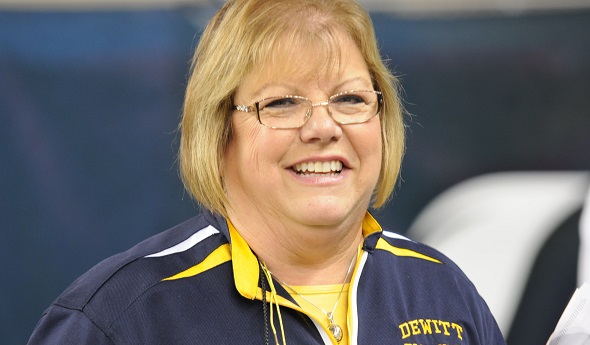
Honoree Leads from Behind the Scenes

January 28, 2014

By Geoff Kimmerly
Second Half editor

Off to the side somewhere, where athletic directors generally reside, Teri Reyburn often enjoys her favorite part of leading DeWitt’s athletic department – watching her school’s athletes shine. 

As head of one of the Lansing area’s most successful programs, she has celebrated more often than not. But while her contributions to those successes usually fall outside of fanfare, they hardly go unappreciated by those who understand the inner workings of high school sports.

Reyburn's faithful support of her school and continuous service to Michigan High School Athletic Association programs will be celebrated Sunday, when she receives the MHSAA’s 27th Women In Sports Leadership Award during the WISL banquet at the Crowne Plaza Lansing West. 

In addition to heading a department since 1999 that annually produces winning teams, Reyburn was a key voice in the creation and growth of the Capital Area Activities Conference a decade ago and has hosted more than 80 MHSAA tournaments at various levels in various sports. 

“I absolutely love the kids. And I take a huge amount of pride in being able to put on and prepare an event, have hundreds or thousands walk in and sit down, enjoy themselves and walk out and leave not knowing the amount of work it took,” Reyburn said. “We have a large amount of volunteers who make that happen. I have some of the most amazing coaches, and the parents support their kids too. It doesn’t get any better than here, and I love what I do.” 

Each year, the Representative Council considers the achievements of women coaches, officials and athletic administrators affiliated with the MHSAA who show exemplary leadership capabilities and positive contributions to athletics. 

Both DeWitt’s girls and boys golf teams have won two MHSAA Finals championships apiece during her tenure. The football program has played in four Finals and both the boys basketball team and competitive cheer teams have finished MHSAA runners-up. 

The Panthers girls basketball team has advanced to three MHSAA Semifinals, and the boys and girls soccer teams and baseball team have combined for five Semifinal appearances during her time guiding the program.

DeWitt has a strong athletic tradition going back decades. But there’s no question Reyburn has played her part well in continuing that legacy.

“DeWitt teams are always hard-working and always the model of good sportsmanship. Many people would assign the credit to the coaches for such behavior,” wrote Lansing Catholic athletic director Rich Kimball is recommending Reyburn for the WISL award. “Having been a coach, I know they deserve a lot of credit for how their teams perform and act, but without the leadership from the ‘boss’ those things don’t usually happen. Teri makes sure her program operates with class at all times.”

Her contributions to athletics off the field of play have been similarly significant, if also understated.   

Since taking over the DeWitt program as interim athletic director in March 1999, and then fulltime that summer, Reyburn regularly has hosted five MHSAA tournaments per school year plus a total of more than 20 rules meetings and a number of clinics in coordination with statewide coaches and officials associations. 

Reyburn, 59, also was among athletic directors who played a significant role in the formation of the CAAC, which combined schools from four leagues into one in 2003. She also was a leading voice in the formation of DeWitt High School’s Hall of Fame, which has inducted 35 athletes and nine teams since 2008.

Reyburn has spoken at WISL conferences on both the role of Title IX in high school athletics and “Tackling the Media Blitz” for young coaches and athletes. She has served on the WISL planning committee as well as on Scholar-Athlete Award, athletic equity, competitive cheer rules, site and officials selection committees.

“Teri Reyburn has provided nearly two decades of quiet, steady leadership in her school district and serves as a mentor for those who are following her in the athletic director role,” said John E. “Jack” Roberts, executive director of the MHSAA. “She’s a role model for not just women, but anyone who aspires to a career in educational athletics. We’re pleased to honor her with the Women In Sports Leadership Award.” 

Reyburn graduated from Cedar Springs High School in 1972, the same year as the enactment of Title IX and the first MHSAA tournaments in girls sports. Her school offered three sports, and she played intramural volleyball and was a cheerleader. She also was a championship-caliber horseback rider during high school summers.

Soon after graduation, Reyburn married her high school sweetheart Kris (they will celebrate their 41st anniversary in November). Hers sons were born not long after – Mike, now a lieutenant colonel in the U.S. Army stationed in South Korea, and then D.J., who will begin his first fulltime season as a Major League Baseball umpire this spring.  

Reyburn took college classes, worked as a study hall aide at Cedar Springs and later served on the Portland Public Schools board of education for 11 years before her family moved to DeWitt. She had intentions of earning a college degree, and discussed the possibility again after joining DeWitt schools a media specialist, middle school sports coordinator and assistant to the high school athletic director in 1994. But after five years in those roles, a sad circumstance led to her taking over the DeWitt program fulltime. 

She was brought into athletics initially by previous director Jim Lutzke, who also worked in the human resources department and served as the Panthers boys basketball coach. He relied on Reyburn to coordinate middle school events and serve as a game manager for many at the high school.

Lutzke was diagnosed with cancer early in the 1998-99 school year, and Reyburn took on additional roles including game setup and equipment ordering. Lutzke died that March, and Reyburn and girls basketball coach Bill McCullen took over the high school athletic director duties on an interim basis. She was then hired as Lutzke’s successor for the following fall – and continues to employ lessons she learned under his mentoring. 

“The biggest thing I got from Jim was just learning not to react quickly. To think, to understand a situation and know all of the facts before I do anything,” Reyburn said. “Jim was extremely good at that. He was even keel and level with everything he did.” 

Reyburn also received plenty of tutelage and support from local athletic directors including longtime Haslett leader Jamie Gent, Williamston’s Jeff Lynch and then-Fowlerville athletic director Jack Wallace. 

Now Reyburn is among those passing the knowledge forward. She’s one of the longest-serving athletic directors in the CAAC and was recognized as her region’s Athletic Director of the Year in 2006 by the Michigan Interscholastic Athletic Administrators Association.

“There are few, if any, athletic directors who are more capable, more organized or more in touch with high school sports than Teri,” Lansing Catholic’s Kimball also wrote. “Teri is the perfect person to win this award – passionate, smart, humorous, organized, but most of all an advocate for educational athletes.”

Past Women In Sports Leadership Award recipients

1990 – Carol Seavoy, L’Anse 
1991 – Diane Laffey, Harper Woods
1992 – Patricia Ashby, Scotts
1993 – Jo Lake, Grosse Pointe
1994 – Brenda Gatlin, Detroit
1995 – Jane Bennett, Ann Arbor
1996 – Cheryl Amos-Helmicki, Huntington Woods
1997 – Delores L. Elswick, Detroit
1998 – Karen S. Leinaar, Delton
1999 – Kathy McGee, Flint 
2000 – Pat Richardson, Grass Lake
2001 – Suzanne Martin, East Lansing
2002 – Susan Barthold, Kentwood
2003 – Nancy Clark, Flint
2004 – Kathy Vruggink Westdorp, Grand Rapids 
2005 – Barbara Redding, Capac
2006 – Melanie Miller, Lansing
2007 – Jan Sander, Warren Woods
2008 – Jane Bos, Grand Rapids
2009 – Gail Ganakas, Flint; Deb VanKuiken, Holly
2010 – Gina Mazzolini, Lansing
2011 – Ellen Pugh, West Branch; Patti Tibaldi, Traverse City
2012 – Janet Gillette, Comstock Park
2013 – Barbara Beckett, Traverse City

PHOTO: DeWitt athletic director Teri Reyburn walks the Ford Field sideline before the Panthers Division 3 Final against Zeeland West this fall. (Click to see more at HighSchoolSportsScene.com.) 

Rep Council Wrap-up: Spring 2020

May 8, 2020

By Geoff Kimmerly
Second Half editor

The addition of seeding at the Regional level in ice hockey and adjustments to provide byes for top-seeded teams in basketball and soccer were among the most notable actions taken by the Representative Council of the Michigan High School Athletic Association during its annual Spring Meeting on May 4.

The Spring Meeting of the 19-member legislative body of the Association’s more than 1,500 member schools is generally the busiest of its three sessions each year. The Council considered 32 committee proposals and dealt with a variety of eligibility rule, postseason tournament and operational issues. As with the Council’s Winter Meeting in March, the Spring Meeting was conducted remotely to keep with social distancing required by the COVID-19 pandemic.

Beginning with the 2020-21 school year, ice hockey will employ a seeding process to place the top two teams in every Regional on opposite sides of that bracket, guaranteeing those two teams could not play each other before the Regional championship game. The two teams are to be seeded in each Regional using the Michigan Power Rating computer formula based on regular-season results against other MHSAA Tournament-eligible teams and opponents’ strength of schedule, the same system used in basketball and soccer and as one of multiple methods to seed in boys lacrosse. (Games against out-of-state or non-MHSAA opponents do not count in the MPR formula.) The MHSAA will draw all ice hockey brackets 15 days before the start of Regional play. The addition of hockey seeding was proposed by the MHSAA Hockey Committee.

The Council also adopted a change to seeding to take affect for hockey, basketball and soccer to provide any existing byes to the #1, and then #2 seed, in that order, if multiple byes are part of a bracket. The draw process then will continue to place the remaining teams on the bracket based on a randomly-selected order determined earlier in the season. 

Similar rules changes in football and basketball approved by the Council and recommended by the MHSAA committees for those respective sports aim to create more opportunities, especially for programs struggling to field teams at multiple levels. In football, while an athlete may still play only four quarters in one day, that athlete may play in up to five quarters per week. In basketball, an athlete may compete in up to five quarters per day, during no more than three dates per week and 20 dates per team or individual. Both changes will allow athletes to contribute to both varsity and subvarsity teams simultaneously, potentially bolstering numbers and opportunities to retain those squads.

The Council also took action on a number of MHSAA Handbook regulations requiring adjustment because of the COVID-19 pandemic and disruption it has caused to Michigan high school athletics. Notably, the Council voted to waive the 2020-21 pre-participation physical exam requirement for athletes who received one during the 2019-20 school year, although they are still required to fill out and sign the MHSAA Annual Sports Health Questionnaire. The Council also authorized schools to make decisions on multiple summer matters, including an opportunity for athletic directors to request a waiver from the MHSAA to wear school competition uniforms during events that are school-sponsored and designed to recognize graduating 12th-graders. Additionally, the Council voted to give schools the opportunity to waive the annually-required week-long period of no summer activity, if they choose to do so.

Here is a summary of other notable actions taken by the Representative Council at the Spring Meeting, which will take effect during the 2020-21 school year unless noted. Additionally, three sport changes were approved by the Council during its Winter meeting in March and not yet publicized; those too are noted below.  

Regulations

• The Council approved a change allowing teams in sports governed by MHSAA summer competition limits – basketball, football, ice hockey, lacrosse, soccer and girls volleyball – to participate against all opponents present at out-of-state summer events. MHSAA member schools must continue to abide by the MHSAA travel limit – traveling only to events that are hosted either in bordering states/provinces (Illinois, Indiana, Ohio, Ontario and Wisconsin) or within 300 miles one way. MHSAA member schools now may participate at those events against out-of-state teams that exceed the travel limit by traveling more than 300 miles to the event site.

Sport Matters   

In baseball, the Council approved a Baseball Committee recommendation to adopt a suspended-game policy stating that any game called before it reaches regulation, or when the score is tied, is suspended with play to pick up at a later time from that point. However, if both schools agree, a game called prior to regulation may be replayed in its entirety.

Also in baseball, during its Winter meeting, the Council approved a Baseball Committee recommendation renaming the “Super Regional” level of the MHSAA Tournament as the “Quarterfinal” level – with trophies and medals to be presented to both Regional champions after the day’s Regional Finals are completed and before the day’s Quarterfinal matching up those two teams. The Council also adopted at the Winter meeting a tournament schedule that during even-numbered years will see Semifinals for Divisions 2 and 4 played on Thursday and Divisions 1 and 3 on Friday. The Semifinal schedule will flip during odd-numbered years.

The Council approved a series of Girls Competitive Cheer Committee recommendations. High school athletes now are allowed to transition to stunts or loads from the flatback position. Also at the high school level, bases will be allowed to rotate or move while a flyer is in the inverted position (in a static inversion), and to provide for the allowance of additional flairs at the point of static inversion.

Also in cheer, the Council approved a Committee recommendation requiring three safety judges (instead of two) and five panel judges at MHSAA Regional events.

In football, the Council approved a Football Committee recommendation extending the running clock when a team leads its opponent by 50 points to both the first and second halves of a game; the 50-point running clock stops only for player injuries and previously was employed only during the second half. The 35-point running clock employed during the second half, with stoppages also for penalty enforcement, scoring plays and called timeouts, will remain in effect if the differential dips below 50 and until it reaches 50 points again.

Also in football, the Council approved a Committee recommendation allowing schools 15 summer dates of non-mandatory contact with an unlimited number of players (wearing helmets only). Schools may use these dates as they see fit, but of these 15 only seven dates may be used for 7-on-7 competition against other teams. This also eliminates the previous allowance for a camp.

The Council approved another change in hockey to improve safety, adopting a Hockey Committee recommendation requiring all members of a coaching staff to wear HECC-certified helmets while on the ice for practices or games.

In alpine skiing, the Council approved a Ski Committee recommendation that will allow athletes who qualify for an MHSAA Final in one discipline (giant slalom or slalom) during Regional racing to compete in both disciplines at the Finals level.

In soccer, the Council approved a recommendation from the Soccer Committee to allow girls soccer athletes to compete in scrimmages at a maximum of two college ID camps during the spring girls soccer season, when these ID events generally take place.

A pair of changes were adopted for swimming & diving, one affecting each group of athletes. The Council approved a Swimming & Diving Committee recommendation allowing swimmers to wear caps reading “State Team” during both regular-season and postseason competition. For diving, the Council approved a Committee recommendation to designate the number of qualifiers from each Lower Peninsula Regional to be in proportion to the number of entries at those respective Regionals in each division. This will allow Regionals with larger numbers of participants to contribute more Finals qualifiers, while eliminating the possibility that a Regional could send all entrants to the Finals regardless of performance because only 12 participate at that site. Each division will continue to advance 36 divers total to the MHSAA Finals. 

In tennis, the Council approved a Tennis Committee recommendation to play the MHSAA Final two-day tournament on Friday and Saturday unless there is a conflict with the host facility. In that case, that specific Final would be scheduled for Thursday and Friday.  

• During its Winter meeting, the Council approved a Classification Committee recommendation that adds girls and boys tennis to the group of sports that schools may play as cooperative programs – with Executive Committee approval – if their combined enrollments do not exceed 3,500 students. The Council will reexamine this allowance after its first two years.

Junior High/Middle Schools

• The Council approved a Junior High/Middle School Committee recommendation to conduct MHSAA-sponsored cross country Regional meets for junior high/middle school athletes at eight sites across the state, based on “zones” currently designated by the MHSAA. These Regional meets will begin with the 2021-22 school year.

• The Council also approved a Girls Competitive Cheer Committee recommendation to allow junior high/middle school teams to participate in three competitions per week (instead of two) as long as one of the three is conducted on a non-school day or a day not followed by school.

Officials

•  The Council approved a series of recommendations from the Officials Review Committee. Of particular note, coaches and athletes ejected from competition now are required to complete an online sportsmanship course from the National Federation of State High School Associations (NFHS) before returning to competition.

The Council also discussed various other topics, including possibilities for presentation during this fall’s Update Meeting statewide tour, and took action to clarify Handbook language regarding a few eligibility scenarios. The Association’s $11.5 million budget for the 2020-21 school year also was approved. 

The Representative Council is the 19-member legislative body of the MHSAA. All but five are elected by member schools. Four members are appointed by the Council to facilitate representation of females and minorities, and the 19th position is occupied by the Superintendent of Public Instruction or designee.

The MHSAA is a private, not-for-profit corporation of voluntary membership by more than 1,500 public and private senior high schools and junior high/middle schools which exists to develop common rules for athletic eligibility and competition. No government funds or tax dollars support the MHSAA, which was the first such association nationally to not accept membership dues or tournament entry fees from schools. Member schools which enforce these rules are permitted to participate in MHSAA tournaments, which attract more than 1.4 million spectators each year.