


Hoops, Hockey Prep for Playoff Changes
December 12, 2019
By Geoff Kimmerly
Second Half editor
The introduction of limited seeding at the District level for girls and boys basketball, and a shift in the postseason schedule for ice hockey, are among changes that will be noticed most this season by those who compete in and follow the 12 winter sports for which the Michigan High School Athletic Association sponsors postseason tournaments.
Girls basketball’s first games tipped off Dec. 2, followed by boys basketball openers Dec. 9. This winter, for the first time, the top two teams in every basketball District will be seeded and placed on the opposite sides of their bracket, making the District Final the earliest round they could play each other. Those top-seeded teams will be determined using the Michigan Power Ratings (MPR) computer formula based on regular-season results against other MHSAA Tournament-eligible teams and opponents’ strength of schedule. (Games against out-of-state or non-MHSAA opponents will not count in the MPR formula.)
The MHSAA will draw all brackets 15 days before the start of District play. After the top seeds are determined and separated to opposite sides of the bracket, the draw process will place the remaining teams on the bracket based on a randomly-selected order determined earlier in the season. MPR also was used to similarly seed Districts for boys soccer for the first time this past fall and in the spring for boys lacrosse.
Also undergoing a change this winter, the MHSAA Ice Hockey Tournament will be played over three weeks rather than two as in previous seasons. The traditional dates for the start of the regular season and Finals will remain the same, as will the total number of regular-season games allowed. However, the MHSAA Tournament will begin on the third Monday before the Finals instead of two weeks before, and the extended postseason schedule places the maximum of six games that may be played from the start of Regionals through Finals over 20 days instead of the previous 13.
While those changes will affect tournament structures, a handful of others affecting daily competition will be particularly noticeable as well this winter:
• As with Lower Peninsula girls swimming & diving season in the fall, a pair of changes for LP boys and Upper Peninsula girls will take effect this winter. For swimmers, the definition of a legal finish has changed to include a competitor touching any part of the finish end of the lane, not just the touch pad. In diving, the degree of difficulty was adjusted for back and reverse somersaults to provide consistency with difficulty of other dives.
• In hockey, the allowed stick length for a non-goaltender has been extended to 65 inches with a blade no more than 12.5 inches long and between 2-3 inches high. The allowances for a goaltender’s stick also were adjusted – the widened portion up to 28 inches from the heel and to 3.5 inches in width, with a blade at maximum 15.5 inches in length. These changes were made to accommodate the greater average height of today’s athletes.
• In girls competitive cheer, non-braced static inversions will be allowed only with the following stipulations: the original base or spotter maintains constant contact with the flyer, prior to the static inverted position the flyer must originate from below shoulder level, and the inversion must dismount to the cheering surface, cradle, any waist-level position or a non-inverted stunt at shoulder level. Also, twists from inversions and inversions released to extended level are illegal.
• A new rule in wrestling will allow for additional time to evaluate head and neck injuries. If an injury occurs involving the head, neck, cervical column and/or nervous system and an appropriate health care professional is present, that caregiver may request the traditional 90 seconds of injury time be extended up to a maximum of five minutes to evaluate the injury. Before that time expires, the wrestler must be ready and able to continue the match or it will be defaulted.
• Also for wrestling, a new criteria has been added to the tie-breaking system used when a dual meet finishes in a tied score. The new sixth criteria “f” states that the team giving up the fewest forfeits during a match shall be declared the winner.
The 2019-20 Winter campaign culminates with postseason tournaments beginning with Girls & Boys Skiing Regionals on Feb. 10, and wraps up with the Boys Basketball Finals on March 28. Here is a complete list of winter tournament dates:
Girls Basketball
Districts – March 2, 4 & 6
Regionals – March 10 & 12
Quarterfinals – March 17
Semifinals – March 19-20
Finals – March 21
Boys Basketball
Districts – March 9, 11 & 13
Regionals – March 16 & 18
Quarterfinals – March 24
Semifinals – March 26-27
Finals – March 28
Girls & Boys Bowling
Team Regionals – Feb. 28
Singles Regionals – Feb. 29
Team Finals – March 6
Singles Finals – March 7
Girls Competitive Cheer
Districts – Feb. 21-22
Regionals – Feb. 29
Finals: March 6-7
Girls Gymnastics
Regionals – March 7
Team Finals – March 13
Individual Finals – March 14
Ice Hockey
Regionals – Feb. 24-March 4
Quarterfinals – March 7
Semifinals – March 12-13
Finals – March 14
Girls and Boys Skiing
Regionals – Feb. 10-14
Finals – Feb. 24
Girls & Boys Swimming & Diving
U.P. Girls & Boys Finals – Feb. 15
L.P. Boys Diving Qualification Meets – March 5
L.P. Boys Finals – March 13-14
Wrestling
Team Districts – Feb. 12-13
Individual Districts – Feb. 15
Team Regionals – Feb. 19
Individual Regionals – Feb. 22
Team Quarterfinals – Feb. 28
Team Semifinals & Finals – Feb. 29
Individual Finals – March 6-7
MHSAA Women In Sports Leadership Conference to Celebrate Multiple Milestones
By
Geoff Kimmerly
MHSAA.com senior editor
September 14, 2022
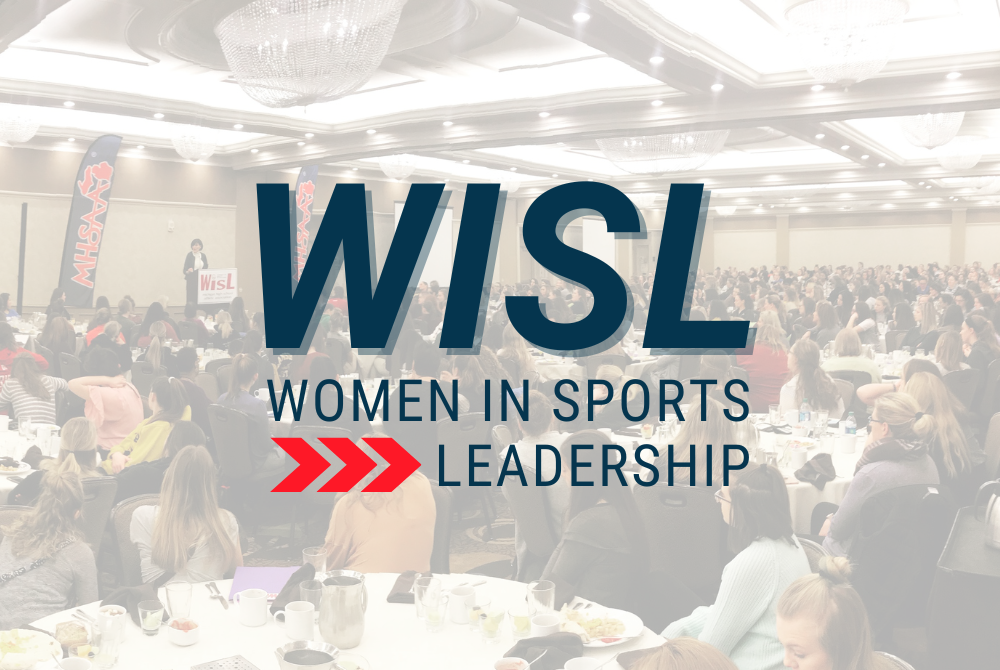
A pair of milestones will be celebrated by the Michigan High School Athletic Association during this year’s Women In Sports Leadership Conference, to be presented Sunday, Oct. 9, and Monday, Oct. 10 at Crowne Plaza Lansing West for 600 participants, most of them high school female student-athletes from across the state.
A theme of “Power of the Past – Force of the Future” will recall opportunities created during the 50 years since the enactment of Title IX in 1972. This also will be the 25th WISL Conference, which remains the first, largest and longest-running program of its type in the country.
This year’s edition again will feature three keynote speakers and a variety of workshops. The opening address will be delivered by Ashley Baker, who serves as the chief diversity, equity and inclusion (DEI) officer at Michigan State University. Baker, originally from Pontiac, earned bachelor and master’s degrees from Bowling Green State University and a doctorate in sport management and policy from the University of Georgia. She came to MSU in December 2020 from Xavier University (Louisiana) where she most recently had served as assistant vice president for student affairs and chief inclusion officer/deputy Title IX coordinator.
First-year Spartans softball coach Sharonda McDonald-Kelley will speak during the Oct. 9 evening general session. She coached Campbell University (N.C.) to back-to-back NCAA Tournament appearances and was a four-time all-Big 12 selection as a player at Texas A&M, appearing in the College World Series before playing professionally for seven years. McDonald-Kelley was named Big South Conference Coach of the Year in 2021, and previously also coached professionally and as associate head coach at Texas Tech University after serving as an assistant for multiple prestigious college programs.
University of Michigan women’s basketball coach Kim Barnes-Arico will speak during the morning session Oct. 10. She led the Wolverines last season to their first NCAA Tournament Elite Eight and is nearing 500 career victories, having won a U-M program-record 218 during her 10 seasons. She’s a two-time Big Ten Conference Coach of Year and was a semifinalist this past season for the Werner Ladder Naismith Coach of the Year honor. Michigan is her fifth college coaching stop; she came to Ann Arbor after 10 seasons at St. John’s. She played basketball one season at Stony Brook University (N.Y.) and then her final three including two as captain at Montclair State University (N.J.).
Workshops offered during the WISL Conference include topics on coaching, teaching and learning leadership; sports nutrition and performance, and injury prevention; and empowerment and goal-setting. Presenters are accomplished in their fields and represent a wide range of backgrounds in sport.
A complete itinerary is available on the MHSAA Website.
The Oct. 9 evening general session also will include recognition for the 2022 Women In Sports Leadership Award winner – recently-retired Livonia Stevenson athletic director Lori Hyman. A basketball standout at MSU during the second half of the 1970s, Hyman went on to coach college basketball for 17 years and then serve as a highly-regarded athletic director for 27 years including the last 22 at her alma mater Stevenson.
Follow the #WISL hashtag on Twitter and Instagram to learn more about the conference’s activities.