

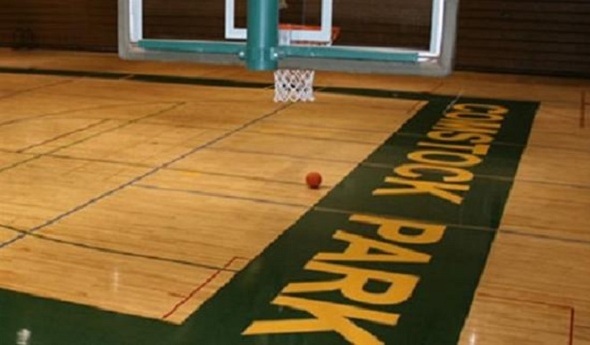
The House Gillette Helped Build
February 1, 2012
Maribeth Johnston’s description made it easy to imagine the bustling activity that was Janet Gillette’s Comstock Park athletic office for 20 years.
Gillette and her secretary’s desks, piled with shelves of labeled and color-coded binders. A wall-sized white board calendar marked with sports activities for the next two months. Floor to ceiling shelf units, labeled cubbies and a copy machine loaded with paper of various colors. Trophies on shelves awaiting their turn in the school’s display case.
And then there were the two most telling images of Gillette’s legacy during four decades as a part of Comstock Park schools. On other walls were hundreds of pictures of students, athletes, coaches and staff. And in the center of the athletic office were two large work tables, usually occupied by student volunteers stuffing envelopes, organizing and counting uniforms or taking any on other task to help out.
“Her attention to detail, service for others and devotion to make every event ‘special’ is what endears her to the people in our school system,” wrote Johnston, who recently finished her 24th season as the school’s volleyball coach, in a letter of recommendation for the MHSAA’s Women in Sports Leadership Award. “The athletic office is a wonderful place. But the person who makes it all happen is Jan Gillette.”
Gillette attended Comstock Park, came back as a teacher and coach, and retired in 2010 after spending her final 19 school years as athletic director. She is the 25th woman to be recognized with the WISL Award for exemplary leadership capabilities and positive contributions to athletics. The award will be presented during Sunday’s Women In Sports Leadership Conference banquet at the Lexington Lansing Hotel.
“One of my quotes that people always hear is there’s no greater privilege in life than to have an impact on a young person. I got to do that every day,” Gillette said. “And they impacted my life as well."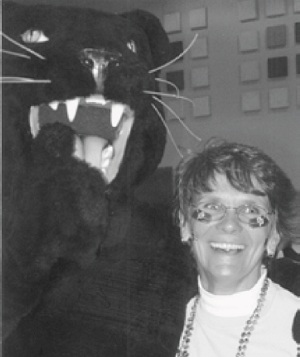
A 1973 graduate of Comstock Park, Gillette began coaching at the school just a year later. A four-sport athlete in high school, she eventually coached girls tennis, softball, volleyball and middle school basketball while also joining the district’s teaching staff in 1977 after attending Grand Rapids Community College and Grand Valley State (playing two sports at the former). Gillette then served as the high school athletic director beginning in 1990.
Under her leadership, Comstock Park served host to numerous MHSAA postseason tournaments, including 15 Lower Peninsula Track and Field Finals and multiple Girls Competitive Cheer Finals. Gillette also was active with the Michigan Interscholastic Athletic Administrators Association, serving as a presenter at numerous conferences and developing a coaches handbook.
“Few administrators have such a long record of hosting MHSAA Finals, evidence again of Janet Gillette’s drive to contribute not only at Comstock Park, but to high school sports on a larger scale,” said John E. “Jack” Roberts, executive director of the MHSAA. “Her involvement with female athletics dates back nearly to their inception. Jan’s impact will continue to be felt for years to come, and her contributions set a high standard for administrators in the future. We’re proud to honor her with the Women In Sports Leadership Award.”
Girls sports have evolved the most since Gillette first joined the athletic scene. Back then, seasons were only eight weeks, and volleyball, bowling and softball were not yet sponsored by the MHSAA. “To see what we have now, it’s just awesome,” Gillette said.
She is a member of the Comstock Park Athletic Hall of Fame, and has been recognized as Regional Athletic Director of the Year by the MIAAA, Athletic Director of the Year by the Michigan Competitive Cheer Coaches Association and the West Michigan Basketball-Football Association, and Comstock Park Employee of the Year in 2004. She also received the MHSAA’s Allen W. Bush Award in 2006 for her service to high school athletics.
In the community, Gillette has served as a coach in the Northwest Little League and been active with the Alpine Baptist Church as an AWANA Director and a Sunday School teacher.
“Mrs. G” hardly has disappeared from the school scene. She still manages the school’s volleyball tournaments and cheer invitationals, and the 250-person effort that makes the Division 3 Track and Field Final happen each spring.
She’s the first to credit all of those helpers, as well as the school boards, principals and superintendents who led the district during her career.
“I love Comstock Park. I love the community. I grew up there, and my dream was always to become a coach and a teacher,” Gillette said. “I didn’t want to do anything else because of the impact my teachers and the staff had on me, and the coaches.
“To go back to your own home town, what better could there be?”
Past Women In Sports Leadership Award recipients
1990 – Carol Seavoy, L’Anse
1991 – Diane Laffey, Harper Woods
1992 – Patricia Ashby, Scotts
1993 – Jo Lake, Grosse Pointe
1994 – Brenda Gatlin, Detroit
1995 – Jane Bennett, Ann Arbor
1996 – Cheryl Amos-Helmicki, Huntington Woods
1997 – Delores L. Elswick, Detroit
1998 – Karen S. Leinaar, Delton
1999 – Kathy McGee, Flint
2000 – Pat Richardson, Grass Lake
2001 – Suzanne Martin, East Lansing
2002 – Susan Barthold, Kentwood
2003 – Nancy Clark, Flint
2004 – Kathy Vruggink Westdorp, Grand Rapids
2005 – Barbara Redding, Capac
2006 – Melanie Miller, Lansing
2007 – Jan Sander, Warren Woods
2008 – Jane Bos, Grand Rapids
2009 – Gail Ganakas, Flint; Deb VanKuiken, Holly
2010 – Gina Mazzolini, Lansing
2011 – Ellen Pugh, West Branch; Patti Tibaldi, Traverse City
PHOTOS courtesy of Comstock Park High School.
Voice of Athletes Heard, Recognized
March 17, 2014
By Geoff Kimmerly
Second Half editor
For more than 40 years, Escanaba’s Dan Flynn has served in just about every role possible in educational athletics. He’s lent his expertise to every group involved with sports at the high school level.
But above all, he’s made sure to advocate for those at the center of our games – the student-athletes taking part.
 Flynn has coached, officiated and served as an athletic director, and also was a longtime member of the MHSAA Representative Council. In recognition of his contributions – and the voice he so often provided for those playing sports – Flynn has been named the 2014 recipient of the MHSAA's Charles E. Forsythe Award.
"My focus has been taking care of kids and helping kids have success. It's the essence of education, the essence of coaching," Flynn said. "The coaches help, the schools help, the parents help provide the programs. But the reason is the kids.”
The annual award is in its 37th year and is named after former MHSAA Executive Director Charles E. Forsythe, the Association's first full-time and longest-serving chief executive. Forsythe Award recipients are selected each year by the MHSAA Representative Council, based on an individual's outstanding contribution to the interscholastic athletics community. Flynn will receive his honor during the break after the first quarter of the MHSAA Class A Boys Basketball Final on March 22 at the Breslin Student Events Center in East Lansing.
Flynn, 67, joined the staff at Escanaba High School as a teacher and coach in 1971 and eventually served as the varsity wrestling coach from 1973-84, varsity football coach from 1985-2011 and varsity boys track and field coach from 1992-2002. He also served as athletic director from 1983-96 and an assistant principal for five years.
Flynn also represented the Upper Peninsula as an elected member of the MHSAA Representative Council from 1988-2010 and worked on the Council’s Executive Committee.
“He’s a coach at heart. He was very student-athlete oriented in his thinking about MHSAA policies and programs and was a dependable voice to bring up the student perspective,” MHSAA Executive Director John E. “Jack” Roberts said. “While he spent his career in the Upper Peninsula, he was capable of thinking about the good for the state as a whole. We’re proud to honor Dan Flynn with the Forsythe Award.”
Before beginning at Escanaba, Flynn taught and coached at Ishpeming High School, including leading the wrestling program from 1967-71. He coached Ishpeming to an MHSAA Upper Peninsula wrestling championship in 1971 and then Escanaba’s wrestling team to six MHSAA U.P. titles in nine seasons. As an assistant football coach for the Eskymos he helped lead the team to the MHSAA Class A title in 1981 and a runner-up finish in 1979.
He also served as a track and field official for 42 seasons, and this fall returned to coaching as a football assistant at Marquette High School.
Flynn received an MHSAA Allen W. Bush Award in 2000 for his contributions to the association. He was inducted into the Michigan High School Coaches Association Hall of Fame in 2001, the Michigan High School Football Coaches Association Hall of Fame in 2003 and the Upper Peninsula Sports Hall of Fame in 2009.
“It was awfully important to me that the kids across the state had a voice in the Representative Council,” Flynn said. “I thought I had something to say. And I was taught by some really good people, Jack Roberts, (associate directors) Jerry Cvengros and Tom Rashid, that I needed to listen to take care of people.”
His contributions to his community reach outside athletics as well. Flynn has participated in the Youth Assistance Program and American Heart Association in Delta County and as a CPR instructor for the Superior Upper Peninsula chapter of the American Red Cross.
Flynn grew up in Chicago and received his bachelor’s degree in health and physical education from Northern Michigan University in 1969 and a master’s from NMU in 1993, and played football for the Wildcats as an undergrad. He also studied at Utah State University and the University of Oregon.
Past recipients of the Charles E. Forsythe Award
1978 - Brick Fowler, Port Huron; Paul Smarks, Warren
1979 - Earl Messner, Reed City; Howard Beatty, Saginaw
1980 - Max Carey, Freesoil
1981 - Steven Sluka, Grand Haven; Samuel Madden, Detroit
1982 - Ernest Buckholz, Mt. Clemens; T. Arthur Treloar, Petoskey
1983 - Leroy Dues, Detroit; Richard Maher, Sturgis
1984 - William Hart, Marquette; Donald Stamats, Caro
1985 - John Cotton, Farmington; Robert James, Warren
1986 - William Robinson, Detroit; Irving Soderland, Norway
1987 - Jack Streidl, Plainwell; Wayne Hellenga, Decatur
1988 - Jack Johnson, Dearborn; Alan Williams, North Adams
1989 - Walter Bazylewicz, Berkley; Dennis Kiley, Jackson
1990 - Webster Morrison, Pickford; Herbert Quade, Benton Harbor
1991 - Clifford Buckmaster, Petoskey; Donald Domke, Northville
1992 - William Maskill, Kalamazoo; Thomas G. McShannock, Muskegon
1993 - Roy A. Allen Jr., Detroit; John Duncan, Cedarville
1994 - Kermit Ambrose, Royal Oak
1995 - Bob Perry, Lowell
1996 - Charles H. Jones, Royal Oak
1997 - Michael A. Foster, Richland; Robert G. Grimes, Battle Creek
1998 - Lofton C. Greene, River Rouge; Joseph J. Todey, Essexville
1999 - Bernie Larson, Battle Creek
2000 - Blake Hagman, Kalamazoo; Jerry Cvengros, Escanaba
2001 - Norm Johnson, Bangor; George Lovich, Canton
2002 - John Fundukian, Novi
2003 - Ken Semelsberger, Port Huron
2004 – Marco Marcet, Frankenmuth
2005 – Jim Feldkamp, Troy
2006 – Dan McShannock, Midland; Dail Prucka, Monroe
2007 – Keith Eldred, Williamston; Tom Hickman, Spring Lake
2008 – Jamie Gent, Haslett; William Newkirk, Sanford-Meridian
2009 – Paul Ellinger, Cheboygan
2010 – Rudy Godefroidt, Hemlock; Mike Boyd, Waterford
2011 – Eric C. Federico, Trenton
2012 – Bill Mick, Midland
2013 – Jim Gilmore, Tecumseh; Dave Hutton, Grandville
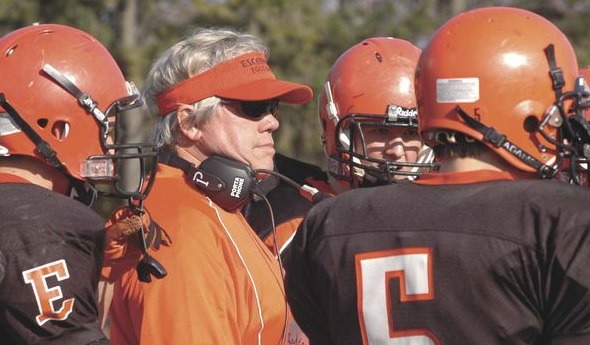
PHOTO: Dan Flynn coaches his football team at Escanaba before stepping down from that post after the 2011 season. (Photo courtesy of the Escanaba Daily Press.)