

Inglis Finds Next Home at MHSAA
By
Geoff Kimmerly
MHSAA.com senior editor
December 4, 2013
The theme chosen by Portage Northern’s student section for its hockey Regional Final in 1989 was “Kings of the Ice,” and as such they wore Burger King crowns as a sign of the royalty their classmates soon would earn.
Just before team captain Cody Inglis accepted the championship trophy, he skated to his friends and was anointed as well as one placed a crown upon his head.
Golden cardboard and all, Inglis received his team’s prize and circled the ice.
Inglis returned home that night eager to discuss the highlights with his dad Bill, a former professional player and one-time coach of the NHL’s Buffalo Sabres. But there was only one thing Bill had to say – and it’s a principle that’s continued to guide Cody throughout his career in high school athletics.
“I was really looking for his input and congratulations, and he looked at me and said very succinctly, ‘There’s a right way and a wrong way to do things. And you chose the wrong way,’” Inglis remembered this week. “At the time, I couldn’t see it with the perspective of a 17-year-old kid. But now I look back on it as the most valuable life lesson I’ve ever gotten.
“I knew he was proud of me. But the lesson he was trying to impart on me was doing things the right way is much more important than winning.”
Inglis has been doing things the right way for two decades while serving first at Suttons Bay and then Traverse City Central High School. He’ll bring a winning list of achievements and wealth of knowledge when he joins the Michigan High School Athletic Association staff as an assistant director in January.
Inglis, 42, has served as athletic director and assistant principal at Traverse City Central since February 2008, taking over after 11 years as athletic director at Suttons Bay. He also has served as secretary for both the Big North and Northwest Conferences and for 13 years as the northern Lower Peninsula representative of 125 athletic directors for the Michigan Interscholastic Athletic Administrators Association.
Inglis will serve as the MHSAA’s director of ice hockey, girls and boys cross country, girls and boys golf, and girls and boys bowling. In addition, he will assist in the direction of girls and boys skiing and girls and boys track and field, and be in charge of the junior high and middle school committee. Inglis also will assist with the administration of the MHSAA’s Coaches Advancement Program and provide his expertise as an instructor.
“We had more than 100 candidates, including a half dozen of the finest ADs in America – not just Michigan. They couldn’t be any better,” MHSAA Executive Director John E. “Jack” Roberts said. “Cody’s selection was based in part on his being just a slightly better fit to the job description we had in mind.
“He’s had to do some tough things as an administrator. But he’s got a personality that causes people to rally around him.”
On the move
Inglis’ dad, Bill, spent 50 years in pro hockey, most of his final 20 as general manager of the Kalamazoo K-Wings, and Cody grew up in lockerrooms around future pros like Ron Hextall, Dirk Graham and Marty Turco. When the Toledo Goaldiggers won the IHL’s Turner Cup when Cody was in sixth grade, he got to carry the cup through downtown. The family moved 17 times, and prior to the stop in Kalamazoo, Cody had never lived anywhere longer than 2½ years.
Inglis graduated from Portage Northern High School in 1989 and went on to Hope College, where he earned a bachelor’s degree in physical education and his teaching certification. He also was the captain of Hope’s 1992 men’s cross country team and captain of the men’s track & field team in both 1992 and 1993, and earned academic All-America honors for cross country.
Given his ties to pro hockey, Inglis might have had an opportunity to follow his dad. But it wasn’t for him. After graduating from Hope, Inglis enrolled at Western Michigan University to study sports management. He went to class for one day and withdrew – his heart just wasn’t into it.
 Instead, Inglis hooked up with his Portage Northern cross country coach Bill Fries and found what he did want to do – coach, and in doing so, teach athletics.
The rest is northern Lower Peninsula history.
Inglis hooked on at Suttons Bay as a 23-year physical education teacher and head cross country and track & field coach, and two years later took over the athletic department.
“I was thrown into the fire right away, but I had a desire to be in sports somehow and coaching was a passion of mine,” Inglis said. “It was kinda sink or swim. I realized the craziness and hecticness of it, but it was something I embraced. I was lucky to have the opportunity to do it at Suttons Bay, to grow there and have people who were willing to let me make some mistakes, learn from my mistakes and become a better administrator.”
Inglis has supervised a group of more than 100 coaches while at Traverse City Central, plus a group of more than 20 teachers and staff as part of his assistant principal duties.
He’s managed more than 100 MHSAA Tournaments, including Ski Finals, Football Semifinals and Hockey Quarterfinals, and a variety of lower tournament levels for hockey, wrestling, track and field, cross country, basketball and golf.
His programs have achieved plentiful success under his leadership. Traverse City Central won the Big North Conference all-sport award every year from 2008-12 and earned six MHSAA Finals team championships during his tenure. The varsity programs have produced 34 academic all-state awards over the past three school years – including 14 in 2012-13 – and 62 percent of the student body was involved in athletics last school year.
While at Suttons Bay, Inglis led an athletic program that won the Northwest Conference sportsmanship trophy nine times and earned two MHSAA Finals championships. He also redeveloped athletic boosters programs, oversaw construction projects and was instrumental in the rewriting of athletic policies at both schools.
He was recognized in the spring with the MHSAA’s Allen W. Bush Award, which recognizes those who serve in high school athletics but do not always receive attention for their contributions.
Mentor to follow
Inglis was instrumental in the creation and later served as an assistant coach for the Traverse City Bay Reps ice hockey team, a co-operative headed by Traverse City St. Francis High School that’s now been in existence 15 seasons. He also was named Division 4 Girls Cross Country Coach of the Year in 2002 by the Michigan Interscholastic Track Coaches Association after leading his team to a runner-up finish at the MHSAA Finals.
Inglis coached a string of girls cross country teams that made the top 10 at MHSAA Finals five straight seasons, plus 25 all-state athletes in cross country and track and field including three individual MHSAA champions.
He has been a member of seven MHSAA sport committees, including for ice hockey. He’s been a frequent presenter at the MIAAA’s annual conferences, covering topics including fundraising, budgeting, organizing successful tournaments, balancing multiple roles and responsibilities, leadership and technology. He’s also taught MIAAA Leadership Training Courses.
Of little surprise, Inglis has been greatly impacted by growing up following his dad. While mother Jeris was the rock of the family, Bill was Cody’s idol and made a significant impact on the manager Inglis has become.
“My dad was so good at the way he treated people. I just saw how he treated them, whether it was the Zamboni drive or an assistant or secretary, he treated them with so much respect,” Inglis said. “That’s the part I’ve really taken from him, how he treated people and the relationships he made. How you treat people in athletics is so key; they’ll treat you the same way back, I’ve found most of the time.”
Inglis received minor degrees at Hope in business administration and communications, and has completed a number of courses toward a master’s in athletic administration from Ohio University.
He is married to Carrie (Ham) Inglis, an MHSAA Finals cross country individual champion for Big Rapids in 1987. They have three sons.
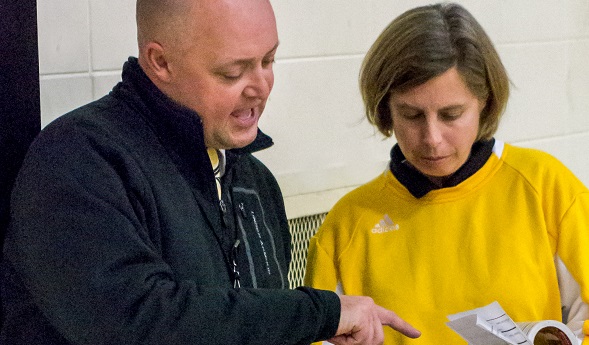
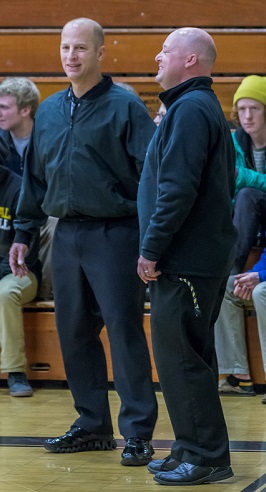
PHOTO: (Top) Traverse City Central athletic director Cody Inglis converses with a member of his staff Tuesday. (Middle) Inglis shares a laugh with an official before Tuesday's girls basketball games. (Photos courtesy of Rick Sack.)
2019 Scholar-Athlete Finalists Announced
By
Geoff Kimmerly
MHSAA.com senior editor
January 22, 2019
By Geoff Kimmerly
Second Half editor
The 120 finalists for the Michigan High School Athletic Association's Scholar-Athlete Awards for the 2018-19 school year, presented by Farm Bureau Insurance, have been announced.
The program, in its 30th year, has recognized student-athletes since the 1989-90 school year and again this winter will honor 32 individuals from MHSAA member schools who participate in at least one sport in which the Association sponsors a postseason tournament.
Farm Bureau Insurance underwrites the Scholar-Athlete Awards and will present a $1,000 scholarship to each recipient. Since the beginning of the program, 768 scholarships have been awarded.
Scholarships will be presented proportionately by school classification, with 12 scholarships to be awarded to Class A student-athletes, six female and six male; eight scholarships will be awarded to Class B student-athletes, four female and four male; six scholarships will be awarded to Class C student-athletes, three female and three male; and four scholarships will be awarded to Class D student-athletes, two female and two male. In addition, two scholarships will be awarded at-large to minority recipients, regardless of school size.
Every MHSAA member high school could submit as many applications as there are scholarships available in its classification, and could have more than one finalist. Detroit Catholic Central has four finalists this year while Bloomfield Hills Cranbrook Kingswood, Mount Pleasant Sacred Heart, Northville and St. Joseph each have three. Twelve schools each have two finalists: Ann Arbor Pioneer, Big Rapids, Davison, Fenton, Grand Rapids West Catholic, Grosse Pointe South, Marlette, Novi, Okemos, Saranac, Traverse City Central and White Lake Lakeland.
Multiple-sport participation remains the norm among applicants. The average sport participation rate of the finalists is 2.4. There are 77 three-plus sport participants in the finalists field, and all but two of the 28 sports in which the MHSAA sponsors postseason tournaments are represented.
Of 418 schools which submitted applicants, 30 submitted the maximum allowed. This year, 1,645 applications were received. All applicants will be presented with certificates commemorating their achievement. Additional Scholar-Athlete information, including a complete list of scholarship nominees, can be found on the MHSAA Website.
The applications were judged by a 65-member committee of school coaches, counselors, faculty members, administrators and board members from MHSAA member schools. Selection of the 32 scholarship recipients will take place in early February. Class C and D scholarship recipients will be announced Feb. 5, Class B scholarship recipients will be announced Feb. 12 and Class A scholarship recipients will be announced Feb. 19. All announcements will be made on the MHSAA Website.
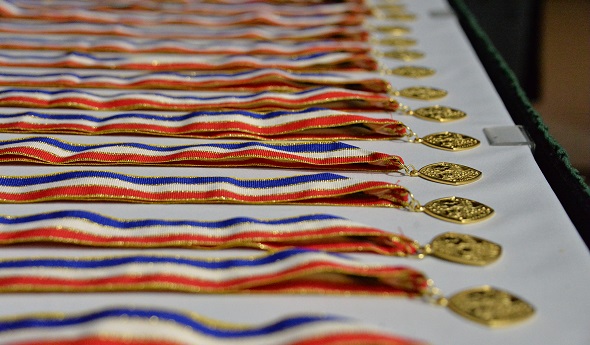
To honor the 32 Scholar-Athlete Award recipients, a ceremony will take place during halftime of the Class C Boys Basketball Final, March 16, at the Breslin Student Events Center in East Lansing.
To be eligible for the award, students must have a cumulative grade-point average of 3.50 (on a 4.0 scale) and previously have won a varsity letter in at least one sport in which the MHSAA sponsors a postseason tournament. Students also were asked to respond to a series of short essay questions, submit two letters of recommendation and a 500-word essay on the importance of sportsmanship in educational athletics.
Farm Bureau Insurance of Michigan was founded in 1949 by Michigan farmers who wanted an insurance company that worked as hard as they did. Those values still guide the company today and are a big reason why it is known as Michigan’s Insurance Company, dedicated to protecting the farms, families, and businesses of this great state. Farm Bureau Insurance agents across Michigan provide a full range of insurance services—life, home, auto, farm, business, retirement, Lake Estate®, and more—protecting nearly 500,000 Michigan policyholders.
The MHSAA is a private, not-for-profit corporation of voluntary membership by more than 1,500 public and private senior high schools and junior high/middle schools which exists to develop common rules for athletic eligibility and competition. No government funds or tax dollars support the MHSAA, which was the first such association nationally to not accept membership dues or tournament entry fees from schools. Member schools which enforce these rules are permitted to participate in MHSAA tournaments, which attract more than 1.4 million spectators each year.
2018-19 Scholar-Athlete Award Finalists
BOYS CLASS A
Colin Czajkowski, Brownstown Woodhaven
David DeBacker, Detroit Catholic Central
Joseph Hardenbergh, Detroit Catholic Central
Keegan Koehler, Detroit Catholic Central
Ryan Marra, Detroit Catholic Central
Jack Killian, Fenton
Noah Stout, Grand Rapids Forest Hills Central
Ryan Downey, Grosse Pointe South
Michael Willard, Grosse Pointe South
Samuel Martens, Holland
Carson Currie, Lapeer
Noah Kinnucan, Muskegon Mona Shores
Daniel McLaughlin, Northville
Matthew George, Novi
Trey Mullins, Novi
Carson Krumm, Okemos
Harrison Poeszat, Orchard Lake St. Mary's
Parker Raymond, Rochester Adams
Nolan Rich, St. Joseph
Edward Roe, Traverse City Central
Michael Song, Troy
John Tisch, Utica
Trent Farquhar, White Lake Lakeland
Avery Robinson, Wyoming
GIRLS CLASS A
Anna Scott, Ann Arbor Huron
Alexa Easter, Ann Arbor Pioneer
EmJ Rennich, Ann Arbor Pioneer
McKenna Evans, Battle Creek Lakeview
Ariella Cuellar, Bay City Central
Emily Moriartey, Davison
Ellie Timmons, Davison
Audrey Whiteside, East Grand Rapids
Chloe Idoni, Fenton
Lexi Loehfelm, Grand Rapids Forest Hills Northern
Adele Kemp, Greenville
Addison Irish, Hudsonville
Maya Albright, Midland
Mariella Simoncini, Northville
Claire Wan, Northville
Alma Cooper, Okemos
Yveloute Rea, Petoskey
Elizabeth Bulat, Rochester
Megan Corbe, St. Joseph
Cailey Rooker, St. Joseph
Jade Turner, Traverse City Central
Madeline Purvis, Troy Athens
Madeline Rehm, White Lake Lakeland
Megan Morehouse, Zeeland East
BOYS CLASS B
Sam Bussler, Battle Creek Harper Creek
Pierce Morrissey, Big Rapids
Clark Doman, Bloomfield Hills Cranbrook Kingswood
Justin Luo, Bloomfield Hills Cranbrook Kingswood
Alex Netzley, Cadillac
Noah Doederlein, Carleton Airport
Adam Bruce, Gladstone
Jack Perry, Michigan Center
Connor Swinehart, Newaygo
Michael Gormley, North Branch
Isaac Waffle, Olivet
Tommee Smith, Sparta
Cooper Clark, Stevensville Lakeshore
Dillon Mochty, Tawas
Dylan Day, Tecumseh
Ethan McKenzie, Whitehall
GIRLS CLASS B
Kamryn Cushway, Big Rapids
Salena Prakah-Asante, Bloomfield Hills Cranbrook Kingswood
Eleri Giem, Boyne City
Lauren Anderson, Charlotte
Olivia Haring, Clare
Daisy Ansel, Comstock
Sarah Bidgood, Comstock Park
Chloe Bartz, Edwardsburg
Zoe Neirink, Frankenmuth
Bridget Kohane, Grand Rapids West Catholic
Dana Wila, Grand Rapids West Catholic
Lindsey Jurecki, Grosse Ile
Robin LeFevere, Imlay City
Sophie Moccio, Milan
Emily Unger, Montague
Mallory Kean, Yale
BOYS CLASS C
Trey Feldeisen, Ann Arbor Greenhills
Brian Goetz, Blissfield
Timothy Marvin, Byron
Noah Waldron, Concord
Jared Swiontek, East Jackson
Alexander VanDeWeghe, Ithaca
Jack Sumners, Marcellus
Logan Marshall, Marlette
Logan Solgat, Marlette
Dane Smitz, Roscommon
Drew Ward, Saranac
Nathan Huizar, Vassar
GIRLS CLASS C
Sarah Barnes, Houghton Lake
Precious Delos Santos, Indian River Inland Lakes
Riley Poupore, Iron Mountain
Lauren Freeland, Kent City
Megan Dopheide, Lawton
Elizabeth O'Hotzke, Manchester
Joslyn Muth, Manistique
Rachel Allen, Mason County Central
Jordan Cooper, Saranac
Thea Johnson, Saugatuck
Lillian Bambacht, Union City
Jordan Craven, Whitmore Lake
BOYS CLASS D
Jake Lane, Climax-Scotts
Brendan LeClaire, Dollar Bay
William Newbold, Frankfort
John Slivka, Manistee Catholic Central
Ryan Yahner, McBain Northern Michigan Christian
Noah Krepostman, Mount Pleasant Sacred Heart
Brendan Zeien, Mount Pleasant Sacred Heart
Brandon Scheurer, Portland St. Patrick
GIRLS CLASS D
Keagan Fischer, Bellaire
Lyndsi Wolfe, Fulton
Natalie Woodland, Lansing Christian
Samantha Somers, Mackinaw City
Scout Nelson, Mount Pleasant Sacred Heart
Abbey Bullis, Peck
Jessie Rieth, Three Oaks River Valley
Julia Diskin, West Bloomfield Frankel Jewish Academy