

Inglis Finds Next Home at MHSAA
By
Geoff Kimmerly
MHSAA.com senior editor
December 4, 2013
The theme chosen by Portage Northern’s student section for its hockey Regional Final in 1989 was “Kings of the Ice,” and as such they wore Burger King crowns as a sign of the royalty their classmates soon would earn.
Just before team captain Cody Inglis accepted the championship trophy, he skated to his friends and was anointed as well as one placed a crown upon his head.
Golden cardboard and all, Inglis received his team’s prize and circled the ice.
Inglis returned home that night eager to discuss the highlights with his dad Bill, a former professional player and one-time coach of the NHL’s Buffalo Sabres. But there was only one thing Bill had to say – and it’s a principle that’s continued to guide Cody throughout his career in high school athletics.
“I was really looking for his input and congratulations, and he looked at me and said very succinctly, ‘There’s a right way and a wrong way to do things. And you chose the wrong way,’” Inglis remembered this week. “At the time, I couldn’t see it with the perspective of a 17-year-old kid. But now I look back on it as the most valuable life lesson I’ve ever gotten.
“I knew he was proud of me. But the lesson he was trying to impart on me was doing things the right way is much more important than winning.”
Inglis has been doing things the right way for two decades while serving first at Suttons Bay and then Traverse City Central High School. He’ll bring a winning list of achievements and wealth of knowledge when he joins the Michigan High School Athletic Association staff as an assistant director in January.
Inglis, 42, has served as athletic director and assistant principal at Traverse City Central since February 2008, taking over after 11 years as athletic director at Suttons Bay. He also has served as secretary for both the Big North and Northwest Conferences and for 13 years as the northern Lower Peninsula representative of 125 athletic directors for the Michigan Interscholastic Athletic Administrators Association.
Inglis will serve as the MHSAA’s director of ice hockey, girls and boys cross country, girls and boys golf, and girls and boys bowling. In addition, he will assist in the direction of girls and boys skiing and girls and boys track and field, and be in charge of the junior high and middle school committee. Inglis also will assist with the administration of the MHSAA’s Coaches Advancement Program and provide his expertise as an instructor.
“We had more than 100 candidates, including a half dozen of the finest ADs in America – not just Michigan. They couldn’t be any better,” MHSAA Executive Director John E. “Jack” Roberts said. “Cody’s selection was based in part on his being just a slightly better fit to the job description we had in mind.
“He’s had to do some tough things as an administrator. But he’s got a personality that causes people to rally around him.”
On the move
Inglis’ dad, Bill, spent 50 years in pro hockey, most of his final 20 as general manager of the Kalamazoo K-Wings, and Cody grew up in lockerrooms around future pros like Ron Hextall, Dirk Graham and Marty Turco. When the Toledo Goaldiggers won the IHL’s Turner Cup when Cody was in sixth grade, he got to carry the cup through downtown. The family moved 17 times, and prior to the stop in Kalamazoo, Cody had never lived anywhere longer than 2½ years.
Inglis graduated from Portage Northern High School in 1989 and went on to Hope College, where he earned a bachelor’s degree in physical education and his teaching certification. He also was the captain of Hope’s 1992 men’s cross country team and captain of the men’s track & field team in both 1992 and 1993, and earned academic All-America honors for cross country.
Given his ties to pro hockey, Inglis might have had an opportunity to follow his dad. But it wasn’t for him. After graduating from Hope, Inglis enrolled at Western Michigan University to study sports management. He went to class for one day and withdrew – his heart just wasn’t into it.
 Instead, Inglis hooked up with his Portage Northern cross country coach Bill Fries and found what he did want to do – coach, and in doing so, teach athletics.
The rest is northern Lower Peninsula history.
Inglis hooked on at Suttons Bay as a 23-year physical education teacher and head cross country and track & field coach, and two years later took over the athletic department.
“I was thrown into the fire right away, but I had a desire to be in sports somehow and coaching was a passion of mine,” Inglis said. “It was kinda sink or swim. I realized the craziness and hecticness of it, but it was something I embraced. I was lucky to have the opportunity to do it at Suttons Bay, to grow there and have people who were willing to let me make some mistakes, learn from my mistakes and become a better administrator.”
Inglis has supervised a group of more than 100 coaches while at Traverse City Central, plus a group of more than 20 teachers and staff as part of his assistant principal duties.
He’s managed more than 100 MHSAA Tournaments, including Ski Finals, Football Semifinals and Hockey Quarterfinals, and a variety of lower tournament levels for hockey, wrestling, track and field, cross country, basketball and golf.
His programs have achieved plentiful success under his leadership. Traverse City Central won the Big North Conference all-sport award every year from 2008-12 and earned six MHSAA Finals team championships during his tenure. The varsity programs have produced 34 academic all-state awards over the past three school years – including 14 in 2012-13 – and 62 percent of the student body was involved in athletics last school year.
While at Suttons Bay, Inglis led an athletic program that won the Northwest Conference sportsmanship trophy nine times and earned two MHSAA Finals championships. He also redeveloped athletic boosters programs, oversaw construction projects and was instrumental in the rewriting of athletic policies at both schools.
He was recognized in the spring with the MHSAA’s Allen W. Bush Award, which recognizes those who serve in high school athletics but do not always receive attention for their contributions.
Mentor to follow
Inglis was instrumental in the creation and later served as an assistant coach for the Traverse City Bay Reps ice hockey team, a co-operative headed by Traverse City St. Francis High School that’s now been in existence 15 seasons. He also was named Division 4 Girls Cross Country Coach of the Year in 2002 by the Michigan Interscholastic Track Coaches Association after leading his team to a runner-up finish at the MHSAA Finals.
Inglis coached a string of girls cross country teams that made the top 10 at MHSAA Finals five straight seasons, plus 25 all-state athletes in cross country and track and field including three individual MHSAA champions.
He has been a member of seven MHSAA sport committees, including for ice hockey. He’s been a frequent presenter at the MIAAA’s annual conferences, covering topics including fundraising, budgeting, organizing successful tournaments, balancing multiple roles and responsibilities, leadership and technology. He’s also taught MIAAA Leadership Training Courses.
Of little surprise, Inglis has been greatly impacted by growing up following his dad. While mother Jeris was the rock of the family, Bill was Cody’s idol and made a significant impact on the manager Inglis has become.
“My dad was so good at the way he treated people. I just saw how he treated them, whether it was the Zamboni drive or an assistant or secretary, he treated them with so much respect,” Inglis said. “That’s the part I’ve really taken from him, how he treated people and the relationships he made. How you treat people in athletics is so key; they’ll treat you the same way back, I’ve found most of the time.”
Inglis received minor degrees at Hope in business administration and communications, and has completed a number of courses toward a master’s in athletic administration from Ohio University.
He is married to Carrie (Ham) Inglis, an MHSAA Finals cross country individual champion for Big Rapids in 1987. They have three sons.
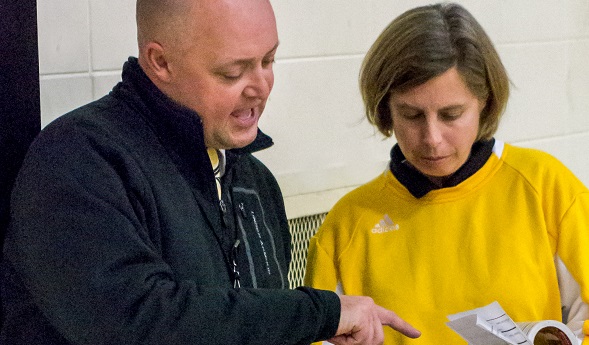
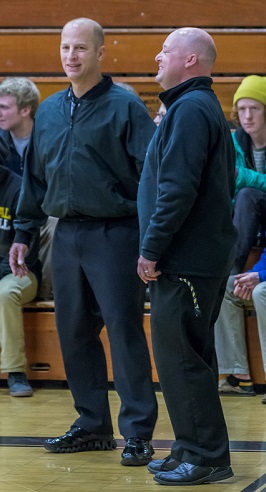
PHOTO: (Top) Traverse City Central athletic director Cody Inglis converses with a member of his staff Tuesday. (Middle) Inglis shares a laugh with an official before Tuesday's girls basketball games. (Photos courtesy of Rick Sack.)

Brighton's Brown Brings Holiday Joy
May 22, 2017
By Geoff Kimmerly
Second Half editor
Bailey Brown will begin at Oakland University this fall with plenty to drive her through what at times will be grueling studies as she prepares for a career in pediatric medicine.
 As the oldest of six siblings, she’s always been around kids – and she loves it that way and looks forward to caring for them as their doctor. But sadly, though just a senior at Brighton, she’s already experienced her share of hospital life – although those tough times also provide motivation and inspired another mission as well.
Brown ran across an advertisement this past winter in an American Girl catalog for dolls without hair – an amazing idea, she thought, because it allows children who have lost their hair during cancer treatment to have a doll that looks just like them.
She decided to raise enough money -- $230 – to buy two dolls for little girls spending Christmas in the hospital. Brown – a recipient of an inaugural MHSAA/Lake Trust Credit Union “Community Service Award” – ended up with more than $5,000 and an opportunity to play Santa Claus to many more thankful families.
“I couldn’t believe how fast things grew. It was hard to keep track of all the donations, but people were just messaging me on Facebook – I couldn’t believe people wanted to do that,” Brown said. “I never thought I’d be able to make such a big difference.”
The Community Service Awards recognize contributions by Michigan’s high school student-athletes away from the field. Brown, a cross country and track runner for the Bulldogs, will use her $1,000 award as a scholarship toward her education at Oakland, where she’ll be part of the Honors College. Six honorees total are receiving awards this spring; Second Half is featuring one a day this week.
 Since seventh grade, Brown has battled what was diagnosed her freshman year as amplified musculoskeletal pain syndrome – an abnormally overactive pain reflex that for Brown caused head-to-toe pain especially in her neck and back, making it difficult to sit and do school work. She also had to stop playing soccer completely and running for a time because of pain in her hips. As a junior, she was diagnosed with bone spurs and torn labrums in both hips, requiring multiple surgeries. As she worked to recover that winter, she had to enter treatment for anorexia after losing 25 percent of her body weight.
Despite those challenges, she managed to build a 3.88 grade-point average to rank among the top 15 percent in her graduating class. She also came back to continue running cross country and returned to the track this spring for the first time since eighth grade, while also participating in National Honor Society and her school’s Interact club.
As a doctor, Brown hopes to help children and teenagers who might be going through the same. Her service over the winter was aimed especially at children who would have to remain in the hospital over the holidays.
The outpouring of donations allowed her to affect many more families than she would’ve at first imagined – she was able to purchase 48 dolls plus hundreds of toys for little boys also undergoing cancer treatment. She delivered the dolls and toys to University of Michigan’s C.S. Mott Children’s Hospital, where she volunteered in the annual Mott Toy Shop that allows parents to pick up gifts for their children free of charge – saving money and time shopping “to make Christmas much easier and children a lot happier.”
Brown surely will be busy jumping into her first year of college, and she still fights pain although running and deep tissue massage alleviate some of it. But she said she’d like to start another campaign for hospitalized kids like the one that came off so successfully this past winter, maybe something even larger in scope.
“I am proud of everything I have accomplished despite my setbacks,” Brown wrote in her award application, “and look forward to touching even more lives this year.
“I have learned never give up, no matter how many obstacles are thrown my way.”
The Community Service Awards are sponsored by the Michigan High School Athletic Association and Lake Trust Credit Union to recognize student-athletes' efforts to improve the lives of others in their communities. In addition to the $1,000 award, the Lake Trust Foundation is awarding an additional $500 to each honoree, to be donated to a non-profit, 501 (c)(3) organization of the awardee’s choice.
PHOTO: (Top) Brighton’s Bailey Brown stands with some of her donation of toys to the C.S. Mott Children’s Hospital this past winter. (Middle) Brown is recognized by Mott on its Instagram feed. (Photos courtesy of Bailey Brown.)
2017 Community Service Awards
Sunday: Colon "Yard Squad" - Read