

Inman's 'Spirit' Recognized by NFHS
March 12, 2019
By John Gillis
Special from NFHS
Searra Inman, a student-athlete at Niles Brandywine High School, has been selected as the Section 4 recipient of the “National High School Spirit of Sport Award” by the National Federation of State High School Associations (NFHS).
The National High School Spirit of Sport Award was created by the NFHS to recognize those individuals who exemplify the ideals of the spirit of sport that represent the core mission of education-based athletics.
A soccer and wrestling participant during her athletic career at Brandywine High School, Inman’s life changed forever during the summer between her junior and senior years.
At that time, she was diligently preparing for her senior wrestling season. With 75 career victories to her credit, she had two goals – to achieve 100 victories and to earn a four-year varsity wrestling plaque.
On July 9, 2018, Inman was involved in a motorcycle crash that left her with a displaced vertebral fracture that severed her spinal cord and resulted in her being paralyzed from the waist down.
Inman underwent surgical procedures at Indiana University Health Methodist Hospital. Surgeons in Indianapolis used her as a case study due to the fact that almost no one with such severe spinal cord injuries had reached the operating table alive. Her initial prognosis was that she would remain hospitalized into January 2019.
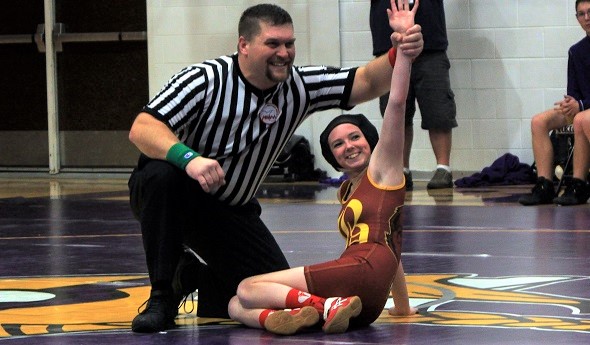
However, on Sept. 14, 2018, Inman led her school’s football team onto the field for its Week 4 game. Then, during Brandywine High School’s December 5th wrestling season opener with Bronson High School, Inman locked her wheelchair, crawled in uniform to the circle of the wrestling mat, and was awarded a forfeit win in the 103-pound weight class.
However, the best might have been saved for last when during a Feb. 12 Division 4 Regional match against Schoolcraft, Inman once again moved to the center of the mat, had her hand raised for another forfeit, and in the process, got victory No. 100 and accomplished her mission.
Click to read the Second Half report "In Her Fight, Inman Seeks to Provide Hope" published earlier this winter.
About the Award
The NFHS divides the nation into eight geographical sections. The states in Section 4 are Michigan, Wisconsin, Illinois, Indiana and Iowa.
Nominations for this award were generated through NFHS member state associations and reviewed by the NFHS Spirit of Sport Award Selection Committee composed of state association staff members.
While the national winner will be recognized June 29 at the NFHS Summer Meeting in Indianapolis, Indiana, the section winners will be recognized within their respective states and will receive awards before the end of the current school year.
PHOTO: Searra Inman has her arm raised in victory during a match this season. (Photo courtesy of the Niles Brandywine wrestling program.)

Bowling, Boys Lacrosse Set Fan Records
August 17, 2018
By Geoff Kimmerly
Second Half editor
Two sports repeated in setting postseason attendance records during the 2017-18 school year, as 1,390,590 total fans attended Michigan High School Athletic Association postseason competitions for which attendance is recorded.
The MHSAA Bowling Tournament – including Regionals and Finals for girls and boys, set an attendance record for the seventh consecutive season this past winter with 14,422 fans. Boys lacrosse, which also begins postseason play at the Regional level, set a record for the second straight season this spring with 12,759 fans – including a record 7,344 for Regional games.
The MHSAA annually tracks attendance for all sports except golf, skiing and tennis – for which admission typically is not charged.
The 2017-18 grand total of just under 1.4 million fans was a decrease of 6.8 percent from 2016-17. However, a couple of circumstances likely factored into the majority of that decline.
The first two weeks of 11-player football playoffs generally are among the highest-drawing events every school year – and last year’s saw a 19 percent decrease from 2016-17, as Pre-District games were played in unseasonably frigid weather across the Lower Peninsula and District Finals were played amid storms in many parts of the state.
Also, the Individual Wrestling Finals saw a 33 percent decrease in attendance after moving to Ford Field in Detroit from its previous home at The Palace of Auburn Hills. However, that decrease is misleading; the event went from three days and five sessions (with tickets required for each session) at The Palace to a two-day, three-session event at Ford Field. The average attendance per session this past winter actually increased by 892 fans from 2016-17.
Despite the District level decreases, football remained the highest-drawing tournament sport sponsored by the MHSAA, with 352,946 fans attending during the 2017 Playoffs including 60,435 combined for the 11 and 8-Player Finals – the most at that level of the tournament since the 2009 season. The MHSAA added a second division of 8-player playoffs last fall; however, that additional championship game contributed only a small amount to the overall 68-percent increase in attendance from the 2016 Finals.
Boys Basketball drew the second-most fans in 2017-18 – 311,494 – keyed in part by a 5-percent increase at the Regional level. Girls Basketball remained the most highly attended girls sport with 158,546 fans – including 104,243 at the District level, the second-highest total at that level of the tournament since 2009-10. Volleyball was the second-highest attended girls sport this past school year, with 105,414 fans making for an overall increase of nearly 3 percent from the 2016-17 tournament – with increases in attendance enjoyed at the District, Regional, Quarterfinal and Finals levels.
Two more girls sports saw increased attendance in 2017-18. Girls Swimming & Diving enjoyed increases at both the Diving Qualification and MHSAA Finals levels for a total of 4,946 fans – a 7-percent increase from 2016-17. Girls Gymnastics also enjoyed increased attendance at both levels of its postseason for a grand total of 2,314 fans – the most for that sport since 2002-03 and an increase of 7 percent as well from the previous season.
Two more sports also set MHSAA Finals records. The Softball Finals, held in conjunction with the Baseball Finals at Michigan State University, drew 6,860 fans to set a record for the second straight season (and baseball drew its most Finals fans since the 2006 season). The Team Wrestling Finals – contended for the first time at Wings Event Center in Kalamazoo – enjoyed a 19-percent increase from 2016-17 with an audience of 9,469 fans that broke the record set at the conclusion of the 2004-05 season.
Also of note:
• Although girls lacrosse saw a slight dip in overall attendance to 5,538 fans this spring, that total still was the third-highest since the MHSAA began sponsoring a postseason tournament for the sport in 2004-05.
• Boys Soccer Districts drew 15,438 fans, the sport’s fourth straight increase at that level and the most to watch Districts since 2008-09.
• The Girls & Boys Cross Country Finals drew 10,445 fans, an increase of nearly 3 percent and the highest total in six seasons.
The MHSAA is a private, not-for-profit corporation of voluntary membership by more than 1,500 public and private senior high schools and junior high/middle schools which exists to develop common rules for athletic eligibility and competition. No government funds or tax dollars support the MHSAA, which was the first such association nationally to not accept membership dues or tournament entry fees from schools. Member schools which enforce these rules are permitted to participate in MHSAA tournaments, which attract more than 1.4 million spectators each year.