

Johnson Served as Storyteller, Guardian
By
Geoff Kimmerly
MHSAA.com senior editor
January 5, 2021
Promoting the value – and values – of school-based sports.
No statement more completely, or succinctly, explains the mission of the Michigan High School Athletic Association.
Those words were sparked in the mind of John Johnson, and also might best describe his work for the MHSAA over more than three decades – which concluded with his retirement Dec. 18.
Johnson’s official title for most of his tenure was communications director, by which he designed and delivered the message of the MHSAA’s work. A more suitable title might have been “guardian” – Johnson in 1987 joined the then 62-year-old organization and became keeper and protector of all the MHSAA had been and was becoming under its recently-hired executive director, Jack Roberts.
More than 33 years later, “JJ” has stepped away as the pioneer in his field and having impacted multiple generations of Michigan high school and middle school athletes in ways that will continue. Whether as the coiner of memorable slogans, the voice explaining the nation’s first elaborate sportsmanship effort or detailing the MHSAA’s work for its schools during tougher times, or simply as the narrator passing on some of the good stories the bubble up from every season, Johnson daily worked to keep those who follow school sports in the know.
 “Being the voice, and having to be the face a lot, is something that came with the territory – somebody had to be the storyteller. And while you can be prideful about that, the important thing is still the story,” Johnson said. “I’ve said it a lot: I was the lucky guy who got the job. Because the story was there to be told, the work was there to be done.”
Thousands upon thousands of times over the years, Johnson did that work with enthusiasm and grace. Most visibly, it came in front of a TV or radio microphone, or as quoted in your local newspaper and media nationwide. He has been the drive behind the MHSAA championship games watched annually on TV and online, and the messenger via various campaigns delivering the good news of why school sports are vital for kids and communities.
Serving as that storyteller, Johnson has never been one to tell much of his own. But there is no shortage of storytellers who have benefitted from Johnson’s wisdom and tutelage over the years – and we were enable to enlist a few to paint a more vivid picture as we recount at least a glance of what Johnson has meant to the MHSAA and its schools over these many years.
***
“The measure of all of us is what we leave behind. Those with whom we’ve been in contact. Those we’ve lifted up along the way. And by that measure, we are witnessing the end of a spectacular career. I’ll take away from all the exchanges, the ready smile, the encyclopedic knowledge that JJ possessed and the sense of calm within the frenzy. It was invaluable to those who popped into his world only a few times a year. John Johnson has left very large shoes in East Lansing.”
– John Keating, longtime FOX Sports Detroit anchor and host for many MHSAA Football and Basketball Finals
***
First and 1 of a Kind
Jack Roberts became the fourth full-time executive director of the MHSAA during the summer of 1986. He brought an emphasis on communication, and “communications director” became the first position he created in East Lansing.
Johnson in 1987 became that first communications specialist at the MHSAA, beginning a long last stop during a run in sports that Johnson began as a student at Mount Pleasant Sacred Heart, about an hour’s drive north of Lansing.
Johnson hadn’t played sports at Sacred Heart, but had taken part in just about every other way possible for a student. He was a team manager, statistician, student trainer, and picked up part-time sports writing work at the former Mt. Pleasant Daily Times. He wrote a series while still in high school on the creation of the MHSAA football playoffs, which were set to kick off in 1975, and that series was syndicated among the newspapers in the Daily Times’ chain. As a student, Johnson moved on to Michigan State University where he majored in journalism, and again he was published and syndicated by the Daily Times – this time for a series on how game officials were being trained by state associations, including the MHSAA.
That series foreshadowed the work he would take up a decade later – it closed with a piece on poor spectatorship toward officials. (Coincidentally, the collection of stories had been clipped and saved by the MHSAA executive director at the time, Vern Norris. The file found its way to Roberts, who eventually found out he had just hired the author.)
Also having served as a student assistant in the MSU sports information office, Johnson began his communications career at Albion College in 1978 as an assistant in the college relations office with responsibility for publicity for the college’s 17 athletic teams. (He didn’t graduate from MSU until 1979, but received two days off per week to get back to East Lansing for classes. He also served as a radio voice for Albion High games on the side.) Johnson moved on to brief stints in the news department with WITL Radio in Lansing and as an intern in the Office of Public Affairs at Ferris State University before landing with the Western Michigan University sports information department as an assistant director.
That led to a three-year stint as an assistant sports information director at Indiana University, where his responsibilities included serving as SID for coach Bobby Knight’s men’s basketball program. Johnson also assisted with press operations at the 1984 U.S. Olympic Basketball Trials hosted by IU. Johnson then left Indiana in January 1986 for a promotions position at Michigan Farm Bureau.
Six months later, his eventual journey to the MHSAA accelerated.
Roberts was hired during the summer of 1986, and not long after he asked MSU sports information director Nick Vista who had been his best student assistant of the past decade. The answer: John Johnson.
Johnson and Roberts met multiple times over the next many months, and Roberts made his choice.
“From the first moment I sat down with Jack Roberts, I knew I wanted to be here,” Johnson said. “The way he talked so passionately about high school sports, and the values of high school sports. … I saw the opportunity to take Jack’s vision and run with it.”
The day before the announcement of Johnson’s hire was to be made, Roberts asked Johnson to come with him to Grand Rapids to watch South Christian basketball star Matt Steigenga (later of MSU and the NBA) – but Johnson couldn’t go because his wife Suzie had gone into labor with their first of two children.
But a little more than a month later, Johnson started at the MHSAA on April 1 – and that came with plenty of jokes on its own.
Yet while Johnson had to miss that trip to Grand Rapids, he and the executive director would get plenty of car time together – to the benefit of the MHSAA’s member schools. To introduce themselves to statewide media, Roberts and Johnson did a driving tour to visit all of them, touring their offices, talking to them about MHSAA initiatives and asking how Association staff could better assist the media in its work. Those drives also allowed them to dream up together “the kinds of things that were unveiled over time,” Roberts recalled.
“We talked so much those first 15 years, we could intuit each other’s thinking the last 15 years,” added Roberts, who retired from the MHSAA in 2018. “We didn’t spend nearly as much time together, but we didn’t need to.”
***
“John Johnson has positively influenced so many more people than he knows and more than anyone realizes. It starts with the thousands and thousands of people who have been able to watch high school sports on the web throughout Michigan. Live-streaming of games has really come to the forefront due to the pandemic, but he was on top of this innovation nearly a decade ago when it was just in the early idea stage. He has been the person who orchestrated and led the countless schools across the state who started streaming their games in the past several years.
“JJ has also impacted numerous student journalists who wanted to learn the craft by covering high school games. He has always been SO supportive of these aspiring broadcasters and writers and reporters, affording them the opportunities to cover high school championships on the biggest stages, and treating those students the same as their professional peers. The students got to be on the turf at Ford Field and in the postgame press rooms, even if their school's team wasn't involved in the game! All they had to do was ask for credentials, and he granted them time and time again.
“JJ's influence also touched those of us who work for the MHSAA in a freelance fashion at various championship events. He has helped so many of us become better communicators, announcers, statisticians, and more. He was always willing to provide feedback & opportunities to learn, and he served as our leader who was always accessible morning, noon, and night. He pushed us to be our best every game, just as the athletes were trying to be their best. It's been my pleasure to work for him as a PA announcer for several years now, and I tried to be perfect every single time because I knew he was listening and because I wanted to do well for him.”
– Roger Smith, advisor for Lake Orion High School’s nationally award-winning School Broadcast Program and public address announcer for MHSAA Finals
***
Telling the Story
In Roberts’ eyes, a few campaigns from his and Johnson’s time together stand out most.
• Promoting the Value – and Values of High School Sports. “I came in with “School Sports – the other half of education” but that wasn’t as good,” Roberts said. … (His words) caught our brand much better.”
• Good Sports are Winners. The MHSAA launched a sportsmanship initiative a few years into their tenures that was “unparalleled” nationally, per Roberts’ description. “Before sportsmanship was an 'in thing' to talk about, John and I were talking about it.” Johnson created all of the print and broadcast materials designed to promote improving sportsmanship, and his work helped make Michigan not just the leader but a voice nationally on the topic.
• Safer Than Ever. The campaign, stretching over much of the last decade, explained that high school football – for a variety of reasons – is safer than it has ever been. Johnson worked with the Michigan High School Football Coaches Association to build the messages and promote them at a time when injury fears were regularly headlining media coverage.
 “John made our ideas visible and practical. People would put them together at the league level and school district level,” Roberts said.
“To narrow (his work) down to three is unfair to him because he did a thousand things.”
And in a number of roles. Johnson started as communications director, picking up along the way responsibilities in information technology, marketing, merchandising and more. Everything from daily media questions to maintaining the MHSAA record book (and serving on the National Federation of State High School Associations (NFHS) national record book committee) fell onto Johnson’s desk, and just about any message read at any game by a public address announcer was his work. His final years were as “all things broadcasting” as Johnson served as the MHSAA’s first director of broadcast properties – an all-encompassing title that included all-encompassing responsibilities.
The MHSAA provides video broadcasts of nearly all of its MHSAA Finals – including football and basketball with FOX Sports Detroit – and Johnson has navigated the growth of those opportunities. Same with the MHSAA Network’s audio offerings during championship events, and his voice has been heard weekly during “This Week in High School Sports” which is aired as part of programming by more than 100 radio stations statewide.
The most significant advance under his guidance over the last two decades has been the School Broadcast Program, begun for MHSAA schools during the 2008-09 school year. The MHSAA relied on that knowledge in playing a leading role last decade in the formation of the NFHS Network – the nationwide digital home for live and on-demand high school events – and it’s not unusual for Michigan SBP schools to broadcast upwards of 500 events per week via the network.
“What people don’t necessarily know is John is the pioneer in this field,” MHSAA Executive Director Mark Uyl said. “The way he shaped this job over the last 30 years has been extraordinary – and has become the model for the 49 other states.”
***
“I’m sure that with me, JJ had to do things he never had done with anyone else – I was pregnant three straight schools years. The accommodations for me, even as just a female, it was kinda crazy especially in the 1980s. But when I was pregnant, I couldn’t walk up stairs, and he always would make special concessions for me, (like to) try to find bathrooms for me. There were so many media, and there always had to be exceptions, but he always had to take special care for me, and I’m so thankful for what he did. We laugh about that stuff all the time.
“I remember too, I had a tragedy in my family one year, and I know he was busy at the Finals, but he took me (aside), sat there and cried with me and talked with me. He took time out of his way. He treated me professionally, like everyone else. But as a person, he has such a gift to connect with people.”
– Jane Bos, longtime prep sports editor for the Grand Rapids Press and 2008 recipient of MHSAA Women In Sports Leadership Award
***
More than Scratching the Surface
The work Johnson pioneered at the MHSAA goes on. Formerly a staff of one (with help from valuable volunteers including long-time postseason assistant Walter Dell) now includes a team of employees to handle the media relations, publications, broadcasting, marketing and other messaging needs.
While making the rules for school sports remains the top priority for the MHSAA, telling the story of their importance in students’ lives comes in a close second – and Johnson has written at least the first chapters of the book.
“It needed to be done; the Association had to take bigger steps into the communications world. And thanks to Jack Roberts, it did. I was the lucky guy who landed in the chair,” Johnson said.
But again, that is simply scratching the surface. We’ll end with longtime Detroit Free Press sportswriter Mick McCabe taking a last deep dive.
I first met John Johnson in the late fall of 1977.
He was a student at Michigan State and worked in the sports information office. I was a sports writer for the Detroit Free Press, covering MSU basketball, featuring JJ’s brother, Earvin.
Well, maybe Earvin and JJ weren’t exactly blood relatives, but they were both fun to be around and each had a profound effect on my life.
No, really.
When watching the Spartans back then you knew you were watching someone special, which is why they called him Magic.
 No one ever used the word magic in describing JJ, but he was young and enthusiastic and sociable while he learned the tricks of the trade under the watchful eyes of Fred Stabley Sr. and Nick Vista, the absolute best sports information directors in the country.
That is why I knew JJ would be such a good fit at Albion College, which just so happened to be looking for an SID when JJ was graduating from MSU.
JJ was exactly what Albion needed and did an excellent job and soon JJ’s career was off and running.
Somewhere along the way JJ landed at Indiana University where Bob Knight learned to tolerate JJ. If you’ve ever met Knight and understand his relationship with other human beings, you know that is like saying JJ and Knight were besties.
That was reinforced in the spring of 1984 when I spent almost two weeks in Bloomington covering the U.S. men’s Olympic basketball trials and interacted with JJ on a daily basis.
In the spring of 1987 JJ accepted a job with the Michigan High School Athletic Association. It was a job that hadn’t existed before JJ came riding into town.
Jack Roberts was in his first year as the MHSAA’s executive director and JJ was one of his first hires. He was also one of his best.
JJ was hired as the MHSAA’s first communications director. Before JJ arrived the words “communication” and “MHSAA” had never been used together in the same sentence.
If a member of the media had a question for the MHSAA chances are good it would never be answered.
That changed the minute JJ was hired. If he didn’t know the answer, he got the answer for you. And if you needed to speak with someone about a particular question, JJ got you to that person.
It wasn’t JJ’s job to do our job for us, but the thing we didn’t want was for him or someone else from the MHSAA to get in the way of us doing our job.
Not only didn’t JJ get out of the way for us, he helped us and made our jobs easier with the way he ran communications for the MHSAA.
A few weeks ago, with JJ’s imminent retirement growing closer, someone asked me to describe the worst phone call I received from JJ, one in which he was irate with something negative I had written about the MHSAA.
Certainly, he assumed, over 34 years there had to be many such phone calls.
He was genuinely surprised to learn it never happened. Not even once.
JJ knew that the media has a job to do and his job didn’t require him to complain when something negative about the MHSAA was written. I’m certain it was a lesson he learned from Stabley and Vista, who operated the same way.
As far as I know, the only times JJ ever called a member of the media after a negative story was when the reporter had the facts wrong. His call just pointed out the errors and he left out the tongue lashing.
JJ was the consummate professional in doing his job and he did it better than anyone else.
There is no way I am going to describe JJ’s job performance at the MHSAA as magical, like Earvin’s, but it was pretty darn close.
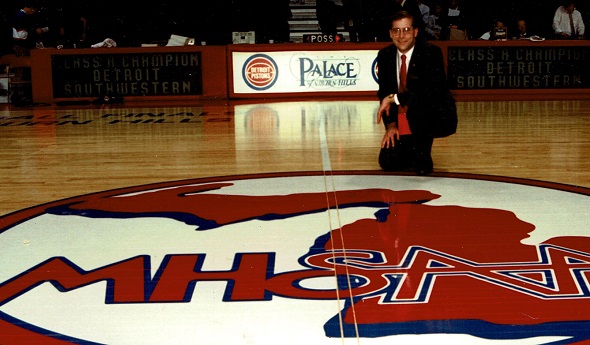
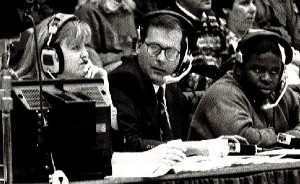
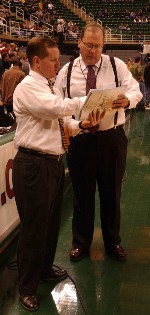
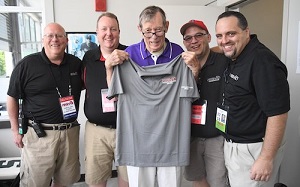
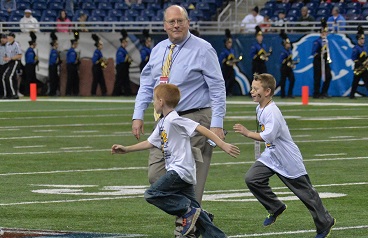
PHOTOS: (Top) MHSAA Communications Director John Johnson kneels at midcourt at The Palace of Auburn Hills in 1990 having designed the floor for that year's Basketball Finals. (2) Johnson, middle, wears the headset during a playoff production. (3) Johnson, right, coordinated media, announcing and stat-keeping among other areas during MHSAA events at the Breslin Center. (4) Johnson, far left, stands with (from left) MHSAA public address announcers Roger Smith, Erik O. Furseth, Tony Coggins and Steve Miller during a Baseball/Softball Finals weekend. (5) Johnson walks the turf at Ford Field during a Football Finals. (Photos from MHSAA archives.)
NFHS's Gardner Announces Retirement
January 9, 2018
Special from NFHS
Bob Gardner, executive director of the National Federation of State High School Associations (NFHS) since May 2010, has announced his retirement, effective Aug. 1, 2018. Gardner notified the NFHS Board of Directors of his retirement plans at the NFHS Winter Meeting on Jan. 3 in Scottsdale, Arizona.
 Gardner is the fifth full-time executive director of the NFHS, following H.V. Porter (1940-58), Cliff Fagan (1958-77), Brice Durbin (1977-93) and Bob Kanaby (1993-2010).
Gardner’s eight-year run as head of the national organization for high school athletics and performing arts activities will conclude a 48-year career in secondary education, including the final 18 years on the NFHS staff in Indianapolis.
Since assuming duties as NFHS executive director in 2010, Gardner has vigorously promoted the values of high school activity programs and expanded opportunities for participation by boys and girls nationwide. During his eight years as executive director, participation in high school sports has increased by almost 400,000, including the expanded opportunity for students with disabilities in high school sports.
Gardner has led the organization’s focus on risk minimization in high school sports, with particular emphasis on concussion awareness, and has brought a heightened national presence to the work of the NFHS and its member state associations. In addition to the continual expansion of the NFHS Learning Center during his tenure, Gardner is credited with starting the NFHS Network, the first-of-its-kind digital coverage of high school sports with more than 25,000 events covered during the 2016-17 school year.
In addition, during his eight years as chief executive of the organization, operating revenue for the NFHS increased by $4 million.
Ironically, Gardner’s entire 48-year career was spent in the state of Indiana. He was a teacher and coach at three schools for eight years and also served as an athletic director for a period of time. In 1978, Gardner became principal of Milan Junior-Senior High School, followed by a stint as superintendent of the Milan Community Schools.
After serving on the Indiana High School Athletic Association (IHSAA) Board of Directors during his time at Milan, Gardner joined the IHSAA staff in 1985 as assistant commissioner. He served 10 years in that role prior to becoming commissioner in 1995.
During his five years as IHSAA commissioner, Gardner led the change in the IHSAA football playoffs to permit participation by all schools, negotiated the association’s largest corporate sponsorship agreement in history with Indiana Farm Bureau Insurance and led the transition to multiple classes in team sports.
Gardner joined the NFHS staff in 2000 as chief operating officer and served in that position for 10 years prior to becoming executive director. During this time, he chaired the NFHS Rules Review Committee and was responsible for day-to-day operations of the organization.
Gardner earned his bachelor’s degree from the University of Evansville (Indiana) and his master’s and education specialist degrees from Ball State University in Muncie, Indiana. He has served on the Board of Directors for USA Football, USA Basketball and the Indiana Sports Corporation. He is a member of the Indiana High School Wrestling Hall of Fame.
Following the March 1 application deadline, finalists for the position will be interviewed by the NFHS Board of Directors April 17-18 in Indianapolis, with the new executive director expected to begin duties Aug. 1.