

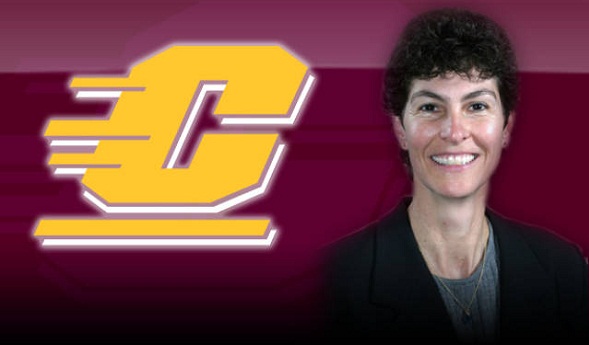
Lessons Learned Keep Paying Off
February 8, 2013
By Terri Finch Hamilton
Reprinted with permission of CMUChippewas.com
Gina Mazzolini's parents taught her to be a good person first, a good student second, and a good athlete after that. But Mazzolini says her involvement in sports at CMU taught her things that went way beyond the classroom.
"At Central, I learned women are just as good as men -- or better," says Mazzolini, assistant director at the Michigan High School Athletic Association. "I learned that if we put our minds to it, we can do anything."
A star athlete in volleyball and basketball at CMU from 1974 to 1978, Mazzolini says college sports helped her soar after the limitations for girls in high school sports in the early 1970s.
"In high school, women were always taking the back seat to men," says Mazzolini, 57. "I didn't see women in leadership positions in high school. Girls couldn't use the weight room -- we had to sneak in, then we'd get kicked out. They'd look at me and say, 'Why would you want to lift weights?'
"When the guys were done with the gym, then we could use it."
As an athlete at St. Johns High School, Mazzolini was just starting to compete competitively, she says. She won the school's first ever female athlete of the year award.
"Then I went to Central Michigan, and my teammates were all the best kids from their high school teams. Suddenly, everybody was good. And everybody we played against was good."
It was eye opening, she says.
"You learn a lot about yourself," she says. "If you can survive a practice, if you can survive playing Michigan State, you get confidence. I realized I was good. I learned how to be competitive, in a good way."
In basketball, she led the Chippewas in scoring and rebounding three straight seasons - averaging in double figures in both categories. After graduating from CMU, Mazzolini went on to teach and coach at the high school and college levels. She was inducted into the CMU Athletic Hall of Fame in 1992.
A few years later, Mazzolini received the 2009-10 Women In Sports Leadership Award by the Representative Council of the MHSAA.
So much of what she learned on the college volleyball and basketball courts prepared her for later success, Mazzolini says.
"In athletics, you can't worry about what just happened," she says. "You control your emotions, you take a deep breath, you move forward."
Good advice on any day, she says.
"You learn that you don't always win, and you learn to take defeat gracefully," she says. "Later, in your business life, you're not going to win everything, either. Sports teaches you how to deal with setbacks, how to work hard and rearrange your goals so that you do better next time.
"You learn if you work together, you can achieve amazing things."
CMUChippewas.com is running a series of stories to celebrate the 40th anniversary of Title IX legislation. Click to see more of the series.

Rep Council Wrap-up: Winter 2014
March 24, 2014
The addition of a training requirement for first-time high school varsity coaches and football practice policy changes focused on player safety highlighted actions taken by the Representative Council of the Michigan High School Athletic Association during its annual Winter Meeting on March 21 in East Lansing.
Raising expectations for coaches’ preparedness is one of four current thrusts of the MHSAA’s ongoing focus on health and safety issues in school sports. The Council voted to require every individual hired for the first time as a varsity head coach at an MHSAA member high school after July 31, 2016 to have completed the MHSAA’s Coaches Advancement Program (CAP) Level 1 or Level 2. CAP is a six-level MHSAA-administered educational regimen that aids coaches in their growth and development as they advance in the field of educational athletics.
This is the third action the Council has approved over the last year to enhance the preparation of coaches with respect to health and safety issues. The first action, adopted in May 2013, requires all assistant and subvarsity coaches at the high school level to complete the same rules and risk minimization meeting requirement as high school varsity head coaches beginning with the 2014-15 school year. The second, adopted during the Fall Meeting in December, requires all varsity high school head coaches have a current CPR certification beginning with the 2015-16 school year.
By adopting a series of football changes, the Council also advanced a thrust toward revising practice policies and game rules to improve player safety in all sports. The practice policy changes were proposed by a Football Task Force made up of coaches, administrators and MHSAA staff which met throughout 2013. The following were approved by the Council:
- During the first week of practice of the season, only helmets are allowed the first two days, only shoulder pads may be added on the third and fourth days, and full pads may not be worn until the fifth day of team practice.
- Before the first regular-season game, schools may not schedule more than one “collision” practice in a day. A collision practice is defined as one in which there is live, game-speed, player-versus-player contact in pads involving any number of players.
- After the first regular-season game, teams may conduct no more than two collision practice days in any week, Monday through Sunday.
- No single football practice may exceed three hours, and the total practice time for days with multiple practice sessions may not exceed five hours. Neither strength/weight training activities nor video/classroom sessions are considered practice for the purposes of the three or five-hour limits.
Additional details and explanations of the new football practice policies are found on the Football page of the MHSAA Website.
The Council also approved a series of proposals regarding the eligibility of international students, who by an estimate from the Council on Standards for International Educational Travel (CSIET) numbered more than 3,800 in Michigan in 2012. The Representative Council approved a change to a portion of the MHSAA’s transfer regulation to refer to international students, not merely “foreign exchange” students, and also approved a proposal that would grant an international student athletic eligibility at an MHSAA school only if that student is placed through an Approved International Student Program accepted for listing by CSIET or approved by the MHSAA.
Those international students placed through an Approved International Student Program would be eligible for a maximum of the first two consecutive semesters or three consecutive trimesters at any secondary school in the United States, after which the student is ineligible for interscholastic athletic competition at any MHSAA member school for the next academic year. International students who do not meet one of the residency exceptions recognized by the MHSAA or are not enrolled through an Approved International Student Program may become eligible to participate at the subvarsity level only.
Continuing its examination of athletics at the junior high/middle school level, the Council also approved changes to allow for longer competitions in two sports. The length of quarters in basketball may be increased from six minutes to a maximum of eight minutes, and the length of quarters in football may be increased from eight minutes to a maximum of 10 minutes.
The Representative Council is the legislative body of the MHSAA. All but five members are elected by member schools. Four members are appointed by the Council to facilitate representation of females and minorities, and the 19th position is occupied by the Superintendent of Public Instruction or designee.
The MHSAA is a private, not-for-profit corporation of voluntary membership by more than 1,500 public and private senior high schools and junior high/middle schools which exists to develop common rules for athletic eligibility and competition. No government funds or tax dollars support the MHSAA, which was the first such association nationally to not accept membership dues or tournament entry fees from schools. Member schools which enforce these rules are permitted to participate in MHSAA tournaments, which attract more than 1.4 million spectators each year.