

MHSAA Announces 2015-16 Concussion Data
September 12, 2016
By Geoff Kimmerly
Second Half editor
The Michigan High School Athletic Association has completed an unprecedented yearlong collection of head injury reports from its member schools, mandated in 2015-16 for the first time as part of an effort to identify and reduce the incidence of those types of injuries in educational athletics.
The MHSAA requested that member schools report, by sport, possible concussions by their student-athletes during both practice and competition. Reporting for the 2016-17 school year is underway, and schools again are required to designate if potential concussions occurred during competition or practice and at which level – varsity, junior varsity or freshman.
The full report of all head injuries experienced during 2015-16 by student-athletes at MHSAA member high schools – including percentages by sport (per 1,000 participants), gender and team level, as well as data tracking when athletes returned to play – is available on the Health & Safety page of the MHSAA Website.
The MHSAA received data from more than 99 percent of its member high schools after the end of the fall, winter and spring seasons, and continued to track each injury report through its conclusion this summer. Member junior high and middle schools also were allowed, although not mandated, to report their potential head injuries; those findings are not part of the published report.
It is the hope that universities, health care systems and the National Federation of State High School Associations will take part in analyzing the data. The MHSAA will work, in particular, with Michigan State University’s Institute for the Study of Youth Sports to explore these findings and their relation to possible changes and additions in coaches education.
“We know that school sports are safer than they’ve ever been, thanks to advances in equipment, increased and more complete coaches education and rules designed to bring higher levels of safety to both practices and competition,” said John E. “Jack” Roberts, executive director of the MHSAA. “However, this unprecedented effort will allow us for the first time to set a baseline by which we can determine year-to-year progress as we work to reduce the incidence of head injuries in school sports, while providing questions we will seek to answer with assistance from our research partners.”
Student-athletes at MHSAA member high schools encountered during 2015-16 a total of 4,452 head injuries – or 5.9 per member school. Total participation in MHSAA sports for 2015-16 was 284,227 – with students counted once for each sport he or she played – and only 1.6 percent of participants experienced a head injury. Boys experienced 3,003 – or 67 percent – of those injuries, although boys participation in sports, especially contact sports, also was higher than girls.
More than half of head injuries – 54 percent – were experienced by varsity athletes. A total of 2,973 – or 67 percent – came in competition as opposed to practice. More than half took place during either the middle of practice or middle of competition as opposed to the start or end, and nearly 56 percent of injuries were a result of person-to-person contact. The largest percentage of athletes – 28 percent – returned to activity after 6 to 10 days, while 20 percent of those who suffered head injuries returned after 11-15 days of rest.
Not surprisingly, contact sports revealed the most head injuries. Ranking first was 11-player football with 49 head injuries per 1,000 participants, followed by ice hockey with 38 and 8-player football with 34. However, girls soccer was just behind with 30 injuries per 1,000 participants, and girls basketball ranked fifth with 29 injuries per 1,000.
A startling disparity in the number of reported head injuries suffered by girls and boys playing the same sports was the most significant finding revealed by the concussion reporting. Soccer, basketball and baseball/softball are played under identical or nearly identical rules, and in those sports females reported significantly more concussions than males playing the same or similar sport.
Female soccer players reported 30 concussions per 1,000 participants. Male soccer players, meanwhile, reported only 18 concussions per 1,000 participants. Female basketball players reported 29 concussions per 1,000 participants; male players reported 11. Softball players reported 11 concussions per 1,000 participants, and baseball players reported four per 1,000.
“Experts tell us that it’s not surprising that girls report more head injuries than boys. But we found it stunning how many more head injuries were reported for girls than boys,” Roberts said. “As we delve deeper into the data, we hope to identify what physiological, social and psychological factors may contribute to this disparity – and how we can better prepare school personnel and especially coaches to watch for over- or under-reporting.”
Schools report possible concussions online via the MHSAA Website. Reports are then examined by members of the MHSAA staff, who follow up with school administrators as those student-athletes continue to receive care and eventually return to play. Student privacy is protected.
The reporting of possible concussions is part of a three-pronged advance by the MHSAA in concussion care begun during the 2015-16 school year which is producing data related to the frequency and severity of head injuries. The MHSAA in fall 2015 launched the largest-ever state high school association sideline concussion testing pilot program, with 62 schools taking part by using one of two screening tests designed to detect concussions. One of the objectives of the pilot was to increase awareness of concussions and improve sideline detection, and results indicated that the average number of possible concussions reported by pilot schools exceeded the average reported by schools outside the pilot group. For the 2016-17 school year, 34 schools are taking part in one of the two pilot programs as the project was concentrated to include schools which were diverse in size and location and able to best conduct the pilots to completion. The pilots will focus on sports for which most concussions occur, according to the mandated reporting by all schools during the 2015-16 school year.
The MHSAA also is the first state association to provide all participants at every member high school and junior high/middle school with insurance intended to pay accident medical expense benefits – covering deductibles and co-pays left unpaid by other policies – resulting from head injuries sustained during school practices or competitions and at no cost to either schools or families. During 2015-16, a total of 159 claims were made – with more than half coming in football (55) or girls basketball (29).
Previously, the MHSAA also was among the first state associations to adopt a return-to-play protocol that keeps an athlete out of activity until at least the next day after a suspected concussion, and allows that athlete to return to play only after he or she has been cleared unconditionally for activity by a doctor (M.D. or D.O.), physician’s assistant or nurse practitioner.
The MHSAA is a private, not-for-profit corporation of voluntary membership by more than 1,400 public and private senior high schools and junior high/middle schools which exists to develop common rules for athletic eligibility and competition. No government funds or tax dollars support the MHSAA, which was the first such association nationally to not accept membership dues or tournament entry fees from schools. Member schools which enforce these rules are permitted to participate in MHSAA tournaments, which attract more than 1.4 million spectators each year.
Honorees Examples of Excellence
By
Geoff Kimmerly
MHSAA.com senior editor
March 13, 2013
By Geoff Kimmerly
Second Half editor
Dave Hutton had stepped away from the hockey program he’d started at Grandville High School more than a decade before when he was asked to come back and save it from extinction.
The team had struggled with low student interest – not to mention decreasing skill – and was under consideration to be eliminated in 1991. So Hutton volunteered to start over again. Order returned, the team quickly became successful and never had a losing season under Hutton before he retired from the sport in 2002.
He’s the first to say he was just one person who assisted in reviving the program. But he also served as an example – a common role he and Jim Gilmore surely shared during careers that have earned them this year’s Michigan High School Athletic Association’s Charles E. Forsythe Award
“It’s been important to me to do it properly; that’s how basically I always looked at it,” Hutton said of being a high school coach. “I was trained well by a lot of mentors, and consequently I tried to do things first class.
“When it comes down to being a coach, you set an example for fellow coaches. But more importantly, you want the athletes and parents to have a positive reaction to what you do, be proud of the program they are part of.”
 The annual award is in its 36th year and is named after former MHSAA Executive Director Charles E. Forsythe, the Association's first full-time and longest-serving chief executive. Forsythe Award recipients are selected each year by the MHSAA Representative Council, based on an individual's outstanding contribution to the interscholastic athletics community. Hutton and Gilmore will receive their honors during quarter breaks of the MHSAA Class A Boys Basketball Final on March 23 at the Breslin Student Events Center in East Lansing. Gilmore will receive his award during the break between the first and second quarters, and Hutton will receive his during the break between the third and fourth quarters.
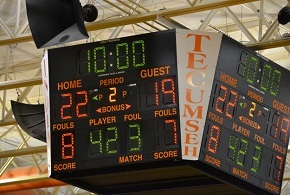
Gilmore and Hutton have made contributing to Michigan high school athletics their lives’ work over the last four decades. Gilmore served four school districts over a 37-year career before retiring in 2008. He coached and taught at his alma mater Grant High School before moving on and eventually serving as athletic director at Kalamazoo’s Barbour Hall Academy (while also assisting at Kalamazoo Hackett Catholic Central High School). He was the athletic director and coached at Morenci High School and then served as athletic director at Tecumseh High School. Gilmore was named to the Michigan High School Football Coaches Association Hall of Fame in 2004 and also served that school year as president of the Michigan Interscholastic Athletic Administrators Association.
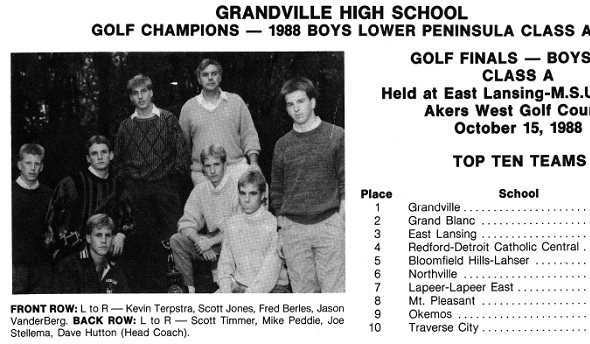
 Hutton, 64, has coached the Grandville High School boys golf team for 42 seasons and also started and led the ice hockey program for 18. His golf teams have posted a 520-180-9 dual meet record, made the MHSAA Finals 20 times and won Class A MHSAA championships in 1976 and 1988. His hockey teams over two stints as coach amassed a record of 212-189-23 with two Regional titles and a Division 1 Semifinal appearance in 2001, his second-to-last season coaching that sport.
“Jim Gilmore and Dave Hutton have made long-standing contributions to their respective sports and communities. Their dedication and high regard for school athletics are signified by their decades of work,” MHSAA Executive Director John E. “Jack” Roberts said. “Their continued efforts – Dave Hutton as a coach and MHSAA Finals director, and Jim Gilmore with the MIAAA – show that for both, this is a life-long commitment. We’re proud to honor Jim Gilmore and Dave Hutton with Forsythe Awards.”
 Gilmore, 65, coached football for 25 years at Grant, Barbour Hall and Morenci, and baseball for 15 seasons. He served on MHSAA site and officials selection committees for seven sports and as president of both the Tri-County Conference and Southeastern Conference. He was instrumental in renovations during his tenures at Morenci and Tecumseh and also wrote the athletic code book that established academic standards for Morenci athletes.
Gilmore also has volunteered in various capacities in his church and communities, and remains active in the MIAAA as part of the past presidents council and the awards and lifetime member committees.
“It’s something I wanted to do even when I was in high school,” said Gilmore, noting former Grant High principal, athletic director and football coach Ray Rynberg as a key mentor. “I was just watching what he did, and it was something I was really interested in as a kid. Participating in athletics, and then having the opportunity after finishing school to coach and be an athletic director, that was really something I enjoyed immensely.”
Hutton served as a member of the Michigan Golf Coaches Association Board for 24 years – and as president in 1984 and 1994 – and has directed a combined 18 boys and girls MHSAA Golf Finals. He was named Michigan golf Coach of the Year in 1977 by the National High School Athletic Coaches Association, Midwest Regional Coach of the Year in 1988 and the NHSACA’s national Coach of the Year in 2001. He also was recognized as the MIGCA Coach of the Year in 1976 and 1988 and as the Michigan High School Coaches Association Coach of the Year in 1977 and 1989. He was inducted into the MIGCA Hall of Fame in 1993 and the MHSCA Hall of Fame in 2002.
Hutton retired from the classroom in 2010 after teaching math and science at the elementary and middle school levels at Grandville for 41 years. He also has impacted his local golf community as a United State Golf Association junior tournament director and Professional Golf Association co-chairman of “Club for Kids” for Kent County.
“There’s still this satisfaction in seeing players in either sport be successful and continue to enjoy the sport when they’ve left (high school),” Hutton said. “There are times when kids say they’ve had enough of that. But it’s nice to see, just being a part of their growth in a sport as it continues beyond, whether they play in college or even as an adult in a rec league or church league, that they enjoyed it and learned something when you were their coach.”
Hutton received his bachelor’s degree from Grand Valley State University in 1967 and his master’s from Michigan State University in 1977. Gilmore received his bachelor’s degree from Western Michigan University in 1975 and followed with graduate studies both at WMU and Eastern Michigan University.
Past recipients of the Charles E. Forsythe Award:
1978 - Brick Fowler, Port Huron; Paul Smarks, Warren
1979 - Earl Messner, Reed City; Howard Beatty, Saginaw
1980 - Max Carey, Freesoil
1981 - Steven Sluka, Grand Haven; Samuel Madden, Detroit
1982 - Ernest Buckholz, Mt. Clemens; T. Arthur Treloar, Petoskey
1983 - Leroy Dues, Detroit; Richard Maher, Sturgis
1984 - William Hart, Marquette; Donald Stamats, Caro
1985 - John Cotton, Farmington; Robert James, Warren
1986 - William Robinson, Detroit; Irving Soderland, Norway
1987 - Jack Streidl, Plainwell; Wayne Hellenga, Decatur
1988 - Jack Johnson, Dearborn; Alan Williams, North Adams
1989 - Walter Bazylewicz, Berkley; Dennis Kiley, Jackson
1990 - Webster Morrison, Pickford; Herbert Quade, Benton Harbor
1991 - Clifford Buckmaster, Petoskey; Donald Domke, Northville
1992 - William Maskill, Kalamazoo; Thomas G. McShannock, Muskegon
1993 - Roy A. Allen Jr., Detroit; John Duncan, Cedarville
1994 - Kermit Ambrose, Royal Oak
1995 - Bob Perry, Lowell
1996 - Charles H. Jones, Royal Oak
1997 - Michael A. Foster, Richland; Robert G. Grimes, Battle Creek
1998 - Lofton C. Greene, River Rouge; Joseph J. Todey, Essexville
1999 - Bernie Larson, Battle Creek
2000 - Blake Hagman, Kalamazoo; Jerry Cvengros, Escanaba
2001 - Norm Johnson, Bangor; George Lovich, Canton
2002 - John Fundukian, Novi
2003 - Ken Semelsberger, Port Huron
2004 – Marco Marcet, Frankenmuth
2005 – Jim Feldkamp, Troy
2006 – Dan McShannock, Midland; Dail Prucka, Monroe
2007 – Keith Eldred, Williamston; Tom Hickman, Spring Lake
2008 – Jamie Gent, Haslett; William Newkirk, Sanford-Meridian
2009 – Paul Ellinger, Cheboygan
2010 – Rudy Godefroidt, Hemlock; Mike Boyd, Waterford
2011 – Eric C. Federico, Trenton
2012 – Bill Mick, Midland
PHOTOS: (Top) Grandville boys golf coach Dave Hutton appeared with his 1988 team in the MHSAA's 1988-89 Book of Champions. (Below) The Tecumseh scoreboard hangs in the gymnasium Jim Gilmore once called home; he led renovation efforts during his tenure as athletic director. (Photo courtesy of Tecumseh High School.)