

MHSAA Announces 2016-17 Concussion Data
August 7, 2017
By Geoff Kimmerly
Second Half editor
The Michigan High School Athletic Association has completed its second year of collecting head injury reports from member schools as it continues to build data that will assist in identifying trends and progress being made to reduce the incidence of head injuries in school sports.
Following a first mandate to do so in 2015-16, member schools again were required to report head injuries to the MHSAA identifying the sport that each student-athlete was participating in and whether the injury was sustained during practice or competition. As reporting for the 2017-18 school year is now underway, schools again are required to designate if potential concussions occur during competition or practice and at which level – varsity, junior varsity or freshman.
The full report of all head injuries experienced during 2016-17 by student-athletes at MHSAA member high schools – including percentages by sport (per 1,000 participants), gender and team level, as well as data tracking when athletes returned to play – is available on the Health & Safety page of the MHSAA Website.
As with the first year of reporting, the MHSAA received data from more than 99 percent of its member high schools after the fall, winter and spring seasons and continued to track each injury report through its conclusion this summer. Member junior high and middle schools also were allowed, although not mandated, to report their potential head injuries; and those findings are not part of the published report.
The 2016-17 concussion report found an 11-percent decrease in the number of confirmed concussions from the previous year. Student-athletes at MHSAA member high schools encountered during 2016-17 a total of 3,958 head injuries – or 5.2 per member school, similar but lower than the 2015-16 average of 5.9. Total participation in MHSAA sports for 2016-17 was 283,625 – with students counted once for each sport he or she played – and only 1.4 percent of participants experienced a head injury; that percentage in 2015-16 was 1.6.
However, MHSAA Executive Director John E. “Jack” Roberts said that while it’s significant to note the similarity in those statistics over the first two years of injury report collection, the lower percentages in 2016-17 don’t necessarily represent a trend – that conclusion can only be made after more data is collected in years to come. Some differences in data from the first year to the second could be the result of schools’ increased familiarity with the reporting system, the refinement of the follow-up reporting procedure and other survey error that is expected to decrease with future surveys.
“Our first survey in 2015-16 raised some initial themes, and the data we collected this past year and will continue to collect will help us identify the trends that will guide our next steps in reducing head injuries in interscholastic athletics,” Roberts said. “However, the necessity for more data to determine these trends should not delay our efforts to experiment with more head protection and modified play and practice rules in contact sports like ice hockey, soccer, wrestling and lacrosse – which all ranked among the top 10 sports for numbers of head injuries per thousand participants.
“We will continue to look for ways to make our good games better and our healthy games safer, and the collection of this data will continue to prove key as we work toward those goals.”
Although the total number of confirmed concussions was significantly lower in 2016-17, a number of findings detailing those injuries fell in line with results of the 2015-16 survey.
Boys experienced 2,607 – or 66 percent – of those injuries, nearly the same ratio as 2015-16 and as boys participation in sports, especially contact sports, remained higher than girls. More than half of head injuries – 55 percent – were experienced by varsity athletes, which also fell within a percent difference of last year’s findings.
A total of 2,973 head injuries – or 65 percent – came in competition as opposed to practice. More than half took place during either the middle of practice or middle of competition as opposed to the start or end, and 52 percent of injuries were a result of person-to-person contact. The largest percentage of athletes – 27 percent – returned to activity after 6 to 10 days, while 23 percent of those who suffered head injuries returned after 11-15 days of rest. All of these findings were within 1-4 percent of those discovered from the 2015-16 data.
Contact sports again revealed the most head injuries. Ranking first was football, 11 and 8-player combined, with 44 head injuries per 1,000 participants – a decrease of five head injuries per 1,000 participants from 2015-16. Ice hockey repeated with the second-most injuries per 1,000, with 36 (down two injuries per 1,000 from 2015-16), and girls soccer was again third with 28 head injuries per 1,000 participants (also down two from the previous year).
In fact, after football and hockey, four of the next five sports to show the highest incidences of head injuries were girls sports – girls soccer followed by girls basketball (23 per 1,000), girls competitive cheer (22) and girls lacrosse (20). Although girls basketball again showed the fifth-highest ratio, it did see a decline of six injuries per 1,000 participants from 2015-16.
Startling indications of another potential trend were seen again in the number of reported head injuries suffered by girls and boys playing the same sports. Soccer, basketball and baseball/softball are played under identical or nearly identical rules. Just as in 2015-16, females in those sports reported significantly more concussions than males playing the same or similar sport.
Female soccer players reported double the concussions per 1,000 participants as male soccer players, while female basketball players reported nearly triple the number of concussions per 1,000 participants (23 to 8). Softball players reported 11 concussions per 1,000 participants, and baseball players reported four per 1,000. The numbers from all three comparisons remained consistent from what the survey found in 2015-16.
It is the hope that Michigan’s universities, health care systems and the National Federation of State High School Associations will take part in analyzing the data and questions that have arisen during the past two years. Michigan State University’s Institute for the Study of Youth Sports submitted a paper titled “Gender Differences in Youth Sports Concussion” based on the 2015-16 results, and that subject will remain closely monitored in 2017-18 and beyond.
“The Institute’s research concluded that there is merit for believing females may be more susceptible than males to having concussions because of structural differences to the neck and head, and also due to neurological differences in the brains of females and males. But the findings also show merit for believing females may be more honest in reporting concussions,” Roberts said.
“We need to find out why. Are girls just more willing to report the injury? Are boys hiding it? These are some of our most important questions moving forward, and they will be critical in our efforts to educate athletes, their parents and coaches on the importance of reporting and receiving care for these injuries immediately.”
Schools report possible concussions online via the MHSAA Website. Reports are then examined by members of the MHSAA staff, who follow up with school administrators as those student-athletes continue to receive care and eventually return to play. Student privacy is protected.
The reporting of possible concussions is part of a three-pronged advance by the MHSAA in concussion care begun during the 2015-16 school year. The MHSAA completed this past spring (2017) the largest-ever state high school association sideline concussion testing pilot program, with a sample of schools from across the state over the last two years using one of two screening tests designed to detect concussions. The second year of the pilot program (2016-17) allowed participating schools to use the sideline detection tests in all sports but mandated they be used in sports (11 total over three seasons) showing the highest prevalence of concussions.
The MHSAA also was the first state association to provide all participants at every member high school and junior high/middle school with insurance intended to pay accident medical expense benefits – covering deductibles and co-pays left unpaid by other policies – resulting from head injuries sustained during school practices or competitions and at no cost to either schools or families. During 2016-17, a total of 139 claims were made – 20 fewer than in 2015-16 – with football (44) and girls basketball (27) the sports most cited in those claims for the second straight year.
Previously, the MHSAA also was among the first state associations to adopt a return-to-play protocol that keeps an athlete out of activity until at least the next day after a suspected concussion, and allows that athlete to return to play only after he or she has been cleared unconditionally for activity by a doctor (M.D. or D.O.), physician’s assistant or nurse practitioner.
In addition, the MHSAA’s Coaches Advancement Program – which includes courses that must be completed by all varsity head coaches hired for the first time at a member school – has augmented for this fall its already substantial instruction on concussion care. Separately, rules meetings that are required viewing for all varsity and subvarsity head and assistant coaches at the start of each season include detailed training on caring for athletes with possible head injuries.
The MHSAA is a private, not-for-profit corporation of voluntary membership by more than 1,400 public and private senior high schools and junior high/middle schools which exists to develop common rules for athletic eligibility and competition. No government funds or tax dollars support the MHSAA, which was the first such association nationally to not accept membership dues or tournament entry fees from schools. Member schools which enforce these rules are permitted to participate in MHSAA tournaments, which attract more than 1.4 million spectators each year.
Detroit Public Schools' McEvans Selected for MHSAA Women In Sports Leadership Award
By
Geoff Kimmerly
MHSAA.com senior editor
January 22, 2026
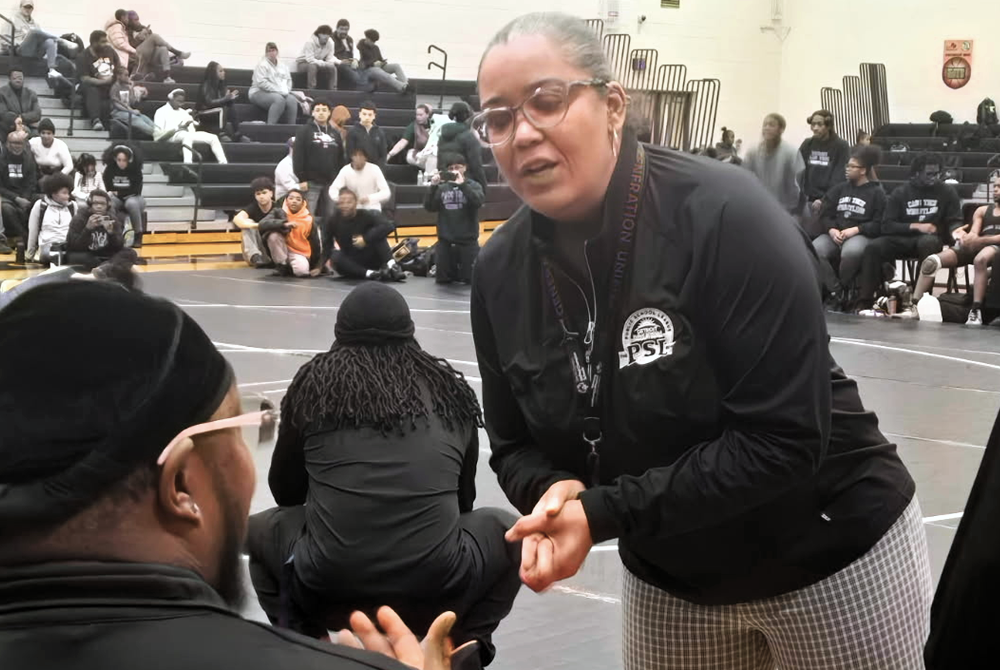
Over nearly three decades as a coach, school and league administrator, Anika McEvans has worked to provide the athletic opportunities for all children that she enjoyed as an athlete herself and later as a mother of three including two who have gone on to play at the collegiate level.
Her work in several roles, serving multiple school districts over nearly 28 years, has benefited thousands of students. In recognition of those contributions, McEvans has been named the 40th recipient of the MHSAA’s Women In Sports Leadership Award.
Each year, the Representative Council considers the achievements of women coaches, officials and athletic administrators affiliated with the MHSAA who show exemplary leadership capabilities and positive contributions to athletics. McEvans will receive her award during the WISL Conference Banquet, Feb. 1 at the Crowne Plaza Lansing.
 Currently midway through her seventh school year serving in the Office of Athletics for the Detroit Public Schools Community District, she is responsible for planning and implementation of the Detroit Public School League’s sports offerings for 72 elementary and middle schools in addition to her several responsibilities supporting the league’s 20 high schools. McEvans came to the PSL from Southfield Public Schools, where as district director she supervised more than 100 coaches, staff and volunteers.
Before that she was a building athletic director, and prior to becoming an administrator she coached multiple sports across tenures at three schools.
“Obviously as an athlete myself, and also the mother of female athletes, my children and I both were very fortunate to have amazing coaches and administrators who elevated our sports,” McEvans said. “I made it a goal of mine everywhere I go to advocate in the same way. I want any child to have what I’d want for my children.”
A basketball, volleyball and softball player while a student at Detroit Renaissance, McEvans returned to high school athletics after college first as a coach, serving as head girls varsity basketball coach at Detroit Academy of Arts & Sciences, assistant boys basketball and softball coach at Renaissance, and assistant girls basketball coach at Southfield.
She served as athletic director from 2012-15 at the former Southfield High School, and as district athletic director through 2017-18 she assisted in the merger of Southfield High and Southfield-Lathrup into Southfield Arts & Technology High School for the start of the 2016-17 school year.
Also during her time at Southfield, McEvans added competitive cheer to the school’s athletic offerings, and then brought the sport to the PSL after moving to the Detroit district office. Cass Tech, Martin Luther King and Renaissance high schools have added competitive cheer teams, and McEvans is hopeful two more schools will do the same over the coming year.
“Anika McEvans continues to create and expand opportunities so as many students as possible can enjoy all of the good that comes with participation in school sports,” MHSAA Executive Director Mark Uyl said. “This award celebrates Anika’s leadership in this way, but also the example she sets in showing what’s possible when someone is driven to make a difference.”
McEvans received an MHSAA Allen W. Bush Award in 2024, celebrating her work often “behind the scenes” in school sports. She was selected for a Skillman Foundation Visionary Award this past year for her work “updating and upgrading the education system in Detroit and beyond.”
She has contributed her expertise to statewide athletics in many ways as well, serving on several MHSAA committees including athletic equity, junior high/middle school, scholar-athlete and as part of multiple officials and site selection committees. She also provided a key voice as part of the MHSAA Multi-Sport Task Force during the last half of the last decade and has played a leading role in providing coaches education throughout Detroit Public Schools through the MHSAA Coaches Advancement Program.
McEvans graduated from Renaissance in 1994 and went on to earn a bachelor's degree in sports management and communications from University of Michigan and a master’s in business administration from the University of Detroit Mercy. She also previously served as director of business operations and then general manager for the Detroit Demolition/Detroit Danger women’s professional football franchise from 2002-06 and as assistant general manager for the Motor City Mechanics minor league hockey team from 2004-06.
Her daughter Cheyenne McEvans is currently a graduate student playing her final season of college basketball at University of Nevada. Son Cameron McEvans played basketball at Lawrence Technological University and most recently professionally in Uruguay. Youngest daughter Cierra McEvans participated on West Bloomfield’s competitive cheer team and is now a sophomore at Grand Valley State University.
“I know how for young men and women that participate in sports, that it rounds out their development, gives them leadership skills and confidence to move through the world,” Anika McEvans said. “I was telling someone the other day that because of their successes and failures on the court, I knew my children would move through the world fearlessly.
“I (also) know in my particular role (at DPSCD) and also to a certain degree at Southfield, there are still gaps in how minority students and programs are supported … (and helping fill that gap) is just my mission.”
More than 700 participants – mostly female high school student-athletes from across the state – have registered to attend this year’s sold-out WISL Conference, the 27th in the series that remains the first, largest and longest-running program of its type in the country.
The opening address Feb. 1 will be presented by Kristen Kelsay, a two-time team captain during her playing career for the Michigan State University women’s volleyball team who recently completed her first season as the Spartans’ head coach and led the team to its highest win total since 2017. MSU women’s basketball coach Robyn Fralick – in her third season and leading a Spartans team that is 17-2 and ranked No. 13 by The Associated Press – will speak during the general session at the start of the Feb. 2 conference schedule.
Several workshops will be offered over the two days, with topics including coaching, teaching and learning leadership; sports nutrition and performance, and empowerment and goal-setting. Presenters are accomplished in their fields and represent a wide range of backgrounds in sport. A complete itinerary is available on the Women In Sports Leadership page.
The first Women In Sports Leadership Award was presented in 1990.
Past recipients
1990 – Carol Seavoy, L’Anse
1991 – Diane Laffey, Harper Woods
1992 – Patricia Ashby, Scotts
1993 – Jo Lake, Grosse Pointe
1994 – Brenda Gatlin, Detroit
1995 – Jane Bennett, Ann Arbor
1996 – Cheryl Amos-Helmicki, Huntington Woods
1997 – Delores L. Elswick, Detroit
1998 – Karen S. Leinaar, Delton
1999 – Kathy McGee, Flint
2000 – Pat Richardson, Grass Lake
2001 – Suzanne Martin, East Lansing
2002 – Susan Barthold, Kentwood
2003 – Nancy Clark, Flint
2004 – Kathy Vruggink Westdorp, Grand Rapids
2005 – Barbara Redding, Capac
2006 – Melanie Miller, Lansing
2007 – Jan Sander, Warren Woods
2008 – Jane Bos, Grand Rapids
2009 – Gail Ganakas, Flint; Deb VanKuiken, Holly
2010 – Gina Mazzolini, Lansing
2011 – Ellen Pugh, West Branch; Patti Tibaldi, Traverse City
2012 – Janet Gillette, Comstock Park
2013 – Barbara Beckett, Traverse City
2014 – Teri Reyburn, DeWitt
2015 – Jean LaClair, Bronson
2016 – Betty Wroubel, Pontiac
2017 – Dottie Davis, Ann Arbor
2018 – Meg Seng, Ann Arbor
2019 – Kris Isom, Adrian
2020 – Nikki Norris, East Lansing
2021 – Dorene Ingalls, St. Ignace
2022 – Lori Hyman, Livonia
2023 – Laurie Glass, Leland
2024 – Mary Cicerone, Bloomfield Hills; Eve Claar, Ann Arbor
2025 – Jennifer Thunberg, Freeland