

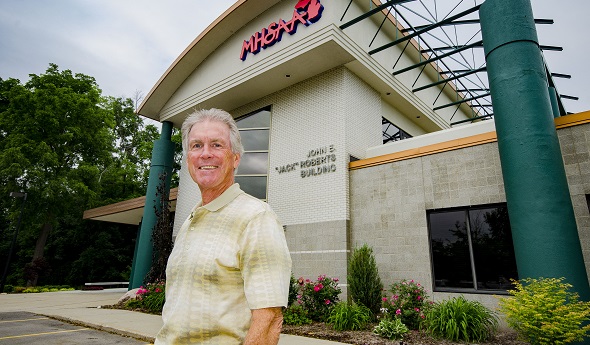
MHSAA Building Named for Retiring Director
By
Geoff Kimmerly
MHSAA.com senior editor
June 26, 2018
To recognize 32 years of leadership and service to Michigan educational athletics, the MHSAA Representative Council has named its home office in East Lansing after longtime Executive Director John E. “Jack” Roberts, who will retire in August.
The dedication of the “John E. ‘Jack’ Roberts Building” was approved by the Council during its Spring Meeting, May 6-7 in Gaylord, with the fabrication and assembly of the lettering financed by several private donations.
The building, located at 1661 Ramblewood Drive in East Lansing, opened as headquarters for the Association on January 3, 1997. The 20,000-square-foot, two-story facility houses MHSAA staff offices and resources including a publications library, plus multiple conference spaces frequently used to host meetings not only for MHSAA business but by leagues, coaches associations and other groups joining people from across the state.
Roberts, who announced his retirement April 24, will conclude his tenure next month as the second-longest serving full-time executive director during the MHSAA’s 94-year history. He is the fourth person to serve that leadership role full time, following Charles E. Forsythe (1931-42, 1945-68), Allen W. Bush (1968-78) and Vern L. Norris (1978-86). Roberts currently is also the nation’s longest-serving executive director of a state high school athletic association.
“This is an entirely unexpected honor,” Roberts said, “and while I am proud of the building, I’m even prouder of the people who have worked in it.”
The metallic lettering announcing the building’s name was designed by Image360 of Brighton and placed on the façade at the center of the building below the large MHSAA logo facing the property’s parking lot.
John Peckham, then of Martin Property Development of East Lansing, oversaw the original Ramblewood project. The building was designed by Keystone Design and built by Granger Construction.
Prior to the move to its current offices, the MHSAA was housed at 1019 Trowbridge Road in East Lansing from 1976-96. The MHSAA moved to the Trowbridge location from a downtown Lansing office it had leased since 1958.
With his retirement upcoming, Roberts also will leave the National Federation of State High School Associations (NFHS) Board of Directors later this week during the Summer Meeting in Chicago. He also will conclude an extended term as board chairperson of the NFHS Network. Roberts previously served as an assistant director for the National Federation from 1973-80 and came to the MHSAA in the fall of 1986 from the Fellowship of Christian Athletes, which he served as executive vice president.
Assistant Director Mark Uyl was chosen by the Representative Council in May to succeed Roberts as MHSAA executive director.
The MHSAA is a private, not-for-profit corporation of voluntary membership by more than 1,500 public and private senior high schools and junior high/middle schools which exists to develop common rules for athletic eligibility and competition. No government funds or tax dollars support the MHSAA, which was the first such association nationally to not accept membership dues or tournament entry fees from schools. Member schools which enforce these rules are permitted to participate in MHSAA tournaments, which attract more than 1.4 million spectators each year.

UPDATE Meeting Series In 37th Year
September 15, 2014
By Geoff Kimmerly
Second Half editor
The Michigan High School Athletic Association will conduct its 37th annual Update Meeting series in the coming weeks, and this year’s schedule will again offer in-service programming for athletic directors at six of the seven locations.
The Update series is annually attended by more than 800 school administrators. During the meetings, information about current MHSAA activities is disseminated, issues affecting interscholastic athletics are discussed, and attendees are surveyed on various topics. Six luncheon meetings are scheduled in the Lower Peninsula, and a morning meeting is scheduled for Marquette in the Upper Peninsula.
MHSAA Executive Director John E. "Jack" Roberts will address high school superintendents, principals, athletic directors and school board members on a variety of topics at these meetings. Update Meetings also provide school administrators an opportunity to ask questions and discuss any recent changes in the Association's rules and regulations.
This will be the 12th year for Athletic Director In-Service programs to take place in morning-long sessions prior to most of the Update Meetings. These workshops are designed to help prepare those administrators for the rigors of their jobs, and with the Update Meetings offer those in attendance an opportunity to meet with administrators from neighboring school districts with whom they normally are not able to have day-to-day contact.
The meeting in Frankenmuth on October 8 also will serve as the Annual Business Meeting for the MHSAA. Click for the registration form for Athletic Director In-Service and Update Meetings.
- Sept. 24 – Pine West, Kalamazoo (Noon – Preceded by AD In-Service at 8:30 a.m.)
- Sept. 29 – DeCarlo’s Center, Warren (Noon - Preceded by AD In-Service at 8:30 a.m.)
- Oct. 2 – Best Western Plus, Lansing (Noon – Preceded by AD In-Service at 8:30 a.m.)
- Oct. 6 – English Hills Country Club, Comstock Park (Noon – Preceded by AD In-Service at 8:30 a.m.)
- Oct. 8 – Zehnder's Restaurant, Frankenmuth (Noon – Preceded by AD In-Service at 8:30 a.m.)
- Oct. 13 – Otsego Club & Resort, Gaylord (Noon – Preceded by AD In-Service at 8:30 a.m.)
- Oct. 24 – Northern Michigan University Superior Dome, Marquette (10 a.m. – Upper Peninsula Athletic Directors Meeting)
The MHSAA is a private, not-for-profit corporation of voluntary membership by more than 1,500 public and private senior high schools and junior high/middle schools which exists to develop common rules for athletic eligibility and competition. No government funds or tax dollars support the MHSAA, which was the first such association nationally to not accept membership dues or tournament entry fees from schools. Member schools which enforce these rules are permitted to participate in MHSAA tournaments, which attract more than 1.4 million spectators each year.