


MHSAA Provides Reopening Guidelines
May 29, 2020
By Geoff Kimmerly
Second Half editor
The Michigan High School Athletic Association today submitted to its member schools a series of updated timelines and recommendations to guide the return of sports, which have been suspended since mid-March to alleviate the potential spread of COVID-19.
The state’s current “Safer-at-Home” order runs through Friday, June 12. There can be no use of any school facilities (indoor and outdoor) and there can be no organized on-site athletic activity, including conditioning or competition, until the current stay-at-home order expires or is lifted by Governor Gretchen Whitmer. When the “Safer-at-Home” order expires or is lifted, the return-to-activity recommendations may be implemented locally by school district leadership, provided the district declares its facilities open to students and staff and the 2019-20 school year has ended for that district (based on its last originally-scheduled school day).
The “MHSAA/NFHS Guidance for Re-Opening School Sports” is based primarily on direction provided by the MHSAA and National Federation of State High School Associations’ (NFHS) Sports Medicine Advisory Committees, in addition to reopening plans provided by the Michigan and federal governments and recommendations from the Center for Disease Control and Prevention (CDC). Concepts from the United States Olympic & Paralympic Committee also were consulted.
The MHSAA/NFHS plan recommends a three-step process to returning to full athletic participation, and for each step outlines actions to be taken in five major areas: pre-workout/contest screening of athletes and coaches for sickness, limitations of the number of participants who may be involved in a gathering, proper cleaning for facilities, the use of equipment during activity and best practices for keeping participants safely hydrated. The plan also places sports into categories based on risk for transmitting the virus (low/moderate/high), with adjusted return-to-activity steps based on that level of risk.
The MHSAA serves more than 1,500 public and private schools, including 750 high schools.
“The MHSAA and its Representative Council believe restarting school sports is essential to the physical and mental well-being of students, and the guidelines outlined for schools today provide the ‘How’ for schools to return to athletics when they’ve received the go-ahead from state and county health officials,” MHSAA Executive Director Mark Uyl said. “We are thankful for our state government, state education and health departments, our medical partners and the NFHS for their guidance these last few months, and we will continue to follow and pass on their recommendations as we prepare our schools to bring back this part of student life that’s been sorely missed.”
At the present time, the only activity allowed continues to be individual, outdoor recreational activity including walking, hiking, running, etc. (as announced in Executive Order 2020-96). If this type of conditioning activity takes place with more than one person present, it must be in groups of fewer than 10 people with social distancing followed, and the activity cannot involve school coaches, be school sponsored or occur at any school facility (indoor or outdoor) until at least June 13.
Voluntary virtual (not in-person) communication and instruction from coaches to any number of students is permitted under MHSAA rules in all sports during the summer.
“The concept is that students can continue to individually condition themselves (by walking, hiking, running), but there should be no organized, group activity by any person until at least June 13. We must all continue do our part to flatten the curve in hopes of increased activity over the coming weeks,” Uyl said. “Again, it is important to note that this document addresses ‘How’ schools can return to activity; the decision on ‘When’ schools can return to activity will be done under the direction of state government and health department officials. As government actions impact this timeline, the MHSAA will continue to update all involved.”
The return-to-activity guidelines are aimed to provide direction for schools as they continue to limit potential exposure to respiratory droplets, the primary avenue for transferring COVID-19. Specifically, the MHSAA/NFHS plan addresses social distancing, use of cloth and other face coverings, event scheduling and transportation, and the possibility that schools may have to break from or completely discontinue activity including competition during the fall or winter because of recurrent outbreaks of the coronavirus.
School district administrators will determine at which step in the MHSAA/NFHS plan their schools are operating based on the number of people allowed to gather by state medical officials.
The document in full is available from the MHSAA Website. Further guidance will be provided over the weeks ahead as new information is available and the prevalence of COVID-19 changes. Updates to the MHSAA/NFHS guidelines will continue to be in accordance with those published by the Governor’s office.
The MHSAA has remained in regular contact with the Governor’s office, Michigan Department of Health & Human Services and Michigan Department of Education throughout the pandemic, in addition to leadership from the state’s superintendents, school principals, athletic administrators and school boards associations.
The MHSAA is a private, not-for-profit corporation of voluntary membership by more than 1,500 public and private senior high schools and junior high/middle schools which exists to develop common rules for athletic eligibility and competition. No government funds or tax dollars support the MHSAA, which was the first such association nationally to not accept membership dues or tournament entry fees from schools. Member schools which enforce these rules are permitted to participate in MHSAA tournaments, which attract more than 1.4 million spectators each year.
2023 Bush Award Honorees Groat, Albright, Show Dedication in Multiple Roles
By
Geoff Kimmerly
MHSAA.com senior editor
August 3, 2023
Battle Creek St. Philip’s Vicky Groat and Midland High’s Eric Albright both have devoted themselves to Michigan school sports for multiple decades – and both continue to lead as highly-successful coaches while also serving in multiple administrative roles within their schools and as important voices in statewide leadership as well.
To recognize their dedication and far-reaching contributions to educational athletics, Groat and Albright have been named recipients of the Michigan High School Athletic Association’s Allen W. Bush Award for 2023.
Al Bush served as executive director of the MHSAA for 10 years. The award honors individuals for past and continuing service to school athletics as a coach, administrator, official, trainer, doctor or member of the media. The award was developed to bring recognition to people who are giving and serving without a lot of attention. This is the 32nd year of the award.
Groat will enter this fall’s girls volleyball season with a career coaching record of 1,240-304-95, ranking seventh on the MHSAA coaching wins list for her sport. She took over for her mother, equally-legendary Sheila Guerra, for the 1997-98 winter season, stepped away briefly after her second year, and returned to lead the program again in 2000-01. Groat has guided the Tigers to 14 MHSAA Finals championships, including a record nine straight in Class D from Winter 2006-07 through Fall 2014 (volleyball moved to the fall with the 2007-08 school year), and most recently guided St. Philip to back-to-back Division 4 championships to cap the 2020 and 2021 seasons.
A 1985 graduate of the school, Groat is entering her 17th year as the athletic director and also took over as principal on an interim basis in December 2014 and then permanently to begin the 2016-17 school year. She previously had served as the school’s student services director and as an assistant principal. She also served on the MHSAA Representative Council from 2016-20 and is a longtime leader as part of the Michigan Interscholastic Volleyball Coaches Association (MIVCA).
Groat is a member of the Battle Creek St. Philip Athletic and MIVCA Halls of Fame. She was named Michigan High School Coaches Association volleyball Coach of the Year in 2009, and the national Coach of the Year for her sport by the National High School Athletic Coaches Association in 2021. She earned her bachelor's degree from Central Michigan University in 1989 and master’s from Fort Hays State University (Kan.) in 2019.
“Vicky Groat has established herself as one of the most accomplished volleyball coaches in the state and also wears multiple difficult hats so well as the athletic director and principal,” MHSAA Executive Director Mark Uyl said. “Her passion for St. Philip school and its students is evident at every turn, and her desire to help all students excel has been a great benefit to her school and throughout Michigan.”
Albright came to Michigan from Minnesota, graduating from Royalton High School in 1992 and then Hamline University with his bachelor’s degree in 1996. He began at Midland High as a teacher in 1997 and continued in the classroom through 2013-14, adding the varsity baseball coaching job in 2003 and building a 520-199 record over the last two decades while also leading the Chemics to seven league and four District titles and a Division 1 Semifinals appearance in 2018. He became the school’s athletic director in 2010 and serves as an assistant principal as well.
Midland has hosted various MHSAA postseason events under Albright’s direction, including Finals tennis, Semifinals in soccer and football and Quarterfinals for basketball, softball and volleyball. Albright has served on seven committees or task forces for the Association and as part of the Representative Council since 2019.
Albright also is beginning his tenure as president of the Michigan Interscholastic Athletic Administrators Association (MIAAA) and is a Leadership Training Course instructor for the National Interscholastic Athletic Administrators Association (NIAAA). He received a master’s degree from Central Michigan University in 2000 and earned a certified athletic administrator designation from the NIAAA in 2013. Albright also has been an MHSAA registered official in basketball and baseball over the last two decades, most recently in both sports since 2018-19. He worked as a professional baseball umpire in the Gulf Coast League during the 1997 season before beginning his tenure at Midland.
“Eric Albright is a leader in school-based athletics across Michigan with his work with the MIAAA and MHSAA, and he’s become a go-to person for other athletic directors statewide,” Uyl said. “He has worked tirelessly to provide a wealth of guidance and vision, continuously demonstrating his passion for educational athletics.”
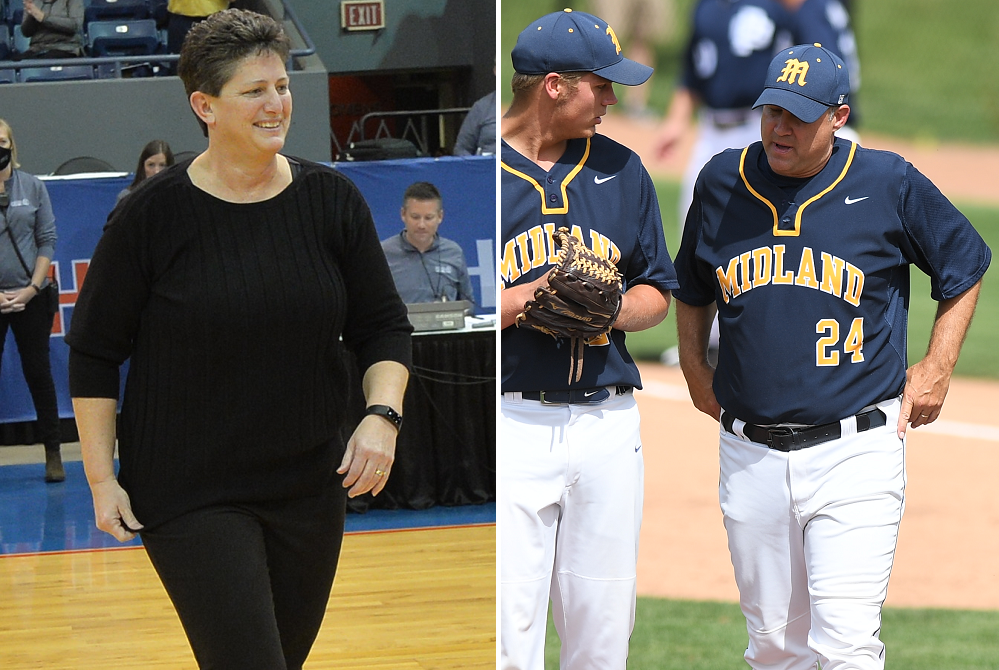
PHOTOS Battle Creek St. Philip volleyball coach Vicky Groat steps on the court to receive her team's Division 4 championship trophy in 2021, and Midland's Eric Albright (far right) confers with his pitcher during the 2018 Division 1 Baseball Semifinals.