

MHSAA Remembers Late Director Norris
By
Geoff Kimmerly
MHSAA.com senior editor
February 12, 2018
Jack Roberts always was astonished at the amount of detail his predecessor Vern Norris could recall about the people he’d met over many years contributing to high school athletics at the state and national levels.
 When the Michigan High School Athletic Association executive director last spoke with his predecessor, Norris had been in contact with past counterparts from Kansas, Iowa and the National Federation – although Norris had retired from the MHSAA more than three decades ago.
“He was genuinely interested in people and their backgrounds and their families,” Roberts said. “He had good friends. He was good at being a friend, and colleague. I think he genuinely cared about relationships between people.”
And he built many over 23 years at the MHSAA office.
Norris, who led the MHSAA from the fall of 1978 through the summer of 1986, died early Monday morning in Lansing. He was 89.
Norris joined the MHSAA staff on July 15, 1963, as Assistant State Director of Athletics under longtime Executive Director Charles E. Forsythe and then-Associate Director Allen W. Bush. Norris was promoted to Associate Director when Bush was appointed Executive Director in 1968, then took over as Executive Director upon Bush’s retirement in 1978. Forsythe, Bush, Norris and Roberts are the only full-time executive directors to serve during the MHSAA’s 94-year history.
Norris brought to the MHSAA a wealth of experience having coached at Traverse City, Rockford and Hillsdale high schools. He served as Assistant Director of Placement at Western Michigan University for the five years prior to joining the MHSAA staff, and during that time Norris built a reputation as a highly-regarded game official in the Kalamazoo area – and worked as a referee during the 1963 MHSAA Class A Boys Basketball Final.
Norris served on a number of national rules-making bodies during his 23-year tenure with the MHSAA, and as president of the Executive Board of the National Federation of State High School Associations (NFHS) during the 1983-84 school year. But he was best known for his work with Michigan’s coaches and especially officials. An award bearing Norris’ name is presented by the MHSAA each spring to a veteran official who has been active in a local officials association, has mentored other officials, and has been involved in officials’ education. The award has been given since 1992 at the annual Officials’ Awards & Alumni Banquet, which was begun during Norris’ tenure in 1980.
“Vern was respected and admired widely by contest officials, and it was because of that that I asked the Representative Council to approve an award for leaders who were especially involved in mentoring and training officials,” said Roberts, who succeeded Norris in 1986. “A total of 26 officials have received the Norris Award, and more than 10,000 officials have been honored at our annual banquet recognizing a group of contributors especially close to his heart.”
Norris shepherded a number of key advances during his tenures both as associate and executive director. The early 1970s saw the addition of MHSAA tournament events in girls sports, and football playoffs were added in 1975. Membership also grew during his time with the association; the MHSAA had 682 member high schools at the start of 1963-64, and 713 when Norris stepped down.
During his time at the MHSAA, Norris also served as a member of the NFHS Basketball Rules Committee from 1978-82, on the NFHS Constitution Revision Committee in 1979 and as a member of the editorial staff of the NFHS Rules Committee from 1980-82.
He served on the NFHS Executive Board representing Michigan’s section of five Midwestern states during a four-year term that concluded with his year as president, and he also served as chairperson of the NFHS Telecommunications Committee in 1972.
After leaving the MHSAA, Norris served as Commissioner of the Great Lakes Intercollegiate Athletic Conference from fall of 1987 through the close of the 1991-92 school year.
 In retirement, Norris kept in touch with MHSAA staff. He and Roberts spoke every few months throughout the years. And, “he could not have been more gracious when he retired and I was hired. He gave me total support and just the right amount of advice,” Roberts added.
When Norris announced he was leaving the MHSAA early in 1986, then-Lansing State Journal Prep Editor Bob Gross wrote “his integrity is beyond question. He has never shown favoritism to a school, and he has never bent the rules. It’s always been strictly business, exactly what it should be. … That’s why I liked Vern Norris so much. He has always been fair.”
A graduate of Grand Rapids Godwin Heights High School, Norris earned his bachelor’s degree in physical education from Western Michigan University and a master’s in school administration from the University of Michigan.
In addition to his MHSAA and NFHS work, Norris served as a football or basketball rules clinician in various states and multiple provinces of Canada, and served on amateur basketball’s rules-making body at the time – the National Basketball Committee of the United States and Canada – from 1972-76. He contributed during the late 1960s and 1970s on the National Alliance Basketball Advisory and National Alliance Football Rules committees. Norris also served on the United States Olympic Committee’s House of Delegates in 1985.
A Service of Coronation will be held at 11 a.m. Friday at Trinity Lutheran Church in Lansing, with family receiving friends from 2-4 and 6-8 p.m. Thursday at Estes-Leadley Greater Lansing Chapel and at 10 a.m. Friday at the church.
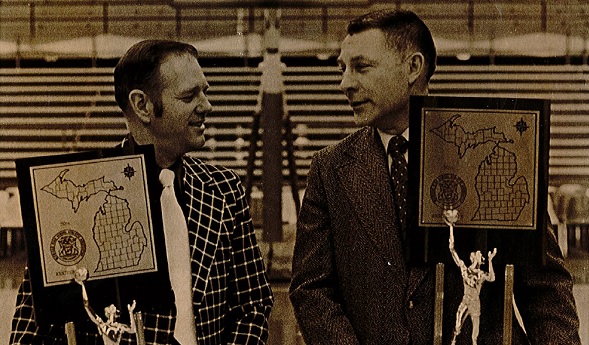
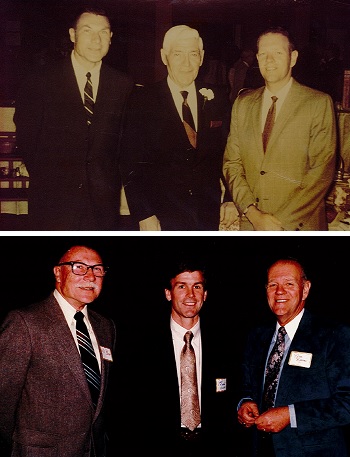
PHOTOS: (Top) Then-Associate Director Vern Norris and Executive Director Al Bush hold up trophies to be awarded at the 1974 Boys Basketball Finals. (Middle) Bush, Charles E. Forsythe and Norris. (Below) Bush, current Executive Director Jack Roberts and Norris in 1988.

MHSAA, MHSFCA to Provide Spring Evaluation Camps for College Football Hopefuls
By
Geoff Kimmerly
MHSAA.com senior editor
March 27, 2023
The Michigan High School Athletic Association, in partnership with the Michigan High School Football Coaches Association (MHSFCA), will be hosting first-ever Spring Evaluation Camps to provide athletes with aspirations of playing college football opportunities to show their skills and abilities to college coaches at one of five locations.
The one-day camps will take place between May 15-18 at Jenison High School, DeWitt High School, Jackson High School, Brighton High School and Detroit Country Day High School. The MHSAA’s involvement will allow for the opportunity for Division I college coaches to attend, and representatives from college football programs at all levels are expected.
Athletes who will be juniors or seniors in Fall 2023 may register to participate via a link on the Football page.
“This is an attempt by the MHSAA to help our athletes get exposure during the spring evaluation period in a way that does not intrude on spring sports,” said Brad Bush, an MHSAA assistant director and past high school and college football coach. “We are working with the MHSFCA to help put together a first-class experience for the athletes and college coaches.”
Cost is $20 per player, and each registrant will receive a shirt to wear based on the athlete’s graduation year and registration number so college coaches in attendance can monitor their camp performance. College coaches also will receive registration information for each athlete in attendance.
All athletes must have a coach from the athlete’s school staff present at the camp, and that coach must be a member of the Michigan High School Football Coaches Association.
MHSFCA executive director Andrew Pratley called the Spring Evaluation Camps a tremendous opportunity for high school athletes in Michigan.
“We are very excited with the partnership with the MHSAA that allows our kids the opportunity to wear a helmet and do drills in front of college coaches in the spring at a minimal cost,” Pratley said. “College coaches are thrilled, and it's a unique opportunity to have the rules waived by the MHSAA at these events only in order to showcase the tremendous talent all over the great state of Michigan.”
The Michigan High School Football Coaches Association (MHSFCA) has been devoted to the promotion of high school football since its inception in March 1972. The MHSFCA has more than 2,500 members and provides several educational and development opportunities for members and their athletes, including an annual coaching clinic, an annual leadership conference for coaches and potential team captains, and the annual summer East-West All-Star Game for graduated seniors. Additionally, the MHSFCA’s Leadership Development Alliance is in its third year of training coaches and offering veteran members of the association as mentors.
The MHSAA is a private, not-for-profit corporation of voluntary membership by more than 1,500 public and private senior high schools and junior high/middle schools which exists to develop common rules for athletic eligibility and competition. No government funds or tax dollars support the MHSAA, which was the first such association nationally to not accept membership dues or tournament entry fees from schools. Member schools which enforce these rules are permitted to participate in MHSAA tournaments, which attract more than 1.3 million spectators each year.