


MHSAA Survey Reveals Participation Fee Usage Remains at Lower Post-Pandemic Level
By
Geoff Kimmerly
MHSAA.com senior editor
August 6, 2025
The annual Michigan High School Athletic Association participation fee survey saw record response for the 2024-25 school year and revealed good news as the percentage of member high schools charging student-athletes to play sports remained consistent with lowered post-pandemic levels.
Of the 720 schools (95 percent of membership) which responded to the most recent survey, only 40 percent of MHSAA member high schools (286) charged participation fees in 2024-25 – consistent with the rates between 40-41 percent revealed annually by the survey the previous four school years after the COVID-19 pandemic struck during the late winter and spring of 2020. Prior to the pandemic, a high of 57 percent of member schools charged participation fees in 2013-14, and 48 percent of high schools required pay-to-play in 2019-20.
The MHSAA began conducting the participation fee survey with the 2003-04 school year. For the purposes of the survey, a participation fee is anything $20 or more regardless of what the school called the charge – registration fee, athletic fee, etc.
Class A schools, as has been the trend, made up the largest group charging fees in 2024-25, with 53 percent of respondents doing so. Class B schools followed, with 40 percent charging fees, while 34 percent of Class C schools and 32 percent of Class D schools also charged for participation.
A standardized fee for each team on which a student-athlete participates – regardless of the number of teams – has remained the norm over the history of the MHSAA’s survey, and 43 percent of schools charging a fee during 2024-25 did so in this way. That was followed by 34 percent of responding schools charging a one-time standardized fee and 17 percent assessing fees based on tiers of the number of sports a student-athlete plays (for example, charging a larger fee for the first team and less for additional sports).
For 2024-25, the median maximum amount a school charged per student-athlete for the school year was $150, and the median annual maximum charged per family was $370. For schools charging student-athletes a one-time fee to cover all sports played, the median was $125. For schools charging a fee per sport, the median was $100 for each team.
The survey for 2024-25 and surveys from previous years can be found on the Pay-To-Play Survey page.
WISL Honoree Thunberg Embraces Leadership Opportunities in Every Role
By
Geoff Kimmerly
MHSAA.com senior editor
March 3, 2025
Through several professional roles in education, Jennifer Thunberg always has maintained a strong connection with athletics and provided leadership – locally, within her league and sport community, and currently at the statewide level serving on the Representative Council of the Michigan High School Athletic Association.
To recognize her vast an ongoing contributions, Thunberg has been named the 39th recipient of the MHSAA’s Women In Sports Leadership Award.
Each year, the Representative Council considers the achievements of women coaches, officials and athletic administrators affiliated with the MHSAA who show exemplary leadership capabilities and positive contributions to athletics. Thunberg will receive her award during the Division 1 Girls Basketball Final, March 22 at the Breslin Student Events Center in East Lansing.
A standout herself as a three-sport athlete at Bay City Central and then volleyball player at Saginaw Valley State University, Thunberg began her coaching career at Central in 1997 and teaching career there in 2001. After coaching the volleyball junior varsity two seasons while still playing collegiately, she led the varsity to a 249-201-43 record over 10 seasons before moving on to Pinconning High School, where she served as athletic director from 2008-14.
Thunberg returned to Central as an assistant principal and became the school’s athletic director in 2017. She remained in that position until becoming principal at Freeland Middle School two years ago.
“A lot of the women who are on that (WISL Award) list are women who have been mentors of mine – who I have worked very closely with – and to be included in that group of women, I’m humbled and honored,” Thunberg said. “Jean LaClair (Bronson, 2015) has been a mentor of mine since I began my coaching career, and I can’t say enough about her. (There are many) between the volleyball world and athletic director world, and I’m just honored to be part of it.”
During her time as Bay City Central’s volleyball coach, Thunberg also served as president of the Michigan Interscholastic Volleyball Coaches Association (MIVCA) from 2005-08, and was instrumental in the creation of the annual Miss Volleyball Award honoring the state’s top high school senior.
As Pinconning and later Central’s athletic director, Thunberg hosted several MHSAA Tournament events and Coaches Advancement Program sessions. She also has served on MHSAA committees for volleyball rules, site selection, Scholar-Athlete Award selection and Women In Sports Leadership Conference planning.
She was one of only two female athletic directors in the Saginaw Valley League when she took that position at Central, and she served as the league’s executive director during the 2022-23 school year. The Michigan Interscholastic Athletic Administrators Association (MIAAA) named her its Region 8 Athletic Director of the Year in 2022.
Thunberg also served on the board for the Michigan Association of Secondary School Principals from 2015-21. She was appointed to the MHSAA’s Representative Council at its 2023-24 Fall Meeting and is serving a two-year term.
“At every stage of her educational career, Jennifer Thunberg has taken on a leadership role, and her vision and dedication to students is admired by her athletic and administrative communities across the state,” MHSAA Executive Director Mark Uyl said. “She is a strong believer in the power of athletics to help drive a student’s all-around education, and we are thankful to have her voice representing school sports.”
A 1996 graduate of Bay City Central, Thunberg played basketball, volleyball and softball for the Wolves. At SVSU, she earned a bachelor’s degree in secondary education and master’s in educational leadership, and she remains among the volleyball program’s all-time leaders in single-season aces.
Thunberg earned her certified athletic administrator designation from the National Interscholastic Athletic Administrators Association (NIAAA) in 2010, and her certified master athletic administrator designation in 2014.
In addition to leading a school and serving on the MHSAA’s Council, she’s also currently serving as president of the Bay County Sports Hall of Fame.
“I was student council president in high school, National Honor Society vice president, and whatever group I got involved in … I just liked to be involved in those organizations,” Thunberg said of taking on leadership roles. “And every single one of those organizations improved and helped me more than I’ve helped the organization. They’ve taught me things, helped me get to know more people – helped me become who I am today.”
Her husband Todd Thunberg is a teacher and Bay City Central’s girls basketball coach, and they have two daughters, 13-year-old Taylor and 11-year-old Rylee.
The first Women In Sports Leadership Award was presented in 1990.
Past recipients
1990 – Carol Seavoy, L’Anse
1991 – Diane Laffey, Harper Woods
1992 – Patricia Ashby, Scotts
1993 – Jo Lake, Grosse Pointe
1994 – Brenda Gatlin, Detroit
1995 – Jane Bennett, Ann Arbor
1996 – Cheryl Amos-Helmicki, Huntington Woods
1997 – Delores L. Elswick, Detroit
1998 – Karen S. Leinaar, Delton
1999 – Kathy McGee, Flint
2000 – Pat Richardson, Grass Lake
2001 – Suzanne Martin, East Lansing
2002 – Susan Barthold, Kentwood
2003 – Nancy Clark, Flint
2004 – Kathy Vruggink Westdorp, Grand Rapids
2005 – Barbara Redding, Capac
2006 – Melanie Miller, Lansing
2007 – Jan Sander, Warren Woods
2008 – Jane Bos, Grand Rapids
2009 – Gail Ganakas, Flint; Deb VanKuiken, Holly
2010 – Gina Mazzolini, Lansing
2011 – Ellen Pugh, West Branch; Patti Tibaldi, Traverse City
2012 – Janet Gillette, Comstock Park
2013 – Barbara Beckett, Traverse City
2014 – Teri Reyburn, DeWitt
2015 – Jean LaClair, Bronson
2016 – Betty Wroubel, Pontiac
2017 – Dottie Davis, Ann Arbor
2018 – Meg Seng, Ann Arbor
2019 – Kris Isom, Adrian
2020 – Nikki Norris, East Lansing
2021 – Dorene Ingalls, St. Ignace
2022 – Lori Hyman, Livonia
2023 – Laurie Glass, Leland
2024 – Mary Cicerone, Bloomfield Hills; Eve Claar, Ann Arbor
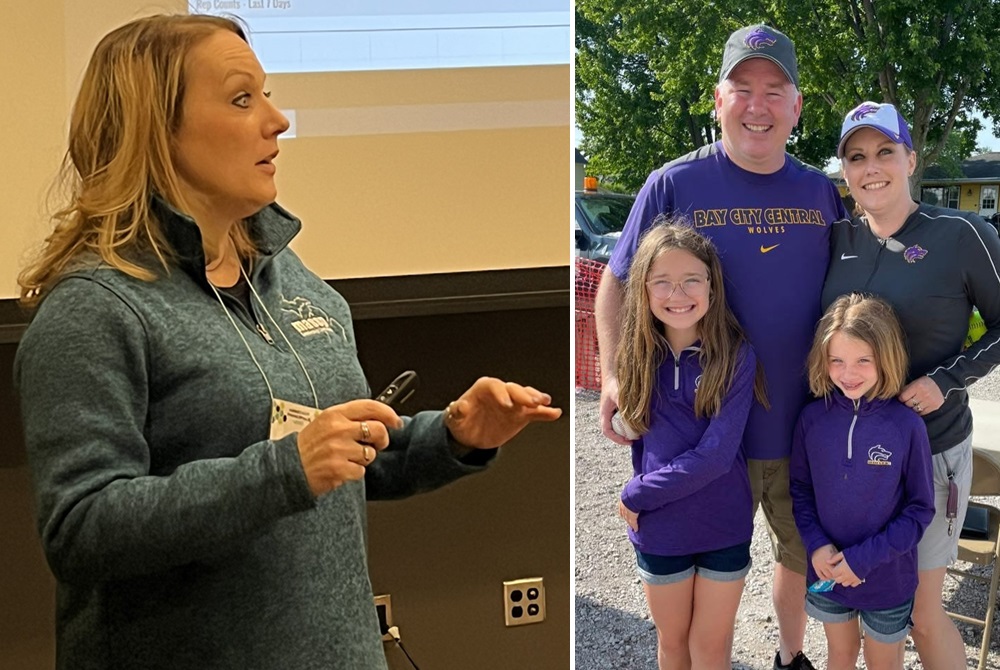
PHOTOS At left, Jennifer Thunberg speaks during an MASSP Conference. At right, she and her family show their support for Bay City Central. (Photos provided by Jennifer Thunberg.)