


MHSAA's Roberts Elected to NFHS Board
July 12, 2016
By Geoff Kimmerly
Second Half editor
MHSAA Executive Director John E. “Jack” Roberts has been elected to serve a four-year term on the Board of Directors for the National Federation of State High School Associations, the national governing body for high school athletics and activities.
Roberts has served as executive director since 1986 and is the longest-tenured active state association executive director among NFHS members. The MHSAA is one of the nation’s largest state associations with more than 1,400 high schools and junior high/middle schools. The NFHS, in its press release on new officers and board members, called Roberts "one of the nation’s most articulate advocates for education-based activity programs."
 After graduating from P. J. Jacobs High School in Stevens Point, Wis., and Dartmouth College and attending graduate school at the University of Wisconsin, Roberts taught English and coached football at high schools in Milwaukee and Denver until 1973, when he joined the staff of the NFHS, which at that time was located in Elgin, Illinois.
From 1973 to 1980, Roberts developed the NFHS’ volleyball, swimming & diving and ice hockey rules programs, and re-codified the Soccer Rules Book. Later, as assistant director, he was in charge of public, legislative and judicial affairs for the NFHS.
Roberts joined the staff of the Fellowship of Christian Athletes (FCA) in 1981 and was named executive vice president of the FCA in 1984. He served in that capacity until 1986, when he was named executive director of the MHSAA.
Roberts served a previous term on the NFHS Board of Directors from 1996 to 2000 and has been chairman of the NFHS Network Board of Directors since 2013. He also has served on two previous NFHS Strategic Planning Committees and is past chair of the board of directors of the Michigan Society of Association Executives.
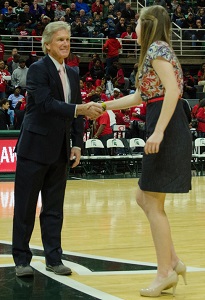
PHOTO: MHSAA Executive Director Jack Roberts congratulates an MHSAA/Farm Bureau Scholar-Athlete Award winner at the Breslin Center.

US District Court Approves Realignment of UP Teams to Statewide MHSAA Soccer Tournament
By
Geoff Kimmerly
MHSAA.com senior editor
August 18, 2023
Upper Peninsula teams playing boys and girls soccer will have the opportunity to participate in a statewide Michigan High School Athletic Association Tournament beginning with the 2023-24 school year after the U.S. federal court in the Western District of Michigan granted on Wednesday, Aug. 16, a joint petition to adjust that portion of the 2000s seasons litigation compliance plan that had required Upper Peninsula boys and girls soccer teams to play in opposite seasons from their Lower Peninsula counterparts.
The petition, filed together by the MHSAA and Communities for Equity, requested that Upper Peninsula soccer teams’ postseason tournaments be realigned with those of the Lower Peninsula soccer teams, such that boys teams be allowed to play with Lower Peninsula teams in a fall statewide MHSAA Boys Soccer Tournament and Upper Peninsula girls teams be allowed to play with Lower Peninsula teams in a spring statewide MHSAA Girls Soccer Tournament.
Almost 20 years ago, the federal court had assigned a separate Upper Peninsula boys tournament for the spring and a separate Upper Peninsula girls tournament for the fall as part of the compliance plan emerging from litigation in a lawsuit filed by Communities for Equity in 1998. The resulting compliance plan, with Lower Peninsula boys soccer season in fall and girls soccer in spring and Upper Peninsula girls soccer season in fall and boys soccer in spring, was put into place beginning with the 2007-08 school year.
However, the different seasons for Upper Peninsula and Lower Peninsula soccer proved unworkable. To realize a full regular season, both boys and girls Upper Peninsula soccer teams at that time instead chose to play during the same regular seasons as their Lower Peninsula counterparts, forgoing participation in an Upper Peninsula-only MHSAA Tournament that was offered consistent with the original compliance plan.
Totals of 13,221 boys and 11,921 girls played on MHSAA member high school soccer teams statewide during the 2022-23 school year. This decision means that hundreds of Upper Peninsula girls and boys soccer players will have the opportunity to have a meaningful regular season and play in a statewide postseason soccer tournament.
“This is great news for our member schools, especially those soccer programs in our Upper Peninsula. We appreciate the partnership on this issue with Communities for Equity, in particular President Diane Madsen, working together in a spirit of cooperation and common sense in making this positive change for soccer players in our state” said MHSAA Executive Director Mark Uyl.
The MHSAA is a private, not-for-profit corporation of voluntary membership by more than 1,500 public and private senior high schools and junior high/middle schools which exists to develop common rules for athletic eligibility and competition. No government funds or tax dollars support the MHSAA, which was the first such association nationally to not accept membership dues or tournament entry fees from schools. Member schools which enforce these rules are permitted to participate in MHSAA tournaments, which attract more than 1.3 million spectators each year.