


MHSAA's Roberts Elected to NFHS Board
July 12, 2016
By Geoff Kimmerly
Second Half editor
MHSAA Executive Director John E. “Jack” Roberts has been elected to serve a four-year term on the Board of Directors for the National Federation of State High School Associations, the national governing body for high school athletics and activities.
Roberts has served as executive director since 1986 and is the longest-tenured active state association executive director among NFHS members. The MHSAA is one of the nation’s largest state associations with more than 1,400 high schools and junior high/middle schools. The NFHS, in its press release on new officers and board members, called Roberts "one of the nation’s most articulate advocates for education-based activity programs."
 After graduating from P. J. Jacobs High School in Stevens Point, Wis., and Dartmouth College and attending graduate school at the University of Wisconsin, Roberts taught English and coached football at high schools in Milwaukee and Denver until 1973, when he joined the staff of the NFHS, which at that time was located in Elgin, Illinois.
From 1973 to 1980, Roberts developed the NFHS’ volleyball, swimming & diving and ice hockey rules programs, and re-codified the Soccer Rules Book. Later, as assistant director, he was in charge of public, legislative and judicial affairs for the NFHS.
Roberts joined the staff of the Fellowship of Christian Athletes (FCA) in 1981 and was named executive vice president of the FCA in 1984. He served in that capacity until 1986, when he was named executive director of the MHSAA.
Roberts served a previous term on the NFHS Board of Directors from 1996 to 2000 and has been chairman of the NFHS Network Board of Directors since 2013. He also has served on two previous NFHS Strategic Planning Committees and is past chair of the board of directors of the Michigan Society of Association Executives.
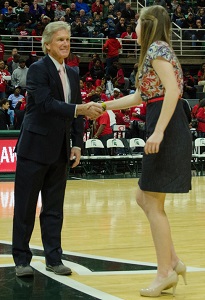
PHOTO: MHSAA Executive Director Jack Roberts congratulates an MHSAA/Farm Bureau Scholar-Athlete Award winner at the Breslin Center.
Fall 2020 to Proceed with Fall Sports
July 17, 2020
By Geoff Kimmerly
Second Half editor
Michigan High School Athletic Association member schools will begin the 2020-21 school year playing Fall sports as traditionally scheduled, but with contingency concepts for potential interruptions due to the spread of COVID-19.
The MHSAA Representative Council, the Association’s 19-member legislative body, met virtually with MHSAA staff Wednesday (July 15) to discuss a series of ideas for playing sports beginning in August. The Council will meet again July 29 for further discussion. Currently, high school football practices are scheduled to begin Aug. 10, with all other Fall sports to start practice Aug. 12.
The MHSAA is moving forward with a plan that first calls for all Fall sports to be started and played as scheduled. However, if the situation deems it necessary, the start of some or all Fall sports practices or competitions could be delayed. The next step in the plan’s progression calls for lower-risk Fall sports that can be played to be completed, with higher-risk Fall sports postponed until later in the school year. If all Fall sports must be suspended, they will be rescheduled during a reconfigured calendar that would see Winter sports begin in November followed by the conclusion of Fall and Spring seasons potentially extending into July 2021.
Additionally, the Council considered a concept that would swap traditional Fall and Spring sports, but determined that was not a feasible plan. Football, girls volleyball, girls swimming & diving and boys soccer during the Fall are considered moderate or high-risk sports because they include athletes in close contact or are played indoors; they were considered the impetus for potentially switching all Fall sports to Spring. But traditional Spring sports – girls soccer and girls and boys lacrosse – carry similar risk, negating the value of making that full season switch. Moving only selected Spring sports, like all low-risk to Fall, was not considered sound because it would force student-athletes to pick between sports they’ve previously played.
Plans remain reliant on progression by schools and regions across the state according to Governor Gretchen Whitmer’s MI Safe Start Plan. Currently two regions are in Phase 5, which allow for limited indoor activity, while the rest are in Phase 4 and unable to host indoor training, practice or competition.
“Our student-athletes just want to play, and we’ve gone far too long without them playing. But doing so safely, of course, remains the priority,” MHSAA Executive Director Mark Uyl said. “Our plan moving forward is Fall in the Fall, starting on time. We’re excited to continue moving forward to bring back sports safely. It’s important for keeping students in our schools and keeping students in our sports programs.
“We remain grateful to the Governor for the opportunity to build the schedule and policies for returning sports to schools. We will continue to support her directives and those of the state and local health departments as we work to create the safest environment for all involved in our activities.”
The MHSAA staff is building COVID-related policies for all Fall sports and will make those guidelines and precautions available to member schools as the season approaches. Those policies will follow up what was presented to schools for summer offseason training, which began June 1 across the state and has seen thousands of student-athletes participate.
The MHSAA is a private, not-for-profit corporation of voluntary membership by more than 1,500 public and private senior high schools and junior high/middle schools which exists to develop common rules for athletic eligibility and competition. No government funds or tax dollars support the MHSAA, which was the first such association nationally to not accept membership dues or tournament entry fees from schools. Member schools which enforce these rules are permitted to participate in MHSAA tournaments, which attract more than 1.4 million spectators each year.