


Michigan's Ranking for High School Sports Participation Continues to Outpace Population
By
Geoff Kimmerly
MHSAA.com senior editor
September 4, 2026
Michigan enjoyed the sixth-highest boys participation in high school sports nationally in 2025-26, moving up one spot in that ranking, and maintained its girls and overall rankings of eighth as well – continuing to outpace where it ranks nationally for population of school-aged children according to U.S. Census Bureau estimates.
Michigan’s overall participation ranking was based on a total of 295,634 participants, data collected as part of the annual national participation study conducted by the National Federation of State High School Associations (NFHS) – of which the Michigan High School Athletic Association is a member. That total number of participants counts students once for each sport played, meaning students who are multiple-sport athletes are counted more than once.
A total of 171,573 boys participants moved Michigan up to sixth nationally on that list, after ranking seventh the past two school years and ninth in 2022-23. The girls total of 124,061 participants ranked eighth for the third-straight school year after Michigan was listed ninth for girls participation also in 2022-23.
Meanwhile, Michigan continued to rank 10th for both high school-aged boys and girls populations – and all high school-aged children combined – according to U.S. Census Bureau estimates.
Three sports for which the MHSAA sponsors postseason tournaments moved up on their respective national lists. Michigan counted the fifth-most boys basketball players, the state’s highest ranking in that sport since 2012-13 and two spots ahead of 2024-25. Girls competitive cheer also moved up two spots to ninth nationally, and boys wrestling moved up one spot on its list to seventh.
Participation in several more MHSAA sports continued to outpace the state’s ranking for high school-aged population.
For girls, bowling (third), tennis (third), golf (fourth), cross country (sixth), track & field (sixth), volleyball (sixth), basketball (seventh), softball (eighth), swimming & diving (eighth), and soccer (ninth) joined cheer in ranking higher than their population listing of 10th nationally. Among boys sports, bowling (second), ice hockey (fourth), golf (fifth), track & field (fifth), tennis (sixth), football (all contact formats combined – sixth), cross country (seventh), swimming & diving (eighth), baseball (ninth) and lacrosse (ninth) joined basketball and wrestling in exceeding the boys ranking of 10th for population. Boys soccer participation placed 10th on its national list.
Only 12 states sponsor alpine skiing, but Michigan again ranked third on both the girls and boys lists for that sport.
Nationally, participation in high school sports increased for the fifth consecutive year and set another record, with the total of 8,415,684 participants an increase of 1.8 percent from 2024-25. The total included 4,761,095 boys and 3,654,589 girls – both record highs as well – according to figures obtained from the 51 NFHS member state associations, which include Washington, D.C.
Eleven-player football remained the most popular boys (and overall) sport, totaling 1,043,716 athletes. Next on the boys list were outdoor track & field, basketball, soccer, baseball, wrestling, cross country, golf, tennis, and swimming & diving, respectively, repeating the same top 10 as in 2024-25.
For girls, the top nine sports remained the same from the previous year – outdoor track & field, volleyball and soccer, in that order, followed by basketball, softball, competitive spirit, tennis, cross country and swimming & diving, respectively. Flag football moved ahead of lacrosse into the 10th spot this past school year.
Texas (911,405) and California (859,022) remained atop the list for overall state participation. Ohio (347,994) ranked third, followed by Illinois (326,756), Pennsylvania (315,647), New York (312,563), Florida (311,233), Michigan (295,634), New Jersey (273,711) and Minnesota (241,536).
The NFHS participation survey was started in 1971 and compiled in its current form through the 2018-19 school year, resuming annually with the 2021-22 survey.
The NFHS, based in Indianapolis, is the national leadership organization for high school sports and performing arts activities. Since 1920, the NFHS has led the development of education-based interscholastic sports and performing arts activities that help students succeed in their lives. The NFHS writes playing rules for 18 sports for boys and girls at the high school level. Through its 50 member state associations and Washington, D.C., the NFHS reaches more than 19,800 high schools and 12 million participants in high school activity programs, including more than 8.4 million in high school sports.
The MHSAA is a private, not-for-profit corporation of voluntary membership by more than 1,500 public and private senior high schools and junior high/middle schools which exists to develop common rules for athletic eligibility and competition. No government funds or tax dollars support the MHSAA, which was the first such association nationally to not accept membership dues or tournament entry fees from schools. Member schools which enforce these rules are permitted to participate in MHSAA tournaments, which attract more than 1.4 million spectators each year.
MHSAA Connecting at Junior High Level
By
Geoff Kimmerly
MHSAA.com senior editor
June 6, 2017
By Geoff Kimmerly
Second Half editor
Signs and banners were displayed at stadiums. Announcements were made to the crowd.
And most of all, questions were answered concerning the current role of the Michigan High School Athletic Association in junior high/middle school athletics – and the increased role the Association would like to take on in the future.
Throughout May, the MHSAA served as presenting sponsor at junior high/middle school track & field meets at Ravenna, Harrison, Grand Blanc and Saginaw White Pine Middle School.
This sponsorship pilot program was a first step on the path to making stronger connections with student-athletes before they reach high school. The MHSAA provided meet management with banners and other signage to hang at the events, and public address announcements on sportsmanship, multi-sport participation, officials recruitment and other notable topics affecting competitors and their families.
Also made available were printed materials on sportsmanship, officials recruitment and the benefits of taking part in junior high/middle school sports. And as part of the opportunity, the MHSAA donated grants of $500 to help with the administration of those meets – again, all in the name of getting the MHSAA message in front of students years before they reach high school.
“I couldn’t believe how many people did not realize middle schools were connected to the MHSAA. That in itself was huge for publicity,” said Damon Amey, athletic director at White Pine. “I feel that if they know we are members, they immediately know we follow a set of rules. We are student-first oriented.”
The MHSAA served 740 junior high/middle school members, plus 24 elementary schools with 6th graders participating, during the 2016-17 school year – up from 705 junior high/middle schools only a year before.
Junior high/middle schools long have been eligible for membership in the MHSAA. An entire section of the MHSAA Handbook is dedicated to them. But the Association also has turned a heavier focus toward that level over the last four years.
The MHSAA Representative Council approved the creation of a Junior High/Middle School Task Force during its December 2013 meeting, and that task force was instrumental in the addition of 6th grader participation this past school year and the lengthening of contests in some sports. The Council this spring approved a recommendation by the Junior High/Middle School Committee (a permanent committee separate from the task force) urging all MHSAA sport committees to consider opportunities to add more games and dates to middle school schedules.
Last month’s sponsorship pilot program also stemmed from this recent work.
“We need to, for the future of high school sports, get more involved at the junior high/middle school level,” said MHSAA assistant director Cody Inglis, who oversees the Junior High/Middle School Committee and led the task force. “It’s not a matter of should we, but how quickly can we get involved.”
Inglis served as something of an ambassador in setting up and attending multiple sponsored junior high/middle school meets. Because of the perception that the MHSAA is mostly associated with high school athletics, Inglis noticed some curious and questioning looks in response to the visible presence of the Association at those meets.
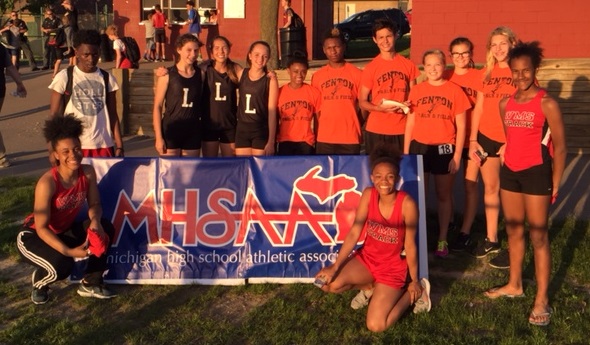
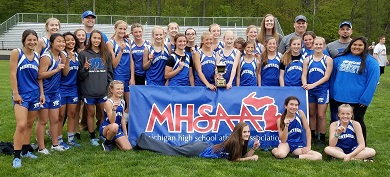 But there were more positives, by far. On multiple occasions, the winners of the meets asked to have their team photos taken with the MHSAA banner on the field. One team took individual photos of each athlete holding the trophy in front of the banner as well.
While not many, Inglis did have conversations about officiating with a handful of interested people – good news as the MHSAA is always in pursuit of adding to those numbers. And his presence gave fans an opportunity to ask about the MHSAA’s role both at the high school and junior high/middle school level – and gave him the opportunity to explain how the Association works and dispel some myths.
“I love the fact that the MHSAA was at our conference track meet,” Montague NBC Middle School athletic director Jay Mulder said. “Cody did a great job in talking with parents, athletes and coaches. The presence was just enough to get people to take notice of the MHSAA.
“As a middle school AD and a middle school coach, I am very encouraged and excited to see the active role that the MHSAA is taking with middle school sports. I think that it bodes well for the future.”
Amey noted a number of opportunities with printed materials and championship medals that could further promote the MHSAA’s messaging at junior high/middle school meets. Also part of future plans is the recruitment of regional “ambassadors” – retired coaches, athletic directors and officials would be among candidates – who will travel to junior highs and middle schools in their areas and grow connections at that level.
As members, junior highs and middle schools receive the structure and support of MHSAA rules and governance, and every athlete receives catastrophic and concussion care insurance managed by the MHSAA. More interaction by these ambassadors could lead to more membership – the meet at White Pine, for example, included nearly half non-MHSAA schools – and also more benefit to members, be it additional sponsorship, off-field programs or even MHSAA-created championship events to give those athletes more opportunities to shine at this lower level and as they work toward taking that big step to high school.
“It’s been like a light bulb has gone off,” Inglis said. “The brand of the MHSAA is viewed as a high school-only brand, and it was humbling to see the power in that brand as people look to the ultimate goal.
“However we can parlay that into more of a presence and use that brand to get involved in school sports at the younger levels, that helps in that transition.”
PHOTOS: (Top) Students from Grand Blanc West Middle School, Fenton Schmidt Middle School and Linden Middle School stand together with an MHSAA banner during the Flint Metro League meet last month. (Middle) The Montague NBC Middle School girls track & field team poses with a banner after winning the West Michigan Conference championship. (Photos courtesy of the Grand Blanc and Montague schools’ athletic departments.)