


Michigan's Ranking for High School Sports Participation Continues to Outpace Population
By
Geoff Kimmerly
MHSAA.com senior editor
September 4, 2026
Michigan enjoyed the sixth-highest boys participation in high school sports nationally in 2025-26, moving up one spot in that ranking, and maintained its girls and overall rankings of eighth as well – continuing to outpace where it ranks nationally for population of school-aged children according to U.S. Census Bureau estimates.
Michigan’s overall participation ranking was based on a total of 295,634 participants, data collected as part of the annual national participation study conducted by the National Federation of State High School Associations (NFHS) – of which the Michigan High School Athletic Association is a member. That total number of participants counts students once for each sport played, meaning students who are multiple-sport athletes are counted more than once.
A total of 171,573 boys participants moved Michigan up to sixth nationally on that list, after ranking seventh the past two school years and ninth in 2022-23. The girls total of 124,061 participants ranked eighth for the third-straight school year after Michigan was listed ninth for girls participation also in 2022-23.
Meanwhile, Michigan continued to rank 10th for both high school-aged boys and girls populations – and all high school-aged children combined – according to U.S. Census Bureau estimates.
Three sports for which the MHSAA sponsors postseason tournaments moved up on their respective national lists. Michigan counted the fifth-most boys basketball players, the state’s highest ranking in that sport since 2012-13 and two spots ahead of 2024-25. Girls competitive cheer also moved up two spots to ninth nationally, and boys wrestling moved up one spot on its list to seventh.
Participation in several more MHSAA sports continued to outpace the state’s ranking for high school-aged population.
For girls, bowling (third), tennis (third), golf (fourth), cross country (sixth), track & field (sixth), volleyball (sixth), basketball (seventh), softball (eighth), swimming & diving (eighth), and soccer (ninth) joined cheer in ranking higher than their population listing of 10th nationally. Among boys sports, bowling (second), ice hockey (fourth), golf (fifth), track & field (fifth), tennis (sixth), football (all contact formats combined – sixth), cross country (seventh), swimming & diving (eighth), baseball (ninth) and lacrosse (ninth) joined basketball and wrestling in exceeding the boys ranking of 10th for population. Boys soccer participation placed 10th on its national list.
Only 12 states sponsor alpine skiing, but Michigan again ranked third on both the girls and boys lists for that sport.
Nationally, participation in high school sports increased for the fifth consecutive year and set another record, with the total of 8,415,684 participants an increase of 1.8 percent from 2024-25. The total included 4,761,095 boys and 3,654,589 girls – both record highs as well – according to figures obtained from the 51 NFHS member state associations, which include Washington, D.C.
Eleven-player football remained the most popular boys (and overall) sport, totaling 1,043,716 athletes. Next on the boys list were outdoor track & field, basketball, soccer, baseball, wrestling, cross country, golf, tennis, and swimming & diving, respectively, repeating the same top 10 as in 2024-25.
For girls, the top nine sports remained the same from the previous year – outdoor track & field, volleyball and soccer, in that order, followed by basketball, softball, competitive spirit, tennis, cross country and swimming & diving, respectively. Flag football moved ahead of lacrosse into the 10th spot this past school year.
Texas (911,405) and California (859,022) remained atop the list for overall state participation. Ohio (347,994) ranked third, followed by Illinois (326,756), Pennsylvania (315,647), New York (312,563), Florida (311,233), Michigan (295,634), New Jersey (273,711) and Minnesota (241,536).
The NFHS participation survey was started in 1971 and compiled in its current form through the 2018-19 school year, resuming annually with the 2021-22 survey.
The NFHS, based in Indianapolis, is the national leadership organization for high school sports and performing arts activities. Since 1920, the NFHS has led the development of education-based interscholastic sports and performing arts activities that help students succeed in their lives. The NFHS writes playing rules for 18 sports for boys and girls at the high school level. Through its 50 member state associations and Washington, D.C., the NFHS reaches more than 19,800 high schools and 12 million participants in high school activity programs, including more than 8.4 million in high school sports.
The MHSAA is a private, not-for-profit corporation of voluntary membership by more than 1,500 public and private senior high schools and junior high/middle schools which exists to develop common rules for athletic eligibility and competition. No government funds or tax dollars support the MHSAA, which was the first such association nationally to not accept membership dues or tournament entry fees from schools. Member schools which enforce these rules are permitted to participate in MHSAA tournaments, which attract more than 1.4 million spectators each year.
MHSAA Opposes Big Ten Friday Football
November 2, 2016
By Geoff Kimmerly
Second Half editor
The executive director of the Michigan High School Athletic Association said today that he is “disappointed and disheartened” by the Big Ten Conference announcement that it will play and televise football games on Friday nights beginning with the 2017 season.
Friday night football remains one of the strongest and longest-standing traditions in high school athletics, and the MHSAA has fought since the start of this century to keep Friday nights sacred against the overstepping of college football and the damage televised Big Ten games are now expected to cause to attendance and media coverage of the sport at the high school level.
MHSAA Executive Director John E. “Jack” Roberts was contacted by both Big Ten Conference commissioner Jim Delany and Michigan State University athletic director Mark Hollis before the decision was announced. Roberts said he is appreciative of Michigan State and University of Michigan’s low tolerance to be included in this venture – at most, both will host a Thursday or Friday night game during Labor Day weekend and play one Friday night away game during the remainder of a season – but remains frustrated that similar respect for high school football was not shown by the conference as a whole.
Michigan State has played Friday night games during Labor Day weekend the last six seasons, hosting five and playing at Western Michigan University in 2015. However, most Michigan high school games continue to be scheduled and played on the Thursday before Labor Day, relieving holiday travel conflicts in most communities. University of Michigan did play on the Thursday before Labor Day at University of Utah in 2015, but has not played on a Friday night of Labor Day weekend this decade. The Wolverines are one of five Big Ten schools without a Friday night game in 2017.
“We are saddened by this decision. We had hoped that the Big Ten Conference would stay above this. We think this cheapens the Big Ten brand,” Roberts said. “Fans won’t like this. Recruits won’t like this. And high school football coaches won’t like this.
“We are grateful that Michigan State University and the University of Michigan are trying to minimize the effects of this decision by the Big Ten. But overall, this is just the latest step by major college athletics in the pursuit of cash that is just crushing high school sports.”
The MHSAA has shown its opposition to the use of Friday nights for televised collegiate football games for more than 15 years, dating back to 2001 when the NCAA lifted its restrictions on Friday night telecasts, which at first led to the broadcasting of “mid-major conference” games on the same night traditionally reserved for high school athletes.
The MHSAA launched in 2001 its “Save Our Friday Nights” campaign to emphasize the role that Friday night high school athletic events play in communities and to rally MHSAA member schools to contact NCAA member school football coaches, athletic directors and conference commissioners to voice their concerns.
In addition to causing lower attendance at events going up against Big Ten football games, Roberts anticipates that Friday night college games also will leave high school football as a secondary priority in many media markets. More than 80 radio stations statewide cover high school games regularly, but many also carry Michigan State or University of Michigan football. High school football could lose significant time on local TV highlights shows and in print and online coverage as well, as resources are diverted to cover a college game – potentially quieting significantly the positive buzz that comes from the typical high school football Friday night.
“Everyone knows that football is struggling right now,” Roberts said. “It’s getting a lot of bad publicity. Participation is declining. And now this; there couldn’t be worse timing.”
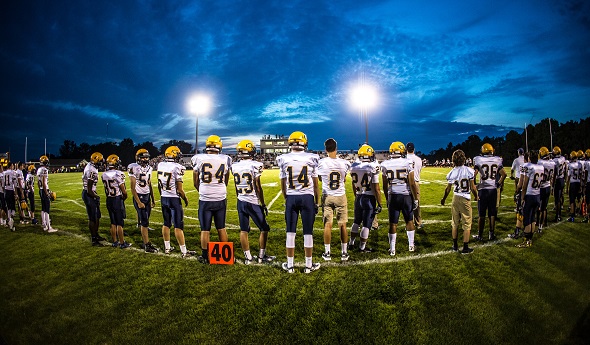
PHOTO: Grand Ledge takes on Okemos under the Friday night lights this season. (Click to see more from HighSchoolSportsScene.com.)