

Michigan's Ranking for High School Sports Participation Continues to Outpace Population
By
Geoff Kimmerly
MHSAA.com senior editor
September 4, 2026
Michigan enjoyed the sixth-highest boys participation in high school sports nationally in 2025-26, moving up one spot in that ranking, and maintained its girls and overall rankings of eighth as well – continuing to outpace where it ranks nationally for population of school-aged children according to U.S. Census Bureau estimates.
Michigan’s overall participation ranking was based on a total of 295,634 participants, data collected as part of the annual national participation study conducted by the National Federation of State High School Associations (NFHS) – of which the Michigan High School Athletic Association is a member. That total number of participants counts students once for each sport played, meaning students who are multiple-sport athletes are counted more than once.
A total of 171,573 boys participants moved Michigan up to sixth nationally on that list, after ranking seventh the past two school years and ninth in 2022-23. The girls total of 124,061 participants ranked eighth for the third-straight school year after Michigan was listed ninth for girls participation also in 2022-23.
Meanwhile, Michigan continued to rank 10th for both high school-aged boys and girls populations – and all high school-aged children combined – according to U.S. Census Bureau estimates.
Three sports for which the MHSAA sponsors postseason tournaments moved up on their respective national lists. Michigan counted the fifth-most boys basketball players, the state’s highest ranking in that sport since 2012-13 and two spots ahead of 2024-25. Girls competitive cheer also moved up two spots to ninth nationally, and boys wrestling moved up one spot on its list to seventh.
Participation in several more MHSAA sports continued to outpace the state’s ranking for high school-aged population.
For girls, bowling (third), tennis (third), golf (fourth), cross country (sixth), track & field (sixth), volleyball (sixth), basketball (seventh), softball (eighth), swimming & diving (eighth), and soccer (ninth) joined cheer in ranking higher than their population listing of 10th nationally. Among boys sports, bowling (second), ice hockey (fourth), golf (fifth), track & field (fifth), tennis (sixth), football (all contact formats combined – sixth), cross country (seventh), swimming & diving (eighth), baseball (ninth) and lacrosse (ninth) joined basketball and wrestling in exceeding the boys ranking of 10th for population. Boys soccer participation placed 10th on its national list.
Only 12 states sponsor alpine skiing, but Michigan again ranked third on both the girls and boys lists for that sport.
Nationally, participation in high school sports increased for the fifth consecutive year and set another record, with the total of 8,415,684 participants an increase of 1.8 percent from 2024-25. The total included 4,761,095 boys and 3,654,589 girls – both record highs as well – according to figures obtained from the 51 NFHS member state associations, which include Washington, D.C.
Eleven-player football remained the most popular boys (and overall) sport, totaling 1,043,716 athletes. Next on the boys list were outdoor track & field, basketball, soccer, baseball, wrestling, cross country, golf, tennis, and swimming & diving, respectively, repeating the same top 10 as in 2024-25.
For girls, the top nine sports remained the same from the previous year – outdoor track & field, volleyball and soccer, in that order, followed by basketball, softball, competitive spirit, tennis, cross country and swimming & diving, respectively. Flag football moved ahead of lacrosse into the 10th spot this past school year.
Texas (911,405) and California (859,022) remained atop the list for overall state participation. Ohio (347,994) ranked third, followed by Illinois (326,756), Pennsylvania (315,647), New York (312,563), Florida (311,233), Michigan (295,634), New Jersey (273,711) and Minnesota (241,536).
The NFHS participation survey was started in 1971 and compiled in its current form through the 2018-19 school year, resuming annually with the 2021-22 survey.
The NFHS, based in Indianapolis, is the national leadership organization for high school sports and performing arts activities. Since 1920, the NFHS has led the development of education-based interscholastic sports and performing arts activities that help students succeed in their lives. The NFHS writes playing rules for 18 sports for boys and girls at the high school level. Through its 50 member state associations and Washington, D.C., the NFHS reaches more than 19,800 high schools and 12 million participants in high school activity programs, including more than 8.4 million in high school sports.
The MHSAA is a private, not-for-profit corporation of voluntary membership by more than 1,500 public and private senior high schools and junior high/middle schools which exists to develop common rules for athletic eligibility and competition. No government funds or tax dollars support the MHSAA, which was the first such association nationally to not accept membership dues or tournament entry fees from schools. Member schools which enforce these rules are permitted to participate in MHSAA tournaments, which attract more than 1.4 million spectators each year.
Cvengros Leaves Lasting Impact
By
Geoff Kimmerly
MHSAA.com senior editor
April 1, 2014
Retired Associate Director Jerry Cvengros, who served at the Michigan High School Athletic Association for more than 13 years after three decades at Escanaba High School, died Monday evening in Lansing. He was 80.
As lead assistant to Executive Director John E. “Jack” Roberts from August 1988 until retiring in January 2002, Cvengros served as director of football and briefly hockey in addition to coordinating the Program of Athletic Coaches Education (PACE), presenting annual in-service training for administrators and serving as MHSAA liaison to statewide principals, athletic directors and coaches associations.
 He came to the MHSAA after 30 years at Escanaba, where he taught, coached, served as athletic director and later principal during a tenure stretching from August 1958 through July 1988. While at Escanaba, Cvengros also represented Upper Peninsula Class A and B schools on the MHSAA Representative Council from 1983-88 and served as the Council’s president from 1986-88.
Cvengros received the MHSAA’s Charles E. Forsythe Award in 2000 in recognition of his many and significant contributions to interscholastic athletics.
“During his lifetime, Jerry Cvengros impacted every area of interscholastic athletics as a coach, athletic director, principal and then associate director of the MHSAA," Roberts said. “He was the perfect combination of fairness, toughness and diplomacy, able to draw on a vast knowledge of MHSAA rules and an understanding of educational athletics fostered by his various experiences.
“Jerry was known and respected statewide for his dedication, and his contributions have had a lasting impact.”
Cvengros built an elite football program at Escanaba as varsity head coach from 1962-84, leading the Eskymos to a 161-42-3 record, a Class A runner-up finish in 1979 and the MHSAA championship in 1981. That team remains the only Class A/Division 1 team from the Upper Peninsula to win an MHSAA football title. Cvengros was inducted into the Michigan High School Football Coaches Association Hall of Fame and served on its original Board of Directors.
His 1979 team fell to Detroit Catholic Central 32-7, but he brought the Eskymos back to the Finals for a 16-6 win over Fraser two seasons later. Cvengros' championship lineup included quarterback Kevin Tapani, who would go on to pitch for the Minnesota Twins among five major league clubs, and tailback Dean Altobelli, who later played at Michigan State University. The title run included a 15-14 Semifinal win over Dearborn Fordson that included a savvy two-point conversion call by Cvengros, who wanted to avoid overtime after a late score drew Escanaba to within a point of tying the score.
As the MHSAA’s director of football, Cvengros was instrumental in creating the current playoff format that expanded the field from 128 to 256 teams beginning with the 1999 season. He also co-authored “Youth Football: A Complete Handbook,” a guide to coaching at that level.
Among many additional honors, Cvengros was inducted into the Upper Peninsula Sports Hall of Fame and Michigan High School Coaches Association Hall of Fame and received the Distinguished Service Award from the Michigan Interscholastic Athletic Administrators Association. The National Federation of State High School Associations twice awarded Cvengros with a Citation – the NFHS’ highest honor – for his service as a coach and then as a member of the MHSAA staff.
Since his retirement, Cvengros and his wife Shelley have continued to reside in Okemos. A visitation will take place beginning at 10 a.m. Monday, April 7, at St. Martha Parish in Okemos, with a funeral Mass to follow at 11 a.m.
Cvengros was a 1951 graduate of Ironwood High School and went on to study and play football at the University of Wisconsin in Madison. He earned his bachelor’s degree in secondary education and teaching from the University of Wisconsin-Superior and a master’s from Northern Michigan University.
He taught English, history and physical education at Escanaba High School and also coached basketball and track and field. He became the school’s athletic director in 1970, added the duties of activities director in 1975 and became principal in 1983.
Cvengros is survived by his wife and children Michael, Steven and David, and seven grandchildren. He was preceded in death by his daughter Lee Ann (Cvengros) Swasey in May 2013.
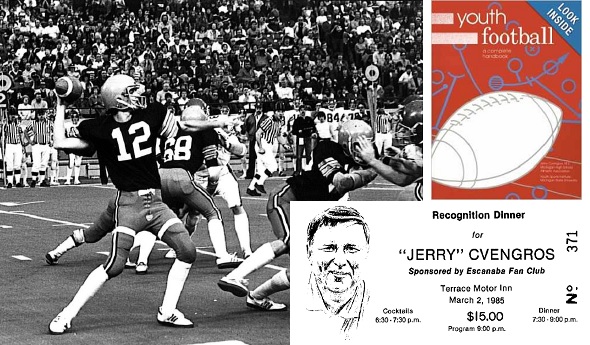
PHOTOS: (Clockwise from left) Escanaba quarterback Mike Beveridge fires a pass during the 1979 Class A Final; Cvengros co-authored a book on coaching youth football; Cvengros was celebrated once more in Escanaba following his final season as football coach.