


Multi-Sport Survey Helps Set Benchmark
July 31, 2018
By Geoff Kimmerly
Second Half editor
NOTE: This report includes a revision Aug. 3 to account for incorrect data for Jenison, which previously was listed with the second-highest percentage of multi-sport athletes in Class A. The updated data changed only two percentages updated below (*), and both by only one tenth of a percent.
Nearly 43 percent of athletes at Michigan High School Athletic Association member high schools participated in more than one sport during the 2017-18 school year, according to the first-ever Multi-Sport Participation Survey conducted this spring and inspired by the work of the MHSAA’s Task Force on Multi-Sport Participation.
Early and intense sport specialization has become one of the most serious issues related to health and safety at all levels of youth sports, as overuse injuries and burnout among athletes have been tied to chronic injuries and health-related problems later in life. In early 2016, the MHSAA appointed the Task Force on Multi-Sport Participation as part of a continued effort to promote and protect participant health and address the issues leading to early sport specialization.
While there is a growing amount of research detailing the negative effects of early sport specialization, there is little research on the prevalence of sport specialization, including at the high school level. This MHSAA survey received responses from 79.9 percent of member high schools and will be conducted annually to measure how multi-sport participation exists at schools of different sizes and also the progress being made to increase it at all schools.
“It’s now well-known that students who specialize in one sport year-round are prone to all kinds of health hazards. This is serious business; we have to find out the ways and means to promote the multi-sport experience,” MHSAA Executive Director John E. “Jack” Roberts said. “This survey will help us identify best practices. If I’m an administrator, and another school of the same size and same demographics has twice the multi-sport participation as my school, I want to know why. What are they doing to encourage that culture?”
From schools that responded to this year’s survey, 42.5 percent of students participated in athletics in 2017-18 – 46.3 percent of boys and 38.7 percent of girls. As anticipated, Class D schools enjoyed the highest percentage of athletes among the entire student body, at 55.2 percent, followed by Class C (50.1), Class B (45.1) and Class A (39.1*).
Of those athletes counted by responding schools, 42.8 percent participated in more than one sport – including 44.6 percent of boys and 40.6 percent of girls. Class D again enjoyed the highest percentage of multi-sport athletes, 58.1 percent, followed by Class C (55.2), Class B (46.7) and Class A (35.9*).
Similar results for overall sport participation and multi-sport participation relative to enrollment size were seen by further breaking down Class A into schools of fewer than 1,000 students, 1,000-1,500 students, 1,501-2,000 students and more than 2,000 students. For both sport participation as a whole and multi-sport participation specifically, the smallest Class A schools enjoyed the highest percentages, while percentages then decreased for every larger size group of schools.
The MHSAA Task Force on Multi-Sport Participation also recommended measuring multi-sport participation in MHSAA member schools to recognize “achievers” – that is, schools that surpass the norm given their enrollment and other factors that affect school sports participation. An achievement program is being developed for future years, and this year’s survey results will assist in setting a benchmark for that recognition.
In Class A, Marquette (82.6 percent), Grand Rapids Union (74.1) and Holland West Ottawa (74.0) posted the highest percentages of multi-sport athletes. In Class B, four schools achieved at least 80 percent multi-sport participation – Birch Run (87.1), Gladstone (83.8), Clawson (81.0) and Shepherd (80).
Class C saw 13 schools with more than 80 percent of its athletes taking part in more than one sport, led by Ubly (90.2 percent) and Detroit Southeastern (89.2). Four Class D schools responded at higher than 90 percent multi-sport participation – Brethren (95.4), DeTour (94.3), Jackson Christian (91.7) and Waterford Our Lady (90.8).
The full summary report on the Multi-Sport Participation Survey is available on the “Health & Safety” page of the MHSAA Website.
MHSAA, NFHS Learning Center Team Up to Provide Online Student Leadership Series
By
Geoff Kimmerly
MHSAA.com senior editor
August 10, 2023
Leadership always has been one of the most valuable and applicable life skills developed by student-athletes participating in educational athletics. To assist in that development, the Michigan High School Athletic Association (MHSAA) and National Federation of State High School Associations (NFHS) have partnered to produce an online Student Leadership series designed to provide the latest research-based instruction to high schoolers throughout the United States.
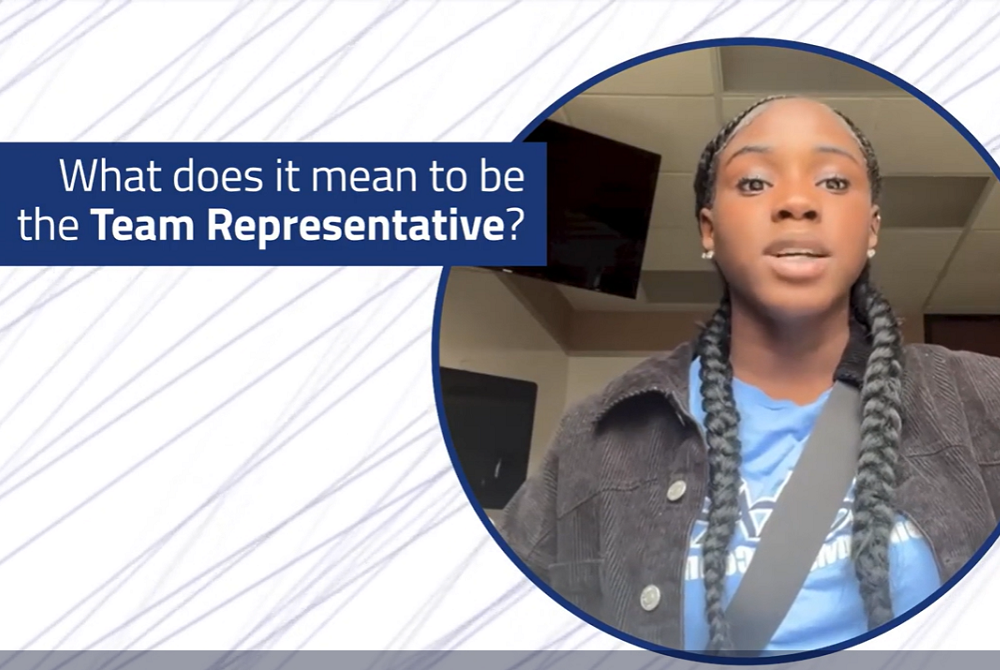
The Student Leadership series is provided as part of the web-based NFHS Learning Center and includes two free courses focused on students – “Becoming a Leader” and “Leading Others” – with a third installment for coaches currently in production. All three are inspired by the latest research on how youth-aged athletes learn to lead.
This latest work builds on the MHSAA-produced “Captains Course” developed in 2015 with Michigan State University’s Institute for the Study of Youth Sports (ISYS). The “Captains Course” has been taken more than 100,000 times and is based on in-person “Captains Clinics” that MHSAA staff and ISYS conduct with thousands of students across Michigan each year.
Each student-focused segment of the new Student Leadership series takes 30-45 minutes to complete and includes frequent and quick activities designed to help students understand how they would apply leadership skills in real-life scenarios. Course instruction was created primarily in coordination with the MHSAA by a pair of nationally-recognized authorities on the subject: Jed Blanton, an assistant professor in kinesiology, recreation and sport studies at the University of Tennessee; and Scott Pierce, an associate professor in kinesiology and recreation at Illinois State University.
Both Blanton and Pierce have vast experience with youth athletics; both also formerly worked for the Institute for the Study of Youth Sports and served as graduate assistants at the MHSAA during their time at MSU, playing large roles in more than a decade of research conducted through coordination with the MHSAA’s 16-member Student Advisory Council. High school administrators, student leaders, and other researchers and mental performance consultants also contributed to the lessons taught in these courses. The NFHS produced the content, including all of the visuals and digital features, and the student-focused courses went live on the NFHS Learn website in mid-summer.
“We’ve taken a good program, and made it even better,” said MHSAA Assistant Director Andy Frushour, who coordinates the Association’s student services programs. “This is a program we do in person in Michigan, but our reach now is across the country – and these courses are free, hopefully allowing us to contribute to the development of even more student leaders.”
The “Becoming a Leader” course defines leadership styles and builds skills to help students consider themselves as leaders. “Leading Others” details how leaders put those skills into practice including during challenging situations. Blanton and Pierce worked closely with student advisory groups from various states to make the research content relatable to school sports participants. All voices heard in the courses belong to high school students – including athletes from Michigan, Illinois and Washington who provided 30 testimonials that describe leadership in action.
The “Coaches Course” will provide the same information as presented to high school students, but in a way that explains how coaches can use these tools to personalize leadership training among their athletes as they seek to recognize which types of leaders they have on a team, and which types are missing and need to be developed.
“The NFHS is grateful for the opportunity to work with the MHSAA as well as Dr. Blanton and Dr. Pierce,” said Dan Schuster, the NFHS’ director of educational services. “We believe these student leadership courses will provide valuable information across the country and will contribute to the improvement of the interscholastic experience for young people.”
Video previews provide additional information on both Student Leadership courses.Click for direct links to “Becoming a Leader" and “Leading Others.”