


New Member to join MHSAA Rep Council
October 15, 2012
Elections were completed recently to fill positions on the Michigan High School Athletic Association’s legislative body, its Representative Council, and one new member was among those selected.
Reese athletic director Dave Derocher will join the council to represent Class C and D schools in the northern section of the Lower Peninsula. He was elected to a two-year team, as were seven others who were re-elected and will begin terms during the council’s fall meeting.
Saginaw Heritage athletic director and assistant principal Peter Ryan will continue to represent Class A and B schools in the Lower Peninsula’s northern section, Buchanan athletic director Fredrick Smith will continue to represent Class A and B in the southwestern section, and Brighton athletic director John Thompson will continue to represent Class A and B in the southeastern section. Negaunee superintendent James Derocher will continue to represent Class C and D schools in the Upper Peninsula.
Grand Haven assistant superintendent Scott C. Grimes was re-elected to a statewide at-large position, and Clare Middle School principal Steve Newkirk was re-elected to represent junior high and middle schools. Vic Michaels, director of physical education and athletics for the Archdiocese of Detroit, will continue to represent private and parochial schools.
The Representative Council is the 19-member legislative body of the MHSAA. All but five members are elected by member schools. Four members are appointed by the Council to facilitate representation of females and minorities, and the 19th position is occupied by the Superintendent of Public Instruction or designee. The Council meets three times annually, and five members of the Council convene monthly during the school year to form the MHSAA’s Executive Committee, which reviews appeals of Handbook regulations by member schools.
Additional elections took place to select representatives to the Upper Peninsula Athletic Committee. St. Ignace superintendent Donald Gustafson was chosen to represent Class D schools. Michael Berutti, who serves as principal, athletic director and football coach at Iron River West Iron County High School, was elected to represent athletic coaches.
Inman's 'Spirit' Recognized by NFHS
March 12, 2019
By John Gillis
Special from NFHS
Searra Inman, a student-athlete at Niles Brandywine High School, has been selected as the Section 4 recipient of the “National High School Spirit of Sport Award” by the National Federation of State High School Associations (NFHS).
The National High School Spirit of Sport Award was created by the NFHS to recognize those individuals who exemplify the ideals of the spirit of sport that represent the core mission of education-based athletics.
A soccer and wrestling participant during her athletic career at Brandywine High School, Inman’s life changed forever during the summer between her junior and senior years.
At that time, she was diligently preparing for her senior wrestling season. With 75 career victories to her credit, she had two goals – to achieve 100 victories and to earn a four-year varsity wrestling plaque.
On July 9, 2018, Inman was involved in a motorcycle crash that left her with a displaced vertebral fracture that severed her spinal cord and resulted in her being paralyzed from the waist down.
Inman underwent surgical procedures at Indiana University Health Methodist Hospital. Surgeons in Indianapolis used her as a case study due to the fact that almost no one with such severe spinal cord injuries had reached the operating table alive. Her initial prognosis was that she would remain hospitalized into January 2019.
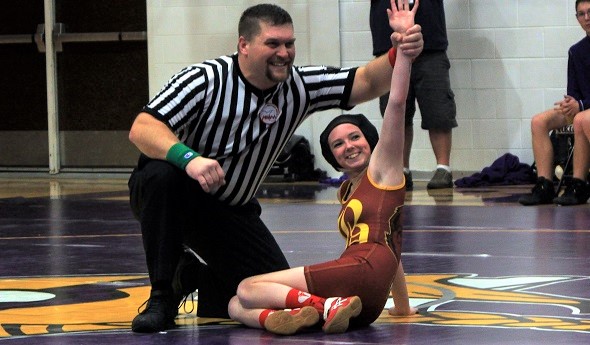
However, on Sept. 14, 2018, Inman led her school’s football team onto the field for its Week 4 game. Then, during Brandywine High School’s December 5th wrestling season opener with Bronson High School, Inman locked her wheelchair, crawled in uniform to the circle of the wrestling mat, and was awarded a forfeit win in the 103-pound weight class.
However, the best might have been saved for last when during a Feb. 12 Division 4 Regional match against Schoolcraft, Inman once again moved to the center of the mat, had her hand raised for another forfeit, and in the process, got victory No. 100 and accomplished her mission.
Click to read the Second Half report "In Her Fight, Inman Seeks to Provide Hope" published earlier this winter.
About the Award
The NFHS divides the nation into eight geographical sections. The states in Section 4 are Michigan, Wisconsin, Illinois, Indiana and Iowa.
Nominations for this award were generated through NFHS member state associations and reviewed by the NFHS Spirit of Sport Award Selection Committee composed of state association staff members.
While the national winner will be recognized June 29 at the NFHS Summer Meeting in Indianapolis, Indiana, the section winners will be recognized within their respective states and will receive awards before the end of the current school year.
PHOTO: Searra Inman has her arm raised in victory during a match this season. (Photo courtesy of the Niles Brandywine wrestling program.)