

NFHS Introduces Updated Logo
July 17, 2019
Special from NFHS
As the National Federation of State High School Associations (NFHS) heads into the next 100 years of leading high school sports and other activity programs nationwide, it will be doing so with a new logo.
 The new logo was unveiled to the membership earlier this month at the close of the NFHS Centennial Celebration. The NFHS and its 51-member state high school associations celebrated the organization’s accomplishments at the 100th Annual Meeting at the JW Marriott in downtown Indianapolis.
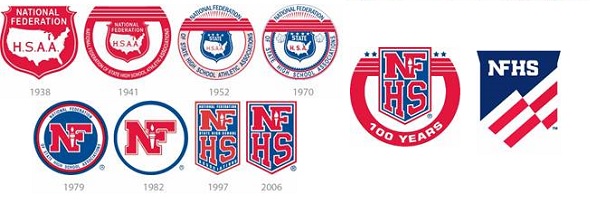
The organization will continue to be branded as the NFHS in the new logo, and the N and F are connected as has been the case since 1979. However, the entire acronym is together on one line as opposed to the previous logo with the NF and HS on separate lines. While red and blue will continue to be the predominant colors, the new logo mixes white with red and blue to suggest a flag waving in the wind. The direction of the flag is pointing upward to symbolize forward-thinking and advancement.
The new design maintains a resemblance to the shield that has been a part of the NFHS logo since 1997. However, the logo is flared at the top, and the bottom of the logo does not have definitive borders, which suggests the organization has moved past its first 100 years and is expanding its reach as the national leadership organization for high school sports and performing arts programs in the United States.
While the organization’s logo from 1952 had four stars to signify the four charter members of the NFHS, the four stripes within the new logo represent the four homes of the organization during the first 100 years.
“We wanted to retain NFHS as the central component of the new logo because the organization’s national presence has continued to spiral upward in the 22 years since the NFHS acronym was adopted,” said Dr. Karissa Niehoff, NFHS executive director. “However, as we celebrated our first 100 years, we felt it was important to establish a new look that would signify our ever-increasing role as the national leader in high school sports and performing arts programs.”
Counting the Centennial logo that was used during the 2018-19 school year, the new logo will be 10th used by the organization since the first one was adopted in the 1930s. The new logo was created by Section 127, an Indianapolis-based design company.
The NFHS was started in 1920 and had offices in Chicago until 1971, when it moved to Elgin, Illinois. The organization moved to Kansas City, Missouri, in 1979, and then in 2000 to Indianapolis, where it remains today.
The Michigan High School Athletic Association is a member of the NFHS, and Michigan is one of the four founding states of the national association.

Fall Tournaments to Conclude in January
December 26, 2020
By Geoff Kimmerly
Second Half editor
The concluding rounds of Michigan High School Athletic Association postseason tournaments in football, girls volleyball and girls swimming & diving will be completed during January, as the MHSAA continues to follow all emergency orders from the Michigan Department of Health & Human Services (MDHHS).
Football teams may begin two days of outdoor, non-contact conditioning and drills, wearing helmets and shoulder pads with physical distancing, on Monday, Dec. 28, in advance of the first round of testing Dec. 30 as part of an MDHHS rapid testing pilot program. Schools will test players, coaches and other team personnel, with full-contact practice then allowed after a first round of negative results. The testing program will utilize BinaxNOW antigen tests that produce results within 15 minutes.
For football, 11-Player Regional Finals and 8-Player Semifinals will be played Saturday, Jan. 9. The 8-Player Finals and 11-Player Semifinals will be played Saturday, Jan. 16; and 11-Player Finals will be played during the weekend of Jan. 22-23.
The MDHHS’s current epidemic order – which paused activity beginning Nov. 18 – is set to expire Jan. 15, and if restrictions on non-contact sports are lifted then volleyball and swimming & diving could practice and compete at that time outside of the required rapid testing program. If the MDHHS epidemic order continues, volleyball and swimming & diving could begin practice, but those teams and individuals will have to follow all requirements of the MDHHS rapid testing pilot program to be eligible to participate. Specific plans and dates for volleyball and girls swimming & diving practice resumption and MHSAA tournaments will be finalized and shared with competing schools in early January.
Volleyball competition will restart with Quarterfinals, and Lower Peninsula girls swimming & diving has advanced to its Finals. The championship events in both sports would be completed no later than Jan. 30.