

NFHS Introduces Updated Logo
July 17, 2019
Special from NFHS
As the National Federation of State High School Associations (NFHS) heads into the next 100 years of leading high school sports and other activity programs nationwide, it will be doing so with a new logo.
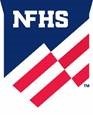 The new logo was unveiled to the membership earlier this month at the close of the NFHS Centennial Celebration. The NFHS and its 51-member state high school associations celebrated the organization’s accomplishments at the 100th Annual Meeting at the JW Marriott in downtown Indianapolis.
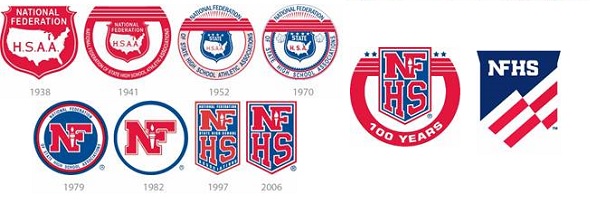
The organization will continue to be branded as the NFHS in the new logo, and the N and F are connected as has been the case since 1979. However, the entire acronym is together on one line as opposed to the previous logo with the NF and HS on separate lines. While red and blue will continue to be the predominant colors, the new logo mixes white with red and blue to suggest a flag waving in the wind. The direction of the flag is pointing upward to symbolize forward-thinking and advancement.
The new design maintains a resemblance to the shield that has been a part of the NFHS logo since 1997. However, the logo is flared at the top, and the bottom of the logo does not have definitive borders, which suggests the organization has moved past its first 100 years and is expanding its reach as the national leadership organization for high school sports and performing arts programs in the United States.
While the organization’s logo from 1952 had four stars to signify the four charter members of the NFHS, the four stripes within the new logo represent the four homes of the organization during the first 100 years.
“We wanted to retain NFHS as the central component of the new logo because the organization’s national presence has continued to spiral upward in the 22 years since the NFHS acronym was adopted,” said Dr. Karissa Niehoff, NFHS executive director. “However, as we celebrated our first 100 years, we felt it was important to establish a new look that would signify our ever-increasing role as the national leader in high school sports and performing arts programs.”
Counting the Centennial logo that was used during the 2018-19 school year, the new logo will be 10th used by the organization since the first one was adopted in the 1930s. The new logo was created by Section 127, an Indianapolis-based design company.
The NFHS was started in 1920 and had offices in Chicago until 1971, when it moved to Elgin, Illinois. The organization moved to Kansas City, Missouri, in 1979, and then in 2000 to Indianapolis, where it remains today.
The Michigan High School Athletic Association is a member of the NFHS, and Michigan is one of the four founding states of the national association.

Participation Remains Steady in 2018-19
July 18, 2019
By Geoff Kimmerly
Second Half editor
Michigan High School Athletic Association member schools continued to experience a decade-long decline in enrollment in 2018-19, and participation across 28 sports for which the MHSAA sponsors postseason tournaments also decreased slightly. However, while the drop in enrollment was 1.28 percent from the previous school year, participation fell only 1.03 percent as four sports repeated in setting records.
A total of 281,992 participants competed in MHSAA-sponsored sports this past school year. The overall MHSAA participation totals count students once for each sport in which they participate, meaning students who are multiple-sport athletes are counted more than once.
Boys participation fell 1.2 percent to 161,614, and for the first time in four years girls participation also decreased, by eight tenths of a percent to 120,378. However, both reductions were smaller than losses in enrollment of 1.36 percent for boys and 1.19 for girls. Since the 2008-09 school year, overall enrollment in MHSAA member high schools is down 12.8 percent. But during that time, overall participation in MHSAA-sponsored sports is down only 7.3 percent.
Girls lacrosse continued its run of setting a participation record every season since becoming a sponsored tournament sport in 2005, this spring with 3,180 participants – a 9.7-percent increase from a year ago. Boys lacrosse set a record for the third consecutive year, up 5.2 percent with 5,438 participants. Both boys and girls bowling also repeated in breaking participation records – boys bowling participation increased 4.7 percent over 2017-18 with 4,329 participants, while girls bowling was up 1.1 percent with 3,093 athletes. Boys cross country, with 9,588 athletes, just missed last year’s record-setting total but still saw its second-largest group of participants since totals first were tracked year-to-year in 1991-92.
Seven more sports saw increases in participation in 2018-19, boys skiing leading the way with 11.2-percent growth – its 6,284 athletes were the sport’s most since 2014-15 thanks with an increase of three tenths of a percent over a year ago. Girls and boys tennis both saw increases; girls 1.8 percent to 9,286 athletes, its most since 2011-12, and boys up 1.6 percent to 6,261 athletes, its most since 2014-15.
Girls swimming & diving was up 1.1 percent to 5,794 athletes, its most since 2013-14. Girls track & field had its highest number of participants since 2009-10 with 17,406, with an increase of seven tenths of a percent from last year. Wrestling increased a percent from 2017-18, to 9,494 athletes, ending two years of declines. Boys Golf was up three tenths of a percent to 6,284 athletes, ending three straight years of decreases.
While 17 sports saw decreases in participation, eight saw decreases by smaller percentages than the loss of enrollment: boys basketball (-1.2 percent), girls competitive cheer (-0.6), boys cross country (-0.7), girls gymnastics (-1.1), girls skiing (-0.5), boys soccer (-0.9), girls soccer (-0.1) and boys track & field (-0.1). Football, despite a decrease in participation of 4.3 percent, remains the most played sport by far with 35,412 participants. Boys track & field is second with 23,548, followed by boys basketball with 21,125. Girls volleyball, despite a 1.8-percent decline from a year ago, remains the most popular girls sport with 19,072 athletes.
The participation figures are gathered annually from MHSAA member schools to submit to the National Federation of State High School Associations for compiling of its national participation survey. Results of Michigan surveys from the 2000-01 school year to present may be viewed on the MHSAA Website.
The following chart shows participation figures for the 2018-19 school year from MHSAA member schools for sports in which the Association sponsors a postseason tournament:
|
BOYS |
GIRLS |
|||
|
Sport |
Schools (A) |
Participants |
Schools (A) |
Participants (B) |
|
Baseball |
639/9 |
17,211 |
- |
0/23 |
|
Basketball |
731/2 |
21,119 |
693 |
15,376/6 |
|
Bowling |
398/13 |
4,302 |
370 |
3,093/27 |
|
Competitive Cheer |
- |
- |
347 |
6,672 |
|
Cross Country |
634/0 |
9,588 |
619 |
8,144 |
|
Football - 11 player |
572/82 |
33,868 |
- |
0/94 |
|
8-player |
79/10 |
1,432 |
- |
0/18 |
|
Golf |
504/74 |
6,136 |
337 |
3,587/148 |
|
Gymnastics |
- |
- |
86 |
694 |
|
Ice Hockey |
242/10 |
3,282 |
- |
-/12 |
|
Lacrosse |
163/8 |
5,423 |
120 |
3,180/15 |
|
Skiing |
102/0 |
924 |
95 |
763 |
|
Soccer |
492/16 |
14,425 |
476 |
13,209/67 |
|
Softball |
- |
- |
628 |
13,290 |
|
Swimming & Diving |
248/18 |
4,968 |
262 |
5,794/35 |
|
Tennis |
290/17 |
6,221 |
330 |
9,286/40 |
|
Track & Field |
679/0 |
23,548 |
673 |
17,406 |
|
Volleyball |
- |
- |
713 |
19,072 |
|
Wrestling |
466/186 |
9,167 |
- |
-/327 |
(A) The first number is the number of schools reporting sponsorship on the Sports Participation Survey, including primary and secondary schools in cooperative programs as of May 15, 2019. The second number indicates the number of schools that had girls playing on teams consisting primarily of boys.
(B) The second number indicates the number of additional girls playing on teams consisting primarily of boys and entered in boys competition.
The MHSAA is a private, not-for-profit corporation of voluntary membership by more than 1,500 public and private senior high schools and junior high/middle schools which exists to develop common rules for athletic eligibility and competition. No government funds or tax dollars support the MHSAA, which was the first such association nationally to not accept membership dues or tournament entry fees from schools. Member schools which enforce these rules are permitted to participate in MHSAA tournaments, which attract more than 1.4 million spectators each year.