

NFHS's Gardner Announces Retirement
January 9, 2018
Special from NFHS
Bob Gardner, executive director of the National Federation of State High School Associations (NFHS) since May 2010, has announced his retirement, effective Aug. 1, 2018. Gardner notified the NFHS Board of Directors of his retirement plans at the NFHS Winter Meeting on Jan. 3 in Scottsdale, Arizona.
 Gardner is the fifth full-time executive director of the NFHS, following H.V. Porter (1940-58), Cliff Fagan (1958-77), Brice Durbin (1977-93) and Bob Kanaby (1993-2010).
Gardner’s eight-year run as head of the national organization for high school athletics and performing arts activities will conclude a 48-year career in secondary education, including the final 18 years on the NFHS staff in Indianapolis.
Since assuming duties as NFHS executive director in 2010, Gardner has vigorously promoted the values of high school activity programs and expanded opportunities for participation by boys and girls nationwide. During his eight years as executive director, participation in high school sports has increased by almost 400,000, including the expanded opportunity for students with disabilities in high school sports.
Gardner has led the organization’s focus on risk minimization in high school sports, with particular emphasis on concussion awareness, and has brought a heightened national presence to the work of the NFHS and its member state associations. In addition to the continual expansion of the NFHS Learning Center during his tenure, Gardner is credited with starting the NFHS Network, the first-of-its-kind digital coverage of high school sports with more than 25,000 events covered during the 2016-17 school year.
In addition, during his eight years as chief executive of the organization, operating revenue for the NFHS increased by $4 million.
Ironically, Gardner’s entire 48-year career was spent in the state of Indiana. He was a teacher and coach at three schools for eight years and also served as an athletic director for a period of time. In 1978, Gardner became principal of Milan Junior-Senior High School, followed by a stint as superintendent of the Milan Community Schools.
After serving on the Indiana High School Athletic Association (IHSAA) Board of Directors during his time at Milan, Gardner joined the IHSAA staff in 1985 as assistant commissioner. He served 10 years in that role prior to becoming commissioner in 1995.
During his five years as IHSAA commissioner, Gardner led the change in the IHSAA football playoffs to permit participation by all schools, negotiated the association’s largest corporate sponsorship agreement in history with Indiana Farm Bureau Insurance and led the transition to multiple classes in team sports.
Gardner joined the NFHS staff in 2000 as chief operating officer and served in that position for 10 years prior to becoming executive director. During this time, he chaired the NFHS Rules Review Committee and was responsible for day-to-day operations of the organization.
Gardner earned his bachelor’s degree from the University of Evansville (Indiana) and his master’s and education specialist degrees from Ball State University in Muncie, Indiana. He has served on the Board of Directors for USA Football, USA Basketball and the Indiana Sports Corporation. He is a member of the Indiana High School Wrestling Hall of Fame.
Following the March 1 application deadline, finalists for the position will be interviewed by the NFHS Board of Directors April 17-18 in Indianapolis, with the new executive director expected to begin duties Aug. 1.
Uyl to Serve as MHSAA's Next Executive Director
By
Geoff Kimmerly
MHSAA.com senior editor
May 8, 2018
Mark Uyl's impact on educational athletics has stretched from his hometown across this state and our country as a teacher, coach, administrator and one of the nation's most respected voices in sport officiating.
The Caledonia native and assistant director for the Michigan High School Athletic Association over the last 14 years is now charged with leading the Association as it continues in the work he has championed for two decades.
 Uyl, 44, has been selected as the next executive director of the MHSAA by its Representative Council. He will succeed retiring Executive Director John E. “Jack” Roberts in August. Roberts, who has served as executive director since the fall of 1986, announced his retirement April 24.
Uyl joined the MHSAA staff in January 2004 and coordinates the Association’s nearly 10,000 officials in addition to serving as director of baseball and administrator of the MHSAA’s catastrophic and concussion care insurance plans. He also has served as director of cross country and wrestling during his tenure.
As assistant director, Uyl was instrumental as the MHSAA became the first state high school athletics association to offer concussion care insurance, which provides gap coverage to assist in covering costs for athletes who are injured while participating in MHSAA-sponsored sports. As an official himself, Uyl has worked to build a stronger relationship with those working high school events that has included an increase in training and support. As a sport director, Uyl has sought to create the best experiences for Michigan high school teams, including with the move of the MHSAA Baseball and Softball Finals to Michigan State University in 2014.
“The foundation built here by Jack Roberts over the last 32 years is the strongest in the country, and I’m honored to have the opportunity to lead our staff in building on that foundation,” Uyl said. “There will be many ways we’ll continue to protect the same values of educational athletics, while also looking for new ways and new opportunities to best serve the students and our member schools in Michigan.”
In addition to his full-time MHSAA duties, Uyl has officiated collegiate baseball since 1997 and is regarded as one of the best at that level. In addition to umpiring major conference baseball all over the United States, Uyl was part of the crews for the 2014 and 2017 College World Series. He also officiated college football for 12 years with several NCAA postseason assignments, and did serve as coordinator of officials for the Michigan Intercollegiate Athletic Association. He was registered with the MHSAA for at least three sports beginning in 1992 and worked the Baseball Finals in 1999.
Additionally, Uyl served on the board of directors of the National Association of Sports Officials (NASO) from 2012-15 and as its chairperson during his final year. Currently, he serves as the high school representative on the Officiating Development Alliance (ODA), which consists of the supervisors of officials for the NFL, NBA, MLB, NHL, CFL, MLS and NCAA Division I sports.
The Council made its decision at the conclusion of its annual Spring Meeting on May 7 in Gaylord. Uyl will become only the fifth full-time executive in the MHSAA’s 94-year history, following Charles E. Forsythe (1931-42, 1945-68), Allen W. Bush (1968-78), Vern L. Norris (1978-86) and Roberts.
“Mark has spent the past 14 years as a highly effective assistant director for the MHSAA,” said Representative Council President Scott Grimes, who serves as Assistant Superintendent of Human Services for Grand Haven Area Public Schools. “He is a proven leader in the organization committed to providing outstanding service to both internal and external constituents. The positive relationships he has fostered with school administrators will help make this a very smooth transition.”
Prior to his time at the MHSAA, Uyl first taught and coached and then served as athletic director and assistant principal at Middleville-Thornapple Kellogg High School, the latter from 2001-03. Before becoming an administrator there, Uyl served as athletic director at Caledonia High School in 2000-01.
 During his tenure as an assistant director at the MHSAA, Uyl also served a four-year term on the Baseball Committee for the National Federation of State High School Associations (NFHS).
“Mark was the obvious choice to become the next executive director of the MHSAA,” Roberts said. “Mark has the proper student-focused perspective of educational athletics, excellent person-to-person communications skills and a deep practical understanding of what is happening day to day in school sports in our state and nationally.”
Uyl graduated from Caledonia High School in 1992, and from Calvin College in 1996 with a bachelor’s degree in history and physical education. He later received a master’s in educational leadership from Grand Valley State University. At Calvin, Uyl was a four-year starter on the baseball team, earning all-conference honors twice and serving as team captain.
Uyl resides in DeWitt with his wife Marcy, an accomplished educator and coach who has served as a high school varsity basketball coach since 1994. They have three children: Jackson (17), Grant (15) and Madison (11).
The MHSAA is a private, not-for-profit corporation of voluntary membership by more than 1,500 public and private senior high schools and junior high/middle schools which exists to develop common rules for athletic eligibility and competition. No government funds or tax dollars support the MHSAA, which was the first such association nationally to not accept membership dues or tournament entry fees from schools. Member schools which enforce these rules are permitted to participate in MHSAA tournaments, which attract more than 1.4 million spectators each year.
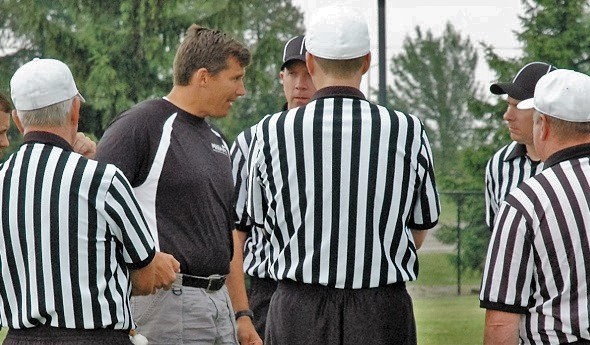
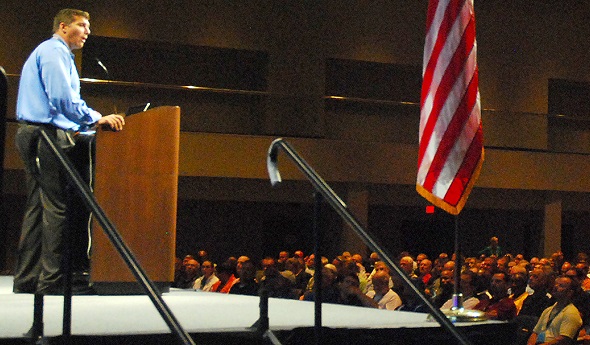
PHOTOS: (Top) MHSAA Assistant Director Mark Uyl provides pointers to football officials during a summer clinic in 2011. (Middle) Uyl speaks at the NASO officiating summit in 2013 in Grand Rapids.