

Our Scoreboard = Your Scoreboard
December 6, 2011
We've undertaken a pretty major endeavor at the MHSAA this winter.
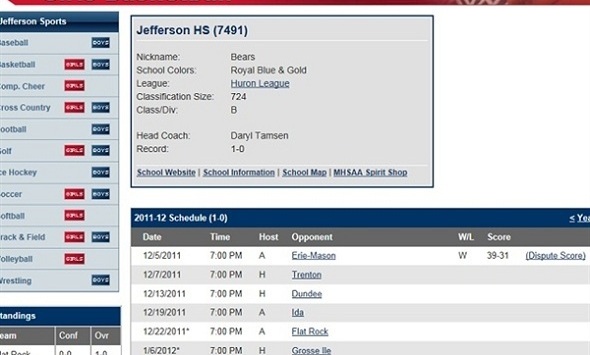
At this moment on Dec. 6, we have roughly 70 percent of all boys and girls basketball games scheduled by our teams for this winter entered into our system -- with the goal of keeping an up-to-date record of every schedule, every score and every league's standings.
That 70 percent might sound like barely passing -- until one considers that's more than 10,000 of a possible 15,000 games that will be played by MHSAA schools this winter.
It's a massive effort. Our athletic administrators, secretaries and coaches have helped a ton. But we'd greatly appreciate your help as well.
Like with football in the fall, anyone can report a score, tell us if we have one incorrect, or add an entire schedule at any time. Just go through a quick registration on our site, and become part of what we hope will be an impressive and useful library of information..
Click here to check out tonight's statewide schedule, or search for any night's games for the entire season. Click on a school name or search under "Schools" to see what we have for that team's full schedule. (Postseason games will be added later.)
And click here for the quick registration (it takes 15 seconds or fewer) if you'd like to give us a hand.
Brighton's Brown Brings Holiday Joy
May 22, 2017
By Geoff Kimmerly
Second Half editor
Bailey Brown will begin at Oakland University this fall with plenty to drive her through what at times will be grueling studies as she prepares for a career in pediatric medicine.
 As the oldest of six siblings, she’s always been around kids – and she loves it that way and looks forward to caring for them as their doctor. But sadly, though just a senior at Brighton, she’s already experienced her share of hospital life – although those tough times also provide motivation and inspired another mission as well.
Brown ran across an advertisement this past winter in an American Girl catalog for dolls without hair – an amazing idea, she thought, because it allows children who have lost their hair during cancer treatment to have a doll that looks just like them.
She decided to raise enough money -- $230 – to buy two dolls for little girls spending Christmas in the hospital. Brown – a recipient of an inaugural MHSAA/Lake Trust Credit Union “Community Service Award” – ended up with more than $5,000 and an opportunity to play Santa Claus to many more thankful families.
“I couldn’t believe how fast things grew. It was hard to keep track of all the donations, but people were just messaging me on Facebook – I couldn’t believe people wanted to do that,” Brown said. “I never thought I’d be able to make such a big difference.”
The Community Service Awards recognize contributions by Michigan’s high school student-athletes away from the field. Brown, a cross country and track runner for the Bulldogs, will use her $1,000 award as a scholarship toward her education at Oakland, where she’ll be part of the Honors College. Six honorees total are receiving awards this spring; Second Half is featuring one a day this week.
 Since seventh grade, Brown has battled what was diagnosed her freshman year as amplified musculoskeletal pain syndrome – an abnormally overactive pain reflex that for Brown caused head-to-toe pain especially in her neck and back, making it difficult to sit and do school work. She also had to stop playing soccer completely and running for a time because of pain in her hips. As a junior, she was diagnosed with bone spurs and torn labrums in both hips, requiring multiple surgeries. As she worked to recover that winter, she had to enter treatment for anorexia after losing 25 percent of her body weight.
Despite those challenges, she managed to build a 3.88 grade-point average to rank among the top 15 percent in her graduating class. She also came back to continue running cross country and returned to the track this spring for the first time since eighth grade, while also participating in National Honor Society and her school’s Interact club.
As a doctor, Brown hopes to help children and teenagers who might be going through the same. Her service over the winter was aimed especially at children who would have to remain in the hospital over the holidays.
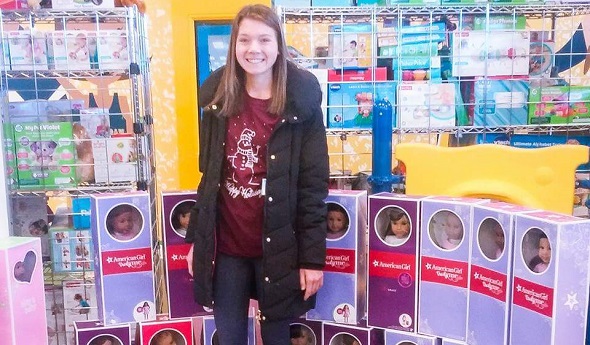
The outpouring of donations allowed her to affect many more families than she would’ve at first imagined – she was able to purchase 48 dolls plus hundreds of toys for little boys also undergoing cancer treatment. She delivered the dolls and toys to University of Michigan’s C.S. Mott Children’s Hospital, where she volunteered in the annual Mott Toy Shop that allows parents to pick up gifts for their children free of charge – saving money and time shopping “to make Christmas much easier and children a lot happier.”
Brown surely will be busy jumping into her first year of college, and she still fights pain although running and deep tissue massage alleviate some of it. But she said she’d like to start another campaign for hospitalized kids like the one that came off so successfully this past winter, maybe something even larger in scope.
“I am proud of everything I have accomplished despite my setbacks,” Brown wrote in her award application, “and look forward to touching even more lives this year.
“I have learned never give up, no matter how many obstacles are thrown my way.”
The Community Service Awards are sponsored by the Michigan High School Athletic Association and Lake Trust Credit Union to recognize student-athletes' efforts to improve the lives of others in their communities. In addition to the $1,000 award, the Lake Trust Foundation is awarding an additional $500 to each honoree, to be donated to a non-profit, 501 (c)(3) organization of the awardee’s choice.
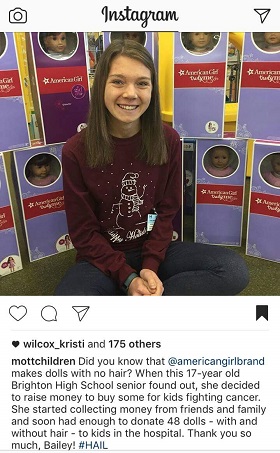
PHOTO: (Top) Brighton’s Bailey Brown stands with some of her donation of toys to the C.S. Mott Children’s Hospital this past winter. (Middle) Brown is recognized by Mott on its Instagram feed. (Photos courtesy of Bailey Brown.)
2017 Community Service Awards
Sunday: Colon "Yard Squad" - Read