

Parade of Champions 2014-15
By
Geoff Kimmerly
MHSAA.com senior editor
June 22, 2015
A total of 90 schools won one or more of the 127 Finals team championships awarded by the Michigan High School Athletic Association during the 2014-15 school year – with five programs winning the first MHSAA team titles in any sport for their respective schools.
The Detroit Western International boys basketball, Armada boys bowling, Detroit Loyola football, Birmingham Roeper boys soccer and Romeo girls volleyball teams all brought home the first MHSAA team championships in their schools’ histories.
A total of 32 teams won their first MHSAA titles. A total of 48 champions were repeat winners from 2013-14 – and 16 of those won for at least the third straight season. The Birmingham Brother Rice boys lacrosse team has the longest title streak of 11 seasons, while the Battle Creek St. Philip volleyball team has won ninth straight titles for the second-longest streak overall and longest among girls programs.
Marquette claimed the most championships, seven, winning in Division 1 boys skiing, Upper Peninsula Division 1 boys cross country and girls cross country, Upper Peninsula boys swimming & diving and girls swimming & diving, and Upper Peninsula Division 1 boys track & field and girls track & field. Three schools won four titles apiece – Birmingham Seaholm, Bloomfield Hills Cranbrook Kingswood and Ishpeming – and four schools won three titles apiece: Birmingham Brother Rice, Monroe St. Mary Catholic Central, Orchard Lake St. Mary’s and Rockford.
Sixteen of the MHSAA's 28 championship tournaments are unified, involving teams from the Upper and Lower Peninsulas, while separate competition to determine titlists in both Peninsulas is conducted in remaining sports.
For a sport-by-sport listing of MHSAA champions for 2014-15 - Click Here (PDF)
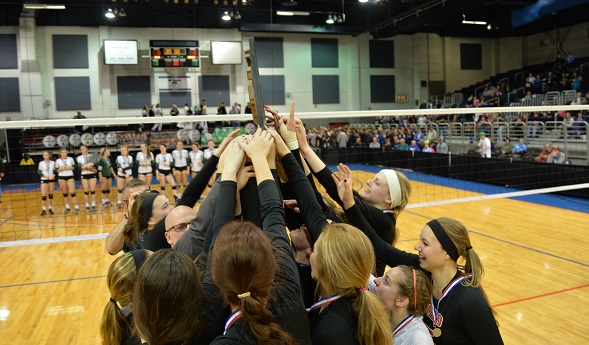
PHOTO: The Romeo volleyball team hoists its Division 1 championship trophy, the first MHSAA Finals trophy won by the school in any sport.

2013-14 School Year Classifications Announced
March 20, 2013
Classifications for Michigan High School Athletic Association elections and postseason tournaments in traditionally classified sports (A, B, C, D) for the 2013-14 school year have been announced, with enrollment breaks for postseason tournaments set up by divisions to be posted Monday on the MHSAA Website.
Classifications for the upcoming school year are based on a second semester count date, which for MHSAA purposes was February 13. The enrollment figure submitted for athletic classification purposes may be different from the count submitted for school aid purposes, as it does not include students ineligible for athletic competition because they reached their 19th birthday prior to September 1 of the current school year and will not include alternative education students if none are allowed athletic eligibility by the local school district.
After all the counts are submitted, tournament-qualified member schools are ranked according to enrollment, and then split as closely into quarters as possible. For 2013-14, there are 756 tournament-qualified member schools and 189 schools in each class.
Effective with the 2013-14 school year, schools with 893 or more students are in Class A in MHSAA postseason tournament competition. The enrollment limits for Class B are 429-892; Class C is 207-428; and schools with enrollments of 206 and fewer are Class D. The break between Classes A and B decreased 18 students from 2012-13, the break between Classes B and C decreased 20 students, and the break between Classes C and D is 10 students fewer than the current school year.
The new classification breaks will see 24 schools move up in class for 2013-14, while 20 schools will move down.
Schools were recently notified of their classification. MHSAA Executive Director John E. "Jack" Roberts said schools may not subsequently lower their enrollment figure. However, if revised enrollment figures should be higher and indicate that a school should be playing in a higher class, that school would be moved up.
Schools have the option to play at any higher classification for a minimum of two years, but must exercise the option by April 15 for fall sports, August 15 for winter sports, and October 15 for spring sports.
MHSAA tournament sports that will be conducted in traditional classifications for 2013-14 are Basketball and Girls Volleyball. Football will use traditional classifications to determine playoff points.
Sports which will compete in nearly equal divisions are: Baseball, Bowling, Girls Competitive Cheer, Lower Peninsula Cross Country, Lower Peninsula Golf, Ice Hockey, Lacrosse, Lower Peninsula Soccer, Skiing, Softball, Lower Peninsula Swimming and Diving, Lower Peninsula Tennis, Lower Peninsula Track and Field and Wrestling.
Visit the respective sport pages on the MHSAA Website on Monday to review the divisional alignments.
The divisions and qualifiers for the MHSAA Football Playoffs will be announced on Selection Sunday, Oct. 27, 2013.
A complete list of school enrollments used to determine classifications for the 2013-14 school year can be found on the Enrollment & Classification page of the MHSAA Website.
Here is a complete list of schools changing classification for 2013-14. (Note: This list does not include schools opting up in class/division for tournaments, which can be found on the Administrators page of the MHSAA Website under Enrollment and Classification):
Moving Up From Class B to Class A
Haslett
Detroit Osborn
Warren Regina
South Lyon East
Middleville Thornapple Kellogg
Trenton
Moving Down From Class A to Class B
Coldwater
Fowlerville
Fruitport
Detroit Henry Ford
Inkster
Milan
Redford Union
Romulus
Detroit Southeastern
Moving Up From Class C to Class B
Dearborn Advanced Technology Academy
Ypsilanti Arbor Preparatory
Delton Kellogg
Harrison
Houghton
Detroit Plymouth Educational Center Prep
Monroe St. Mary Catholic Central
Detroit University Prep Science & Math
Grand Rapids Wellspring Preparatory
Detroit Westside Academy
Moving Down From Class B to Class C
Southfield Bradford
Farwell
Detroit Henry Ford Academy School for Creative Studies
Houghton Lake
Kalkaska
Lakeview
Moving Up From Class D to Class C
Beal City
Detroit Dr. Benjamin Carson HS for Science & Medicine
Kimball Landmark Academy
St. Ignace LaSalle
Mendon
Mio-Au Sable
Detroit Universal Academy
Pittsford
Moving Down From Class C to Class D
Albion
Detroit Collegiate Prep
Harper Woods HEART Academy
Marcellus
Stephenson
New Postseason Eligible Tournament Schools in 2013-14
Detroit Jalen Rose Leadership Academy
Detroit University Prep Science & Math
Grand Rapids West MI Aviation Academy
Kalamazoo Lakeside Academy
Marquette North Star Academy
Wetmore Munising Baptist
Enrollment Breaks by Classes – 2013-14
(Number of schools in parentheses)
Class A: 893 and above (189 schools)
Class B: 429 – 892 (189)
Class C: 207 – 428 (189)
Class D: 206 and below (189)