


Participation Again Bests Population Rank
August 11, 2016
By Geoff Kimmerly
Second Half editor
For the eighth straight year, Michigan ranked seventh nationally in high school sports participation, according to statistics for the 2015-16 school year released recently by the National Federation of State High School Associations. That level of participation continued to best Michigan’s national ranking for total number of residents of high school age, which remained ninth for the fourth consecutive year, and Michigan also again ranked ninth or higher in participation in 26 of 28 sports in which the Michigan High School Athletic Association conducts a postseason tournament.
Michigan’s participation ranking was based on a number of 295,436, with 126,160 girls and 169,276 boys taking part, and included sports in which the MHSAA does not conduct postseason tournaments. The totals count students once for each sport in which he or she participates, meaning students who are multiple-sport athletes are counted more than once.
The state’s girls participation remained seventh nationally for the fifth consecutive year, while the boys participation figure continued to rank sixth. According to the latest U.S. Census Bureau figures from 2015, Michigan ranks ninth in both females and males ages 14 through 17.
For the second straight year, 13 sports bested the state’s overall national participation ranking of seventh by placing sixth or higher on their respective lists. Six Michigan sports improved in national ranking during 2015-16, while three sports dropped one position.
Michigan girls bowling, girls tennis and girls and boys skiing all improved from fourth to third in national participation ranking, while wrestling improved to seventh and gymnastics one spot to 11th. Michigan also moved up to eighth, from 11th, for 8-player football participation – significant because the state’s 11-player football participation ranking didn’t fall with that increase, remaining at sixth nationally.
The three sports that fell in national rankings in 2015-16 still remained above population rank – competitive cheer from fifth to sixth nationally, girls track & field one spot to eighth and baseball also from seventh to eighth on its list.
The other Michigan sports that ranked sixth or higher all equaled their national rankings from 2014-15 and included boys basketball at sixth, boys bowling third, boys golf and girls golf both sixth, ice hockey fourth, boys tennis fifth and girls volleyball fourth. Other Michigan sports that equaled their 2014-15 national rankings were girls basketball at seventh, boys and girls cross country both also seventh, boys lacrosse eighth, girls lacrosse 13th, boys and girls soccer both ninth, softball seventh, boys swimming & diving ninth, girls swimming & diving 10th and boys track & field also seventh.
National participation in high school sports in 2015-16 set a record for the 27th consecutive year with 7,868,900 participants – an increase of 61,853 from the year before. After a decline the previous year, boys participation increased about 25,000 to an all-time high of 4,544,574, while girls participation increased for the 27th consecutive year with an additional 36,591 participants and set an all-time high of 3,324,326.
Track and field registered the largest increase in participants nationally for both boys and girls, with an additional 12,501 boys and 7,243 girls. Track and field ranked second to football in boys participants with 591,133, and remained the most popular sport for girls with 485,969 participants. In addition to track and field, six other top-10 girls sports registered increases nationally in 2015-16, including volleyball, soccer, softball, cross country, tennis and lacrosse. After track and field among the top 10 boys sports, soccer registered the largest gain with an additional 7,753 participants, followed by cross country (up 6,710), basketball (up 4,949) and baseball (up 2,248).
Football (1,083,308) remained the most-played high school sport overall and enjoyed an encouraging development. After a decline of nearly 10,000 participants in football the previous year, the number of boys playing 11-player football nationally in 2015 was almost identical to 2014 with a drop of just 309 from the 2014 total of 1,083,617.
Hoopfest Returns to Jenison Field House
March 19, 2018
Second Half editor
March Magic Hoopfest will return to Jenison Field House for this weekend’s MHSAA Boys Basketball Finals, with extended hours and a Project UNIFY tournament highlighting the ninth championship weekend the event has run concurrent with the games being played at Michigan State University’s Breslin Center.
Up to 10 Special Olympics Project UNIFY teams will take part in a tournament played during the afternoons of March 22 and 23. Unified teams put special education students on the court participating in concert with their general education peers. Lineups must consist of three unified student athletes and two unified student partners on the floor at all times.
Games will be played on the two Hoopfest center courts. On March 24, the center courts will host a number of “JumpBall Jamboree” games made up of teams of boys and girls in grades 3-8.
A number of other favorite attractions will return including slam dunk (on lowered rims), 3-point shootout and half-court shot areas where fans can visit at any time and participate, and the festivities also will include a court for timed “Around the World” shooting games and another court featuring a skills challenge. Also returning is the Walk of History, showcasing championship games, life-size photos and display boards from throughout the MHSAA Finals’ near century-long run.
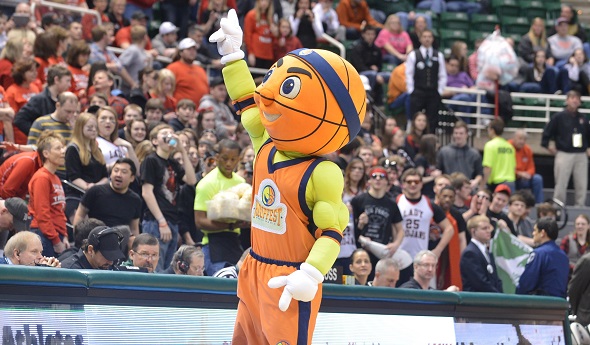
Hoopfest again also will be home to Hoopie, the event’s mascot who made his first public appearances during the 2014 MHSAA Finals.
Admission to the March Magic Hoopfest is $2 per person, and fans attending the MHSAA Boys Basketball Semifinals and Finals will be admitted free with their game tickets. Hours on March 22 and 23 will be 1 p.m. to 7 p.m.; the event is open from 10 a.m. to 6 p.m. on March 24. Jenison Field House, site of Hoopfest, also was the site of the MHSAA Boys Basketball Finals for 31 years. To find out general information about the event, visit the March Magic Hoopfest website.
The March Magic Hoopfest is conducted in partnership between the Greater Lansing Sports Authority (GLSA), a division of the Greater Lansing Convention and Visitors Bureau, and the MHSAA, with vital support coming from the Department of Intercollegiate Athletics at Michigan State University.
“Hoopfest is not just for kids, but the kid in all of us,” MHSAA Director of Brand Management Andy Frushour said. “The adults who stop in seem to love it as much as their children. There are basketball hoops everywhere, and with all of the different games to try it’s like being back on the playground.”
The Greater Lansing Sports Authority’s mission is to be the leading voice of sports tourism in the Greater Lansing area and to promote economic growth by attracting a diverse range of sporting events to the region. The GLSA strives to enhance the quality of life for area residents through the development of local sports and fitness programs for all ages, and supports the continued development and maintenance of safe, high-quality athletic facilities.
“Hoopfest has become the must-attend event for spectators of the MHSAA Tournament,” said Meghan Ziehmer, Associate Director of the Greater Lansing Sports Authority. “With games geared for all ages and abilities, the young and young-at-heart can play before, between and after sessions. With activities like the skills challenge, 3-point shooting contest and lowered rims to show off your athletic prowess, there is no shortage of fun activities.”