Participation Again Bests Population Rank
August 11, 2016
By Geoff Kimmerly
Second Half editor
For the eighth straight year, Michigan ranked seventh nationally in high school sports participation, according to statistics for the 2015-16 school year released recently by the National Federation of State High School Associations. That level of participation continued to best Michigan’s national ranking for total number of residents of high school age, which remained ninth for the fourth consecutive year, and Michigan also again ranked ninth or higher in participation in 26 of 28 sports in which the Michigan High School Athletic Association conducts a postseason tournament.
Michigan’s participation ranking was based on a number of 295,436, with 126,160 girls and 169,276 boys taking part, and included sports in which the MHSAA does not conduct postseason tournaments. The totals count students once for each sport in which he or she participates, meaning students who are multiple-sport athletes are counted more than once.
The state’s girls participation remained seventh nationally for the fifth consecutive year, while the boys participation figure continued to rank sixth. According to the latest U.S. Census Bureau figures from 2015, Michigan ranks ninth in both females and males ages 14 through 17.
For the second straight year, 13 sports bested the state’s overall national participation ranking of seventh by placing sixth or higher on their respective lists. Six Michigan sports improved in national ranking during 2015-16, while three sports dropped one position.
Michigan girls bowling, girls tennis and girls and boys skiing all improved from fourth to third in national participation ranking, while wrestling improved to seventh and gymnastics one spot to 11th. Michigan also moved up to eighth, from 11th, for 8-player football participation – significant because the state’s 11-player football participation ranking didn’t fall with that increase, remaining at sixth nationally.
The three sports that fell in national rankings in 2015-16 still remained above population rank – competitive cheer from fifth to sixth nationally, girls track & field one spot to eighth and baseball also from seventh to eighth on its list.
The other Michigan sports that ranked sixth or higher all equaled their national rankings from 2014-15 and included boys basketball at sixth, boys bowling third, boys golf and girls golf both sixth, ice hockey fourth, boys tennis fifth and girls volleyball fourth. Other Michigan sports that equaled their 2014-15 national rankings were girls basketball at seventh, boys and girls cross country both also seventh, boys lacrosse eighth, girls lacrosse 13th, boys and girls soccer both ninth, softball seventh, boys swimming & diving ninth, girls swimming & diving 10th and boys track & field also seventh.
National participation in high school sports in 2015-16 set a record for the 27th consecutive year with 7,868,900 participants – an increase of 61,853 from the year before. After a decline the previous year, boys participation increased about 25,000 to an all-time high of 4,544,574, while girls participation increased for the 27th consecutive year with an additional 36,591 participants and set an all-time high of 3,324,326.
Track and field registered the largest increase in participants nationally for both boys and girls, with an additional 12,501 boys and 7,243 girls. Track and field ranked second to football in boys participants with 591,133, and remained the most popular sport for girls with 485,969 participants. In addition to track and field, six other top-10 girls sports registered increases nationally in 2015-16, including volleyball, soccer, softball, cross country, tennis and lacrosse. After track and field among the top 10 boys sports, soccer registered the largest gain with an additional 7,753 participants, followed by cross country (up 6,710), basketball (up 4,949) and baseball (up 2,248).
Football (1,083,308) remained the most-played high school sport overall and enjoyed an encouraging development. After a decline of nearly 10,000 participants in football the previous year, the number of boys playing 11-player football nationally in 2015 was almost identical to 2014 with a drop of just 309 from the 2014 total of 1,083,617.
On Call as Doctor, Director, Mom
By
Geoff Kimmerly
MHSAA.com senior editor
October 31, 2013
By Geoff Kimmerly
Second Half editor
Dr. Kiran Taylor is in her 10th year as a practicing psychiatrist and specializes in providing therapy to cancer patients and family members who care for them.
 Taylor is the medical director of the Supportive Care Medicine Clinic at Spectrum Hospital’s Lemmen-Holton Cancer Pavilion in Grand Rapids. She's also the Chief of Psychiatry and Behavioral Medicine for the entire Spectrum Health System, which includes 11 hospitals and nearly 200 ambulatory and service sites all over the western Lower Peninsula.
And Thursday, she made sure to schedule a trip to her children’s school for the Halloween parade and costume parties.
Balancing is a daily requirement for Taylor (formerly Khanuja), an MHSAA Scholar-Athlete Award winner as an East Lansing senior in 1994. But the skills she learned as a tennis standout for the Trojans and at the University of Michigan are those she relies on still as a doctor, director and Mom.
“My high school athletic experience impacts all areas of my life,” Taylor said. “I think about the journey of those experiences and how those changed me.
“The discipline and time management skills you have to have as a scholar-athlete, to pay attention to school and pay attention to your sport, those are certainly skills I carry with me today.”
Taylor was one of 20 scholar-athletes recognized that winter by the MHSAA and  Farm Bureau Insurance, which continues to sponsor the award program that has grown to 32 recipients. In advance of this March’s 25th celebration, Second Half is catching up with some of the hundreds who have been recognized.
Taylor advanced as far as the Lower Peninsula Class A No. 1 singles championship match during her high school tennis career, finishing runner-up at the top flight her junior season. She already had an interest at that point in health and an understanding of what went into playing at a high level, and was most interested in sports medicine and orthopedics when she began medical school, also at U-M.
But as she got a little deeper into her studies, Taylor discovered a path that seemed more in line with her personality.
‘Natural fit’
A video bio of Taylor on the Spectrum Health website includes her explaining that she chose psychiatry because it’s an area that allows her to empower patients to help themselves. In her line of work, she not only heals but aspires to help those in her care reach their potential.
“When they’re helping themselves, they’re helping others, they’re helping their communities,” Taylor said, “and the impact is endless.”
While at U-M, Taylor found a mentor in Dr. Michelle Riba, the director of the PsychOncology program at U-M’s Comprehensive Cancer Center. Her work, like Taylor’s at Spectrum, centers on treating patients in their dealing with the emotional issues that come with cancer diagnosis and treatment.
Taylor’s role as chief of psychiatry and behavioral medicine for the entire Spectrum system allows her to affect a patient’s entire care by making more accessible treatment for emotional and well as physical needs.
There are days she comes home after working with a patient facing especially somber circumstances, and through her medical training has learned how to keep those sad situations from affecting her personally.
But there also are days when she’s had to deal with a difficult managerial situation, and during those times she taps into the skills she learned while on the court.
"You manage adversity on a tennis court. It could be a tight match, or you're up 5-0 or down 5-0," Taylor said. "It's a microcosm of the world.
"If I have a challenging colleague or someone with a different opinion in a meeting, I tap into knowing how to deal with adversity."
Pass it on
Taylor, 37, remains tied to a few from her Scholar-Athlete Awards class. She has known Okemos winner Andy Dhaliwal since childhood and he is now a doctor too, having also graduated from U-M. Jackson winner Harland Holman is a family physician in Grand Rapids and also part of the Spectrum Health system, and knew Taylor's husband through wrestling.
Karin is married to Dr. Joe Taylor, quite a former scholar-athlete himself – he was a standout wrestler at Charlotte before graduating in 1995 and going on to study at U-M.
Thanks at least in part to their parents’ inclination toward sports, the Taylor kids are beginning to try some out. The oldest is 9, the same age as when Kiran first picked up a tennis racket.
For this, Taylor also is prepared thanks to her high school and college careers. Considered together, they give her a long perspective when it comes to kids and sports.
“(It’s about) letting them figure out what they’re interested in, letting them explore. They want to pay attention to things or don’t; watching them unfold was fun,” Taylor said. “It’s about understanding the road, and that’s what high school athletics did, and going on into college athletics. They helped me understand it’s a long road. You don’t have to start your kid at 4 and have the best at 7.”
And it's a road she advises this year's Scholar-Athletes to appreciate now as they pick up knowledge they'll use for a lifetime.
“The lessons they’re learning now, and how they conduct themselves – being a scholar-athlete, I think, is about the way you conduct yourself – those are the skills they will take with them no matter what they do at any point in life,” Taylor said. “That’s what being a scholar-athlete has done for me.”
Click to read the series' first installment:
25 Years Later, Scholar Athletes Shine On
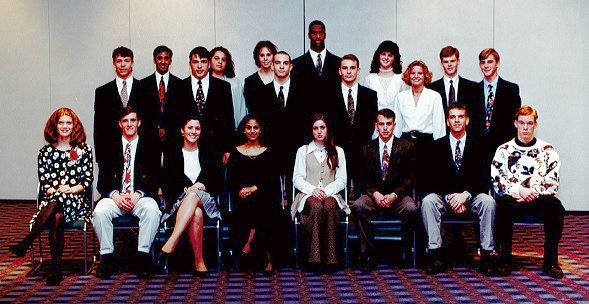
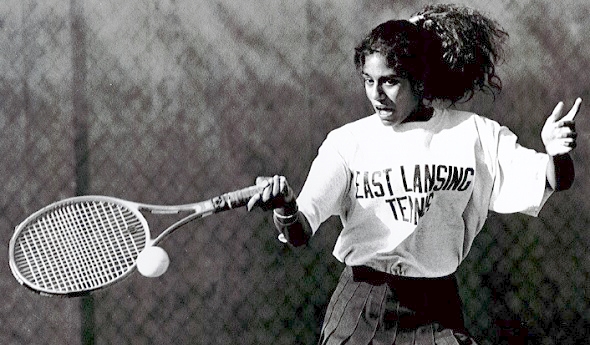
PHOTO: (Top) Kiran Khanuja returns a volley during a tennis match while at East Lansing High School. (Bottom) The MHSAA Scholar-Athlete Award class of 1993-94 included Khanuja, seated fourth from left.