


Participation Again Outpaces Population
August 26, 2019
By Geoff Kimmerly
Second Half editor
For the third straight school year, Michigan in 2018-19 had the eighth-most participants in high school sports nationally according to statistics recently released by the National Federation of State High School Associations, again outpacing the state’s national ranking of 10th for total number of residents of high school age.
Michigan’s participation ranking was based on a number of 292,947, with 126,342 girls and 166,605 boys taking part in high school athletics, and included sports in which the Michigan High School Athletic Association does not conduct postseason tournaments. The totals count students once for each sport in which he or she participates, meaning students who are multiple-sport athletes are counted more than once.
The state’s girls participation ranked eighth nationally for the third straight year, while boys participation fell back to eighth, after moving up one spot to seventh during 2017-18. However, as with overall population, Michigan continued to rank 10th for both females and males ages 14-17 according to the latest U.S. Census Bureau estimates from 2018.
A total of 19 sports bested the state’s overall national participation ranking of eighth by placing seventh or higher on their respective lists. Four Michigan sports improved in national ranking during 2018-19, while the state fell in the rankings of five sports.
Perhaps the most notable improvement among Michigan sports came in boys bowling, where Michigan moved up one spot to second – its highest ranking in any of the 28 sports under MHSAA administration. Michigan previously ranked second nationally in boys bowling as recently as 2013-14 before falling to third for the last four years. Michigan’s boys tennis participation moved up one spot as well to fifth on its ranking list, while girls track & field moved up one spot to seventh and girls lacrosse moved up one spot to 13th after a one-year drop back in 2017-18.
Three of five sports that fell on participation lists still outpaced Michigan’s overall participation rank – girls volleyball fell one spot to fifth, while girls golf and girls competitive cheer both fell one spot to sixth on their respective rankings lists. Other Michigan sports that ranked eighth or higher in 2018-19 were baseball (eighth), girls basketball (sixth), boys basketball (seventh), girls bowling (fourth), girls and boys cross country (both seventh), 11 and 8-player football (sixth and seventh, respectively), boys golf (sixth), boys ice hockey (fourth), girls and boys skiing (both third), girls softball (seventh), girls tennis (third) and boys track & field (seventh).
Boys lacrosse, girls soccer and boys and girls swimming & diving participation all slotted ninth on their respective lists, holding to their 2017-18 rankings and placing still ahead of where Michigan slotted for high school-aged population. Michigan wrestling participation fell two spots to ninth nationally, but still outpaced population, and boys soccer fell one spot to 10th. Girls gymnastics participation ranked 11th nationally for the second straight year.
National participation in high school sports in 2018-19 declined for the first time in 30 years – but the total of 7,937,491 participants still ranked third highest all-time, consisting of 4,534,758 boys and 3,402,733 girls.
Girls volleyball saw the largest increase in participants nationally with 6,225 more this past year over 2017-18, followed by boys track & field (+5,257), girls soccer (+3,623) and girls lacrosse (+3,164).
Football, despite a 5.8-percent decrease from 2017-18, remained the most-played high school sport nationally with 1,006,013 participants. Boys track & field (605,354), boys basketball (540,769), girls track & field (488,267), baseball (482,740), boys soccer (459,077) and girls volleyball (452,808) all saw at least 400,000 participants, while girls basketball (399,067) and girls soccer (394,105) approached that total.
The top 10 states by participants remained the same in 2018-19. Texas and California topped the list again with 825,924 and 824,709 participants, respectively, followed by New York (369,266), Ohio (339,158), Illinois (333,838), Pennsylvania (316,429), Florida (308,173), Michigan (292,947), New Jersey (281,058) and Minnesota (240,487). Only Texas, California and Minnesota reported higher figures than the previous year.
The participation survey has been compiled in its current form by the NFHS since 1971 through numbers it receives from its 51 member state associations, including the District of Columbia. Click to see the complete 2018-19 High School Athletics Participation Survey.
The NFHS, based in Indianapolis, Indiana, is the national leadership organization for high school sports and performing arts activities. Since 1920, the NFHS has led the development of education-based interscholastic sports and performing arts activities that help students succeed in their lives. The NFHS sets direction for the future by building awareness and support, improving the participation experience, establishing consistent standards and rules for competition, and helping those who oversee high school sports and activities. The NFHS writes playing rules for 16 sports for boys and girls at the high school level. Through its 50 member state associations and the District of Columbia, the NFHS reaches more than 19,500 high schools and 12 million participants in high school activity programs, including almost 8 million in high school sports. As the recognized national authority on interscholastic activity programs, the NFHS conducts national meetings, sanctions interstate events, offers online publications and services for high school coaches and officials, sponsors professional organizations for high school coaches, officials, speech and debate coaches, and music adjudicators; serves as the national source for interscholastic coach training and serves as a national information resource of interscholastic athletics and activities.
The MHSAA is a private, not-for-profit corporation of voluntary membership by more than 1,500 public and private senior high schools and junior high/middle schools which exists to develop common rules for athletic eligibility and competition. No government funds or tax dollars support the MHSAA, which was the first such association nationally to not accept membership dues or tournament entry fees from schools. Member schools which enforce these rules are permitted to participate in MHSAA tournaments, which attract more than 1.4 million spectators each year.
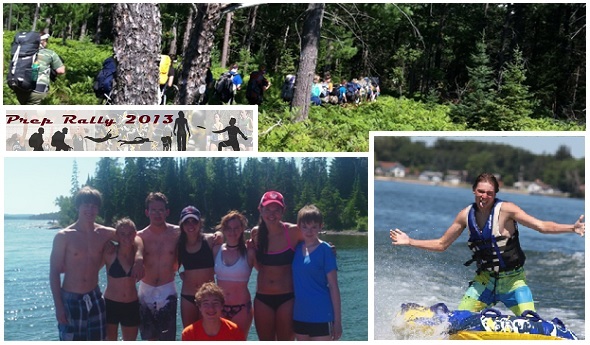
Rally Finalists Prepped for Competition
August 16, 2013
By Geoff Kimmerly
Second Half editor
The MHSAA’s inaugural “Prep Rally” contest was born this spring to help us teach athletes the importance of staying in shape during the offseason – while showing them fun ways to do so.
And like with our MHSAA “Battle of the Fans” contest during the past two winters, we learned a few things from our Prep Rally participants – most notably, that athletes during the school year enjoy staying active during the offseason. And especially if that activity includes a creative challenge or two.
Following are brief stories behind our three finalists for this summer's contest, which was part of the MHSAA’s PLAY (Preparation Lasts All Year) initiative designed to encourage athletes to remain active during the offseason so they are prepared physically and acclimated to warm weather when practice begins in the fall.
Thanks to all who submitted applications – we hope this is just the start of your helping us tell more athletes the best and most enjoyable ways to stay in shape and get ready for competition. The inaugural Prep Rally winner will be announced Monday on Second Half and be awarded tickets to an MHSAA Final of their choice, at which they will be recognized for their accomplishment.
Not surprising given Michigan’s abundance of woods and water, outdoor activities were a dominant theme of the inaugural Prep Rally.
Here’s a look at our finalists:
Beal City: Game Changers
“For many students the summer is simply a time to kick back, relax, hang out on the couch and play video games. However, this is not the case for Beal City athletes,” sophomore Billy Chilman wrote.
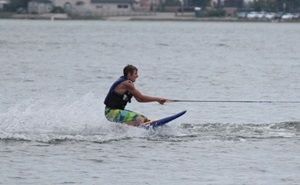 “When we are not training for our championship teams on the field or in the classroom, we are always looking for new ways to stay fit and have fun. Whether it’s going to Coldwater Lake, to boat, knee board, ski or tube, we always seem to find something active to do.”
And that led to ATV tubing.
In essence, a four-wheeler on one bank of a small pond pulls the rider, sitting on a snow sled, across the pond. “It was also a great workout, improving our balance and upper body strength,” Chillman added.
Fenton: Into the Woods
A team that will spend all fall in the pool spends a valuable part of it offseason prep on dry land.
 Fenton girls swimming and diving team journeys away from home leading up to every season. This summer it headed to Pigeon River Country State Forest near Vanderbilt at the northern end of the Lower Peninsula for a three-day “survival trip.”
Plans included a four-mile hike to the first camp, followed by 4-5 mile hikes to each day to a new camp site.
The team also was divided into four smaller squads that competed in challenges as well as setting up camp, building fires and cooking meals.
“The purpose of the trip is to provide some physical conditioning as well as a team-building activity,” Fenton coach Brad Jones wrote in the Tigers’ submission.
Grosse Pointe Woods University Liggett: Crossing the Isle
Seniors Hannah Hodges and Danielle Lorant participate in three sports together during the school year – cross country, hockey and soccer – so staying in shape over the summer is especially key.
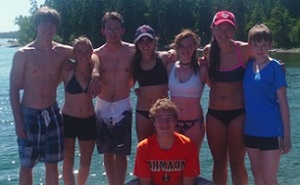 This summer, that included a five-day backpacking trip at Isle Royale National Park as part of a program hosted by Michigan Tech University.
The Knights’ pair hiked 45 miles while carrying 50 pounds of supplies in backpacks. To prepare for the trip, Hodges and Lorant went on weekly hikes closer to home at Stoney Creek Metropolitan Park, Island Lake State Recreation Area and Algonac State Park – which built endurance but also allowed for an opportunity to test their gear.
“Backpacking on Isle Royale granted the chance to interact in nature and connect with other Michigan high school athletes who also participated in the trip, and to stay in good physical condition,” Hodges wrote in her submission.
“This trip demonstrated that there are other ways to stay in shape over the summer besides participating in the sports that we play during the school year.”
Follow the #PrepRally conversation on Facebook and Twitter @MHSAA.