


Participation Ranks 7th Nationally
August 26, 2014
By Geoff Kimmerly
Second Half editor
For the sixth straight year, Michigan ranked seventh nationally in high school sports participation, according to statistics for the 2013-14 school year released recently by the National Federation of State High School Associations. That level of participation continued to best Michigan’s national ranking for total number of residents of high school age, which remained ninth for the second consecutive year.
Michigan’s participation ranking was based on a number of 299,246, with 127,275 girls and 171,971 boys taking part, and included sports in which the Michigan High School Athletic Association does not conduct postseason tournaments. The totals count students once for each sport in which he or she participates, meaning students who are multiple-sport athletes are counted more than once.
The state’s girls participation remained seventh nationally for the third consecutive year, while the boys participation figure continued to rank sixth. According to the latest U.S. Census Bureau figures from 2013, Michigan ranks ninth in both females and males ages 14 through 17.
Michigan ranked ninth or higher nationally in participation in 26 of the 28 sports in which the MHSAA conducts a postseason tournament (not counting separately 8-player football), and 14 sports bested the state’s overall national participation ranking, placing sixth or higher on their respective lists.
Boys cross country participation improved for the second straight year, up one spot to seventh nationally. Eight-player football also jumped, three spots to 11th, while 11-player football fell only one spot to sixth on its national list despite the shift of some teams to the 8-player format.
Seven Michigan boys sports joined 11-player football in falling slightly in national rankings, although none placed lower than ninth on their respective lists. Boys basketball fell from fourth to sixth, boys ice hockey from third to fourth, boys lacrosse from seventh to eighth, boys soccer from eighth to ninth, boys swimming and diving from seventh to ninth, boys track and field from sixth to seventh and wrestling also from sixth to seventh. Baseball (seventh), boys bowling (second), boys golf (sixth), boys skiing (fourth) and boys tennis (fifth) held constant to their 2012-13 national rankings.
Twelve of 14 girls sports also ranked the same as a year ago – girls basketball at seventh nationally, girls bowling at fourth, competitive cheer fifth, girls cross country fifth, girls golf sixth, gymnastics 12th, girls lacrosse 13th, girls skiing fourth, girls soccer ninth, softball seventh, girls swimming and diving ninth and girls tennis fourth. The two remaining girls sports fell in ranking, but only slightly – track and field from seventh to eighth and volleyball from fourth to fifth nationally.
National participation in high school sports in 2013-14 set a record for the 25th consecutive year with 7,795,658 participants – an increase of 82,081 from the year before. Girls participation also set a record for the 25th straight year, increasing this time 44,941 participants to 3,267,664 total. Boys participation rose above 4.5 million for the first time with a total of 4,527,994 – 37,140 more participants than in 2012-13. Part of the boys record total can be attributed to a jump in 11-player football participation, which grew by 6,791 players over the 2012 season – the first increase in national 11-player participation in five years.
Football (1,123,852 participants including 6, 8 and 9-player teams) remained the top sport for boys participation and top high school sport overall, with baseball the largest gainer among the top 10 boys sports. Girls track and field topped the girls national participation list, with volleyball the biggest girls gainer moving to third on that list behind also basketball. Outdoor track and field (1,059,206 boys and girls combined) was the second-most participated in sport nationally, followed by basketball (974,398 boys and girls combined).
The MHSAA is a private, not-for-profit corporation of voluntary membership by more than 1,500 public and private senior high schools and junior high/middle schools which exists to develop common rules for athletic eligibility and competition. No government funds or tax dollars support the MHSAA, which was the first such association nationally to not accept membership dues or tournament entry fees from schools. Member schools which enforce these rules are permitted to participate in MHSAA tournaments, which attract more than 1.4 million spectators each year.
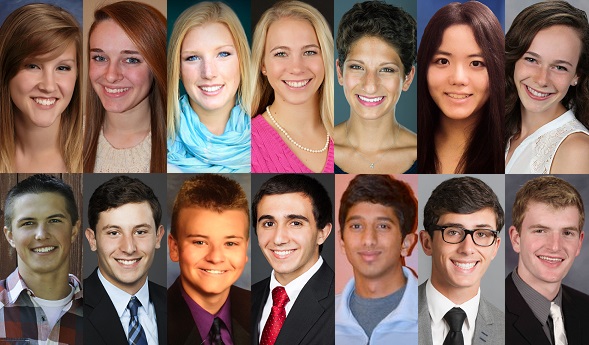
Scholars and Athletes 2014: Class A
By
Geoff Kimmerly
MHSAA.com senior editor
February 18, 2014
The Michigan High School Athletic Association has selected 14 student-athletes from Class A member schools to receive scholarships through its Scholar-Athlete Award program.
Farm Bureau Insurance, in its 25th year of sponsoring the award, will give $1,000 college scholarships to 32 individuals who represent their member schools in at least one sport in which the Association sponsors a postseason tournament. The first 30 scholarships are awarded proportionately by school classification and number of student-athletes involved in those classes; also, there are two at-large honorees who can come from any classification.
Each of the scholarship recipients will be honored at halftime ceremonies of the Class C Boys Basketball Final game March 22 at the Breslin Student Events Center in East Lansing. Commemorative medallions will be given to the finalists in recognition of their accomplishments.
The Class A Scholar-Athlete Award honorees are: Paige Blakeslee, Gibraltar Carlson; Kirsten Avery Chambers, Riverview; Elizabeth Cowger, Fenton; Caroline Ann Hagan, East Lansing; Anna Haritos, Auburn Hills Avondale; Grace Kao, Okemos; Elianna Shwayder, Saline; Ryan S. Fischer, Grandville; Rami Kadouh, Dearborn; Cody James McKay, Utica Ford; Samuel A. Mousigian, Dearborn; Vikram Shanker, Midland Dow; Jalal Taleb, Dearborn Heights Crestwood; and Tanner Vincent, Novi.
Overviews of the scholarship recipients of the Class A Scholar-Athlete Award follow. A quote from each recipient's essay also is included:
Paige Blakeslee, Gibraltar Carlson
Will play her fourth season of varsity soccer this spring to go with three varsity seasons of basketball and two of volleyball. Has served as captain of five teams, including all three of her varsity squads, and helped the volleyball team to a District title in 2012. Earned all-District honors in soccer last spring. Serves as leader of the trumpet section of her marching band and earned its Maestro Performance Award; has played in marching band and symphonic band each for four years and jazz band for three years. Serves on executive board of school’s Marauder Captains Mentoring Program, and also founded and serves as president of her school’s Earth Club. Participates in National Honor Society and Students Against Destructive Decisions. Will attend Central Michigan University and study graphic design and illustration.
Essay Quote: “When I graduate, I will head off to college where I will be working with upwards of 20,000 other students. Just like my team, we will come from different backgrounds ... but we all have the same goal in mind. Good sportsmanship has taught me to accept people for who they are and to move past their differences. We are all on the same team; we need to focus on the same goal.”
Kirsten Avery Chambers, Riverview
Playing her fourth season of varsity basketball and will play her fourth of varsity soccer this spring; also ran three seasons of varsity cross country and one of track and field. Earned all-league honors her first three seasons of soccer and all-state honorable mention in 2013, when she set her school single-season record for assists. Qualified for the MHSAA Finals in cross country in 2010. Serves as captain of the girls basketball team and has been named captain for soccer. Maintains a grade-point average higher than 4.0 and is in her third year in National Honor Society. Participated four years in student government including as class treasurer, four years in Diversity Club including as vice president and three years in Key Club including as secretary. Attended the Huron League Leadership Conference and Michigan Roundtable for Diversity and Inclusion Regional Youth Consortium. Volunteered for American Cancer Society’s Relay for Life for four years. Will attend Adrian College and study microbiology.
Essay Quote: “Just one negative experience with poor sportsmanship can have a lasting impact in the lives of those exposed to the poor sportsmanship. Completely opposite of that, the same lasting impact can be obtained in situations in which there was positive sportsmanship displayed in educational athletics.”
Elizabeth Cowger, Fenton
Playing her third season of varsity basketball and will play her fourth of softball this spring; also ran three seasons of varsity cross country after playing freshman volleyball. Served as captain of cross country and basketball teams and will serve as softball captain. Earned softball all-state honorable mention as a junior and has earned all-league recognition in both basketball and cross country. Helped basketball team to a District championship in 2013. Served four years on student council including this year as all-school president, and also is serving for the second year as editor-in-chief of the school’s newspaper, Fenton InPrint, a 2012-13 winner of the Michigan Interscholastic Press Association Spartan Award (its highest honor). Carries a 4.0 grade-point average and is participating in National Honor Society for the second year, serving as chair of the Teacher Appreciation Committee. Named Miss Fenton by her local Chamber of Commerce. Also participated on school’s LifeSmarts student business competition team that finished state runner-up. Will attend the University of Minnesota and study supply chain and operations management and finance.
Essay Quote: “(Sportsmanship’s) value encompasses much more than just a handshake at the end of a contest. It includes stepping up in a pressure situation, making individual sacrifices for your teammates and setting the best examples to those who look up to you.”
Caroline Ann Hagan, East Lansing
Ran four years of varsity cross country and will play her third season of varsity soccer this spring, also played varsity basketball as a junior and competes at a statewide level in figure skating. Qualified for the MHSAA Finals in cross country as both a freshman and sophomore and earned all-District recognition in soccer. Served as captain multiple seasons in soccer and basketball. Serving as student body president after two years as her class president as a sophomore and junior. Participating in National Honor Society for the third year and earned school’s Distinguished Scholar Award all four years. Participated in Young Life youth group four years and as a volunteer for the LINKS autism program, the Sparrow Foundation’s Women Working Wonders group and as a youth soccer coach. Will attend Michigan State University and study business and broadcast journalism.
Essay Quote: “Sportsmanship to me is not the amount of medals you win or state championships you bring home. It is about being with your teammates, knowing how to help them when they are down. Sportsmanship is about picking your friends up, giving hugs and high fives, so you both succeed.”
Anna Haritos, Auburn Hills Avondale
Ran three years of varsity cross country and will run her fourth with the varsity track and field team this spring, when she will serve as team captain. Qualified for MHSAA Finals in cross country twice; also twice finished among top eight in 300-meter hurdles at MHSAA Track and Field Finals and qualified twice as part of 3,200 relay teams. Participating in National Honor Society for the third year. Ranked as a top-10 member of the school’s Class Board all four years and also is a member of the French Honor Society. Participated four years in Greek School Club, including as class board president, and has served as a junior camp counselor at the Lloyd A. Stage Nature Center and as an event organizer for Kids Against Hunger. Will attend the University of Michigan and study pre-medical with a major in chemistry and minor in classical studies-Modern Greek.
Essay Quote: “The athletes who respect the event create a contagious positive attitude because their love of the spirit of the game and pure drive illuminate the true nature of the sport. (Sportsmanship) lessons are about friendly competition: learning how to rely on opponents as a tool for self-improvement and not as a source that fuels negative emotions.”
Grace Kao, Okemos
Participated in her fourth season of varsity swimming and diving and holds one team, three league and four pool records. Helped team to four league meet championships and served as captain this fall. Earned all-state as part of two relays during career, and this fall also finished 10th in the 100-yard backstroke at the MHSAA Lower Peninsula Division 2 Finals. Earned academic all-state honors and a National AP Scholar award, also is a two-year member of the National Honor Society, serving as secretary. Participated on Science Olympiad team that qualified for the state tournament. Earned highest or superior performance ratings playing the viola and piano, respectively. Served as captain of ACTION Volunteer Club and started Chieftain Champs mentoring program to assist elementary students. Taught culture class for Lansing Chinese School and earned first place in Michigan Chinese Schools speech competition. Will attend Carnegie Mellon University and study computer science.
Essay Quote: “Sometimes we forget that everything is just a game. We get so buried in our thoughts of winning that we forget that at the end of the game, we are all just peers, and even friends. ... Everyone is playing for the fun of the sport and the feeling of accomplishment after all of the time and work put in.”
Elianna Miriam Johanna Shwayder, Saline
Ran four years of varsity cross country and will run her fourth with the track and field team this spring. Finished sixth and then fourth, respectively, the last two seasons in the Lower Peninsula Division 1 Cross Country Final after winning three Regional championships and two league titles. Earned individual league championships multiple years in the 1,600 and 3,200-meter track runs and was part of a 3,200 relay that placed among the top seven at the last three MHSAA LP Division 1 Finals. Ranks number one academically in her class and earned an AP Scholar with Distinction award while being named a National Merit Scholarship semifinalist and the Wendy’s High School Heisman Award state female winner. Earned “Best Delegate” acknowledgements as part of her school’s Model United Nations club and represented her school as a delegate to the American Legion Auxiliary Michigan Girls State conference. Will attend Harvard University to study pre-medical while majoring in cultural anthropology or religious studies.
Essay Quote: “My team understands that sportsmanship is fundamental to our success as we compete for ourselves, for our team, but most of all, for each other. This attitude has been integral in holding us together in times of victory and defeat. We have learned to win with confident poise and lose with humble acknowledgement.”
Ryan S. Fischer, Grandville
Playing his third season of varsity hockey and also lettered in baseball and two seasons in football. Serving as captain of the hockey team and served as captain of his football team. Named to his hockey team’s leadership council and earned all-league honors as a junior, and earned academic all-league in baseball last spring. Served four years on the student government executive board and is a member of the MHSAA Student Advisory Council. Carries a 4.0 grade-point average and is in his second year of National Honor Society. Serves on the Grandville High School Leadership Team and also serves on his church’s youth leadership council and mission trip and youth group retreat planning teams. Selected to attend the U.S. Military Academy Summer Leadership Experience and the U.S. Naval Academy Summer Seminar. Will attend the U.S. Military Academy at West Point and intends to study aerospace engineering.
Essay Quote: “In almost any venture they choose to pursue after high school, students will find themselves in some form of competition. The manner in which they conduct themselves in these situations will have a direct impact on achieving their goals. By applying the principles of sportsmanship ... student athletes will find the success they seek, one handshake at a time.”
Rami Kadouh, Dearborn
Played three years of varsity football, will play his fourth this spring of varsity golf and also played two seasons of subvarsity basketball. Served as captain of both the varsity football and his subvarsity basketball teams, and earned all-league honorable mention and academic all-state in football. Served as his class president all four years of high school, and founded and served as president of his school’s Aspiring Medical Professionals club. Participated in Key Club four years and National Honor Society for two, and also on the city of Dearborn Youth Commission and as president of the Dearborn Rotary Youth Board. Earned national school and individual certification in school-based Enterprise Operations while participating in Distributive Education Clubs of America (DECA). Participated two years on the Center for Arab American Philanthropy Teen Grantmaking Initiative and earned a Sparky Anderson Youth in Philanthropy Award. Will attend the University of Michigan and study cell and molecular biology.
Essay Quote: “When in life it is up to the individual to choose between right and wrong, when it is necessary to tell the truth even if it brings about harsh ramifications, when in every occurrence we must respect and work with one another, it is in these moments essential to life that sportsmanship should and does find its place.”
Cody James McKay, Utica Ford
Played four years of varsity tennis and will play his second season of varsity golf this spring. Served as tennis team captain in the fall and earned all-league honors after being named team Most Valuable Player as a junior. Earned scholar-athlete honors all four years of tennis and anticipates the same for golf as he ranks second in his graduating class with a 4.13 grade-point average. Earned an AP Scholar award and is in his second year in National Honor Society. Participated four years in his school’s Interact Club community service group, including the last two years as president. Served as a Rotary Youth Leadership Awards conference representative in Ontario last spring and ranked among the top 10 students at the Utica Center for Math Science and Technology; also was selected to attend the University of Michigan Engineering Camp. Will attend the University of Michigan and study mechanical engineering.
Essay Quote: “Sportsmanship defines one’s character. Putting others’ feelings before your own selfish interests is the epitome of sportsmanship. ... Throughout my high school athletic career, I worked diligently to show that same respect toward my opponents; playing with integrity and humility, always winning or losing with a positive demeanor. Thankful for the competition, it was my goal to prove to my opponent I was a true gentleman, win or lose.”
Samuel A. Mousigian, Dearborn
Participating in his fourth varsity season of swimming and diving, to go with three varsity cross country seasons, one on the varsity soccer team, and an expected fourth on the track and field team this spring. Served as captain of both the swimming and diving and cross country teams. Qualified for the MHSAA Finals in swimming and cross country, earning all-area honors in both in 2013. Earned all-league honors in cross country three years and was named his team’s Most Valuable Player after both of the last two. Participated in National Honor Society the last two years, including as his chapter’s president, and also is editor of the yearbook that won the Walsworth Award of Excellence in 2012-13. Participated in both student council and Students Against Destructive Decisions. Earned a second place in the Science and Engineering Fair of Metro Detroit. Will attend the University of Michigan and study computer engineering.
Essay Quote: “My disposition and how I treat those around me will be the determining factor of my life’s overall success. For that reason, I’m grateful my athletic experiences have educated me in the value of sportsmanship. Our decisions reflect our character and can always have a lasting impact on those around us.”
Vikram Shanker, Midland Dow
Played four years of varsity tennis, earned all-state honors all four years with four Regional individual championships, two individual MHSAA Finals championships and as part of four MHSAA team champions. Served as team captain the last two seasons. Finished a combined 73-1 the last two seasons and ranks in the MHSAA record book for career and single-season doubles wins and consecutive doubles wins. Named a National Merit Scholarship semifinalist and earned an AP Scholar with Distinction award. Participated in Dow’s student union government four years and as a Mentor Center tutor the last two. Also participated two years on the varsity debate team, including as captain, and four on the school’s DECA team including as treasurer and then president. Expects to complete the highest Student Achievement Testing ranking for piano this year. Participated on regional champion Science Olympiad teams. Undecided on where he will attend college, but will study electrical engineering and computer science.
Essay Quote: “In both life and athletics, we encounter thrilling wins and heartbreaking losses, engage with all types of personalities and persevere through obstacles with hard work, determination and the support of those who are close to us. Sportsmanship provides a moral compass by which to guide our behavior and our demeanor on and off-court.”
Jalal Taleb, Dearborn Heights Crestwood
Played four seasons of varsity soccer and will play his second of varsity golf this spring; also ran two seasons of varsity track and field. Served as soccer captain the last two seasons as the team won District championships to cap both. Ran as part of league champion 3,200-meter relay teams as a freshman and sophomore and medaled at his golf league tournament as a junior; he will serve as captain of the golf team for the second season this spring. Served four years on his school’s student congress including this year as student body president. Participated in National Honor Society for three years and also buildOn for two years. Captained the quiz bowl team the last two years and serves as president of the Spanish Club. Also participates in Students Against Destructive Decisions and his school’s Link Crew board of directors, and was the senate majority leader during his American Legion Boys State conference. Will attend the University of Michigan and study biopsychology, cognition and neuroscience, and Spanish.
Essay Quote: “Honesty, respect, fairness, integrity and openness of the heart are important traits that a sportsman must portray. One who aspires to call himself a sportsman would never perform deception upon others; he should never cheat others and the game he loves.”
Tanner Vincent, Novi
Participating in his fourth season of swimming and diving and is serving as captain for the second season. Qualified for MHSAA Finals in three events in 2013 and four events in 2012, and finished eighth last season in Lower Peninsula Division 1 in the 200-yard individual medley. Holds school record in 100 butterfly. Participating in National Honor Society for the third year including this year as president, and participating in fourth year of Quiz Bowl and also as president this season. Also serves as class vice president. Named a National Merit Scholarship semifinalist and earned an AP Scholar with Distinction award. Volunteered as part of Novi’s city youth soccer program and as leader of his church’s middle school group. Attended the U.S. Air Force summer seminar and will attend the Air Force Academy. Intends to study history with a minor in philosophy before applying to medical schools after finishing his undergraduate programs.
Essay quote: “While sportsmanship is usually applied to acting decently toward an opponent, it has an even greater role within one’s own team. Sportsmanship can either bring a team together to finish the match or win the meet, or drive everyone apart. ... Sportsmanship is the glue which allows teams, especially on the high school level, to provide a place in which everyone can contribute.”
Other Class A girls finalists for the Scholar-Athlete Award were: Saige Tomczak, Bay City Central; Jessica Hacker, Bay City Western; Tatyanna Dadabbo, Bloomfield Hills Marian; Clare Nienstedt, Bloomfield Hills Marian; Tala Taleb, Dearborn Heights Crestwood; Mallory Beswick, Grand Haven; Claire Elise Borchers, Grand Haven; Joslyn Mae TenBrink, Jenison; Jessica Graves, Lowell; Gabrielle Gencheff, Marquette; Fiona B. Shea, Middleville Thornapple Kellogg; Kallisse R. Dent, Midland Dow; Rachel Barrett, Milford; Meghan Datema, Rockford; Molly Peregrine, Traverse City Central; Sarah O'Connor, Waterford Kettering; and Jenna Ciennik, Waterford Mott.
Other Class A boys finalists for the Scholar-Athlete Award were: Stone Manczak, Bay City Central; Zachary Segall, Berkley; Andrew Barton, Birmingham Seaholm; Jared Hagan, Dearborn Heights Crestwood; Brad King, Garden City; Kenneth Elkin, Grosse Pointe North; Chris Kruger, Holt; David Doyle, Linden; Craig Ekstrum, Marquette; David Walter III, Middleville Thornapple Kellogg; Nate Fisher, Midland; Trevor Denoyer, Petoskey; Kellen Scott Michael, South Lyon; Kyle Dotterrer, Traverse City Central; Devin Kimberlin, Walled Lake Northern; Mitchell Dennis, Walled Lake Western; and David J. Walczyk, Walled Lake Western.
The Class C and D scholarship award recipients were announced Feb. 4, and the Class B honorees were announced Feb. 11.
Farm Bureau Insurance, one of Michigan's major insurers, has a statewide force of more than 400 agents serving more than 380,000 Michigan policyholders. Besides providing life, home, auto, farm, business and retirement insurance, the company also sponsors life-saving, real-time Doppler weather tracking systems in several Michigan communities.
The MHSAA is a private, not-for-profit corporation of voluntary membership by more than 1,500 public and private senior high schools and junior high/middle schools which exists to develop common rules for athletic eligibility and competition. No government funds or tax dollars support the MHSAA, which was the first such association nationally to not accept membership dues or tournament entry fees from schools. Member schools which enforce these rules are permitted to participate in MHSAA tournaments, which attract more than 1.4 million spectators each year.